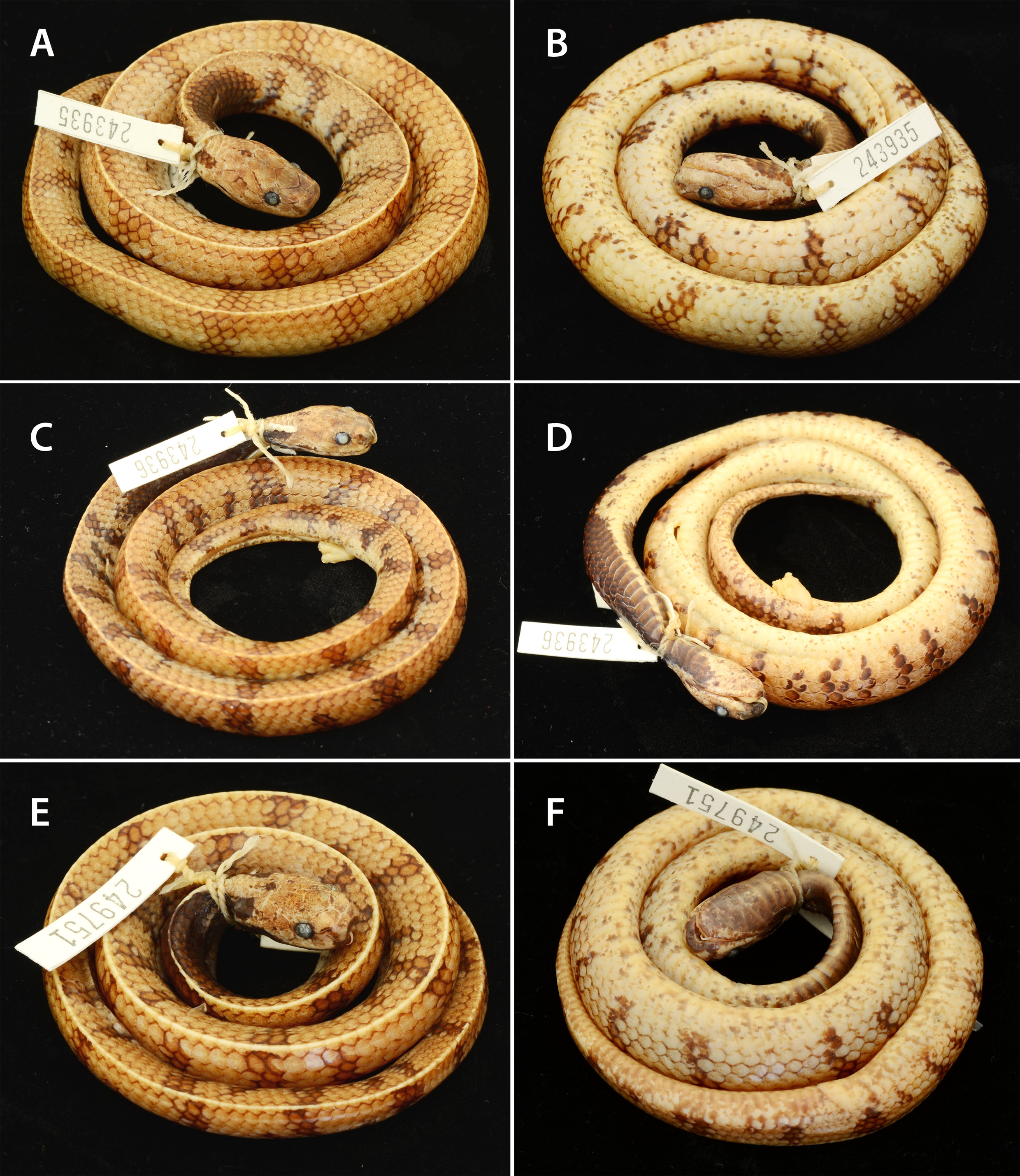
Description of holotype. Adult female SVL 411 mm and Tal 55 mm; rostral slightly wider than tall; head bulbous, somewhat rectangular in shape, longer than wide (HL / HW 1.73); nasals undivided; internasals shorter than prefrontals; posterior margin of prefrontals contact eye; frontal hexagonal, slightly longer than wide; loreals present, longer than tall; supraoculars subpentagonal, approximately a quarter of both the length and width of frontal; preoculars absent; upper and lower postoculars present on both right and left sides of head, lower postocular extending to below orbit; suboculars absent; supralabials 7 / 7 with 3 rd and 4 th contacting orbit and 7 th elongate; temporals 2 (+ 1) + 2 / 2 + 1, i. e. on left side of head there are two anterior temporals and two posterior temporals but between lower anterior and lower posterior temporal is an additional scale resulting in two upper temporals and three lower temporals, and on the right side of the head the upper anterior and posterior temporals are fused resulting in a single upper temporal and three lower temporals; mental triangular wider than long; anterior inframaxillary pentagonal, in contact with infralabials 1 – 3; two pairs of posterior inframaxillaries following anterior inframaxillary, both pairs of posterior inframaxillaries somewhat hexagonal, rhomboid-shaped, elongated; infralabials 5 / 5 with 3 rd pair in medial contact. Body long, stout, laterally compressed, bearing a prominent keel-shaped vertebral region; dorsal scales smooth, in 15 / 15 / 15 rows, vertebrals slightly enlarged; 179 ventrals; 38 divided subcaudals; cloacal scute entire; tail tapering to point. Colouration in preservation (Fig. 2 A & B). The ground colour of the head, body and tail are beige with very fine speckling. The speckling is lighter on the flanks and becomes heavier on the back closer to the vertebral scale rows. The top and underside of the head is lightly speckled and there are dark spots on the rostal, 1 st supralabials, 7 th supralabials along opening of the mouth, mental, inframaxillaries, and infralabials 1 – 3 along their medial sutures. On the neck is a dark patch starting from the nape, extending to approximately the position of the 20 th ventral. The dark patch starts as a narrow stripe on the 5 th & 6 th dorsal scale rows, gradually widens to dorsal scale rows 1 – 7, and does not extend cross the vertebral scales but completely encircles the ventrals. Starting behind the dark neck patch are 29 dark bands along the body that are somewhat rhomboidal to inverted-triangle in shape, and nine bands on the tail. The dark body bands range between 1 – 4 dorsal scales in length and are faint on the dorsum near the vertebral scale row and more prominent on the lower flanks and edges of the ventrals. The venter is beige and bears, dark lateral blotches from the extensions of the dorsal bands that meet the ventral scales as well as scattered dark spots the entire length of the body and tail. The thin vertebral stripe is cream.