Biologi & Ekologieng
Biological remarks. Developing in a variety of substrates, from rotting fruit to dung, the larvae are active predators upon those of other flies and other soft-bodied insects.
Sumber: The Muscidae (Diptera) of Saudi Arabia, descriptions of two new species, new records and updated list of species
Distribusieng
Distribution. This species was previously recorded from Saudi Arabia by Beccari (1971). This species is tropically and subtropically cosmopolitan. It was described from the Nicobar Islands. In Arabian Peninsula it is known from Oman and Yemen (Pont 1991).
Sumber: The Muscidae (Diptera) of Saudi Arabia, descriptions of two new species, new records and updated list of species
Distribusieng
Distribution. Angola, Benin, Burkina Faso, Cabo Verde, Cameroon, Central African Republic, Comoros, Côte d’Ivoire, Democratic Republic of Congo, Ghana, Kenya, Madagascar, Malawi, Mali, Mauritius, Mozambique, Namibia, Nigeria, Oman, Réunion Is., Rodrigues Is., Senegal, Seychelles, Sierra Leone, South Africa, Sudan, Tanzania, Togo, Uganda, United Arab Emirates, Yemen, Zambia, Zanzibar Is., and Zimbabwe.
Sumber: A contribution to the Atherigona (Diptera, Muscidae) fauna of Angola
Distribusieng
Distribution. Introduced. Cosmopolitan; Galápagos: Española, Floreana, Genovesa, Isabela, Marchena (ICCDRS), San Cristóbal (ICCDRS), Santa Cruz.
Sumber: An annotated checklist of the Diptera of the Galápagos Archipelago (Ecuador)
Deskripsieng
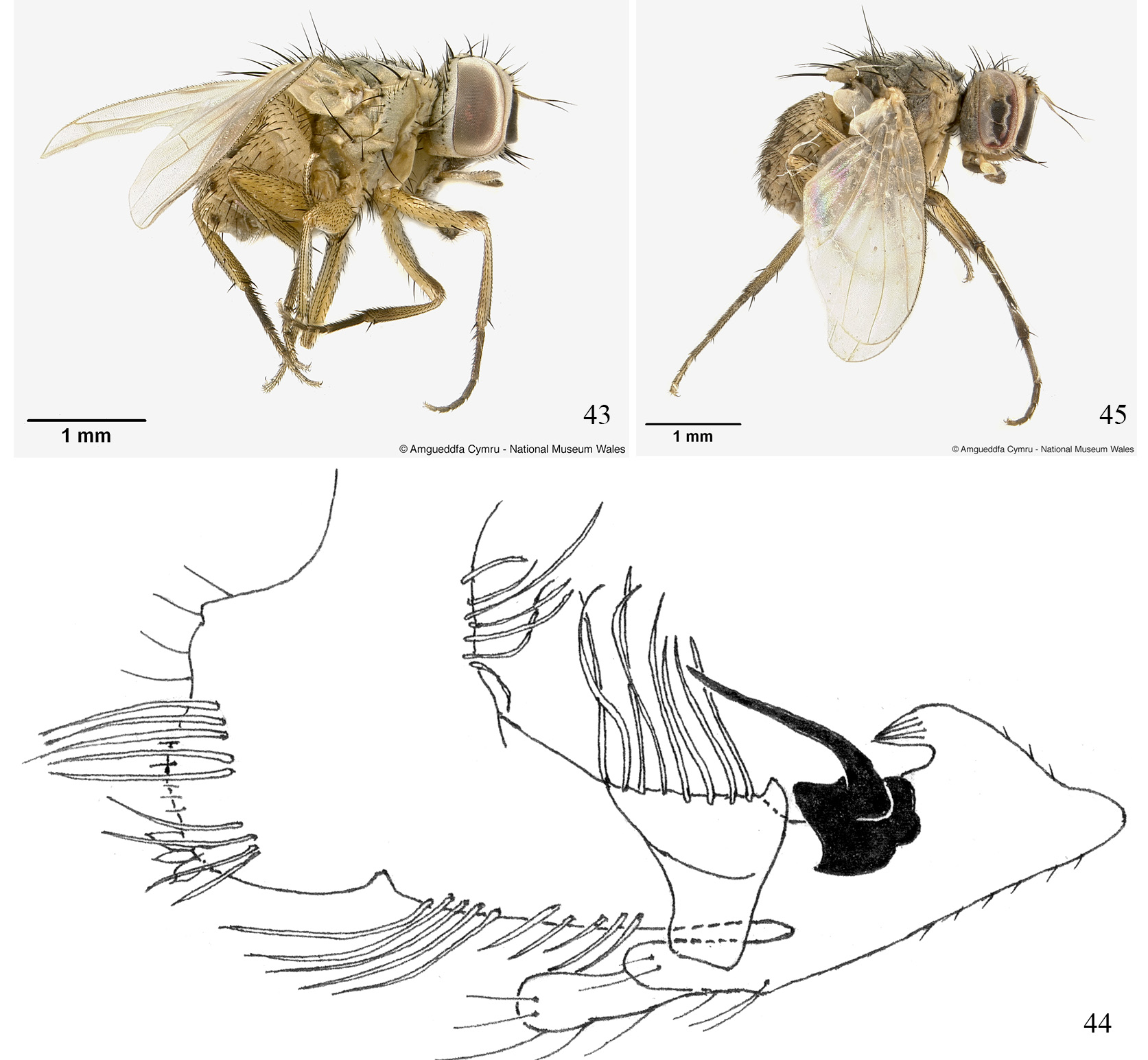
Deeming 2022: 140; Deeming 2019 b: 93. Coenosia excisa Thomson, [1869]: 560. Atherigona trilineata Stein, 1900: 157. Acritochaeta pulvinata Grimshaw, 1901: 42. Atherigona magnipalpis Stein, 1906: 66. Material examined: 1 ♀, Keetmanshoop District, Khabus 146, 26 ° 17 ' S, 18 ° 14 ' E, 30. vi – 23. vii. 1988, N. & G. Olivier, preservation traps, on dolomitic hill east slope; 1 ♂, 1 ♀, Rundu District, Rundu (Kavango Lodge), 17 ° 54 ' 43 '' S, 19 ° 45 ' 33 '' E, 27 – 29. iii. 2003, A. H. Kirk-Spriggs & W. Mey, light trap; 1 ♀, West Caprivi Park, Kwando River, Susuwe, 17 ° 45 ' 37 '' S, 23 ° 20 ' 55 '' E, 28. ix – 02. x. 1998, A. H. Kirk-Spriggs, Malaise trap in dry woodland (all NMNW). Remarks: Larval development takes place in a wide variety of decaying fruits, in which larvae prey upon other soft-bodied insects, but are also able to develop in other breeding media, including faeces. For this reason, Bohart & Gressitt (1951), regarded the species as of major medical importance on the island of Guam in the Pacific, due to its ability to transfer pathogenic organisms to human food. The immature stages were described in detail by Skidmore (1985: 290), who included figures of the larval cephaloskeletons and details of the puparium. Distribution: A common largely circumtropical species, occurring in all zoogeographical regions, except Antarctica: (Afrotropical): Angola, Benin, Burkina Faso, Cabo Verde, Cameroon, Central African Republic, Comoros, Côte d’Ivoire, Democratic Republic of Congo, Ghana, Kenya, Madagascar, Malawi, Mali, Mauritius, Mozambique, Namibia, Nigeria, Oman, Réunion Is., Rodrigues Is., Senegal, Seychelles, Sierra Leone, South Africa, Sudan, Tanzania, Togo, Uganda, United Arab Emirates, Yemen, Zambia, Zanzibar Is. and Zimbabwe.
Sumber: A contribution to the knowledge of Namibian Atherigona Rondani (Diptera: Muscidae), with the descriptions of four new species and two new subspecies
Distribusieng
Distribution in Argentina (Fig. 4): Chaco (General José de San Martín) (new record); Corrientes (Bella Vista) (new record); Formosa (new record); Misiones (Iguazú, Loreto); Salta (Aguaray, Santa Rosa) (new record); Santiago del Estero (new record).
Sumber: On the identity of Bithoracochaeta sociabilis Blanchard (Diptera: Muscidae): a new synonym of Atherigona orientalis Schiner