
Biologi & Ekologieng
Habitat. Borneo lowland rainforest, including nutrient-poor heath and peat swamp forest and mangrove forests, and secondary forests up to elevations of ¢. 1000 m.
Sumber: Pteropodidae
Family Pteropodidae · Order Chiroptera
Data diperbarui secara berkala dari berbagai sumber observasi biodiversitas.
26 titik observasi Balionycteris maculata di Indonesia
Memuat peta...
Setiap titik merepresentasikan satu lokasi observasi yang tercatat. Klik titik untuk melihat detail.
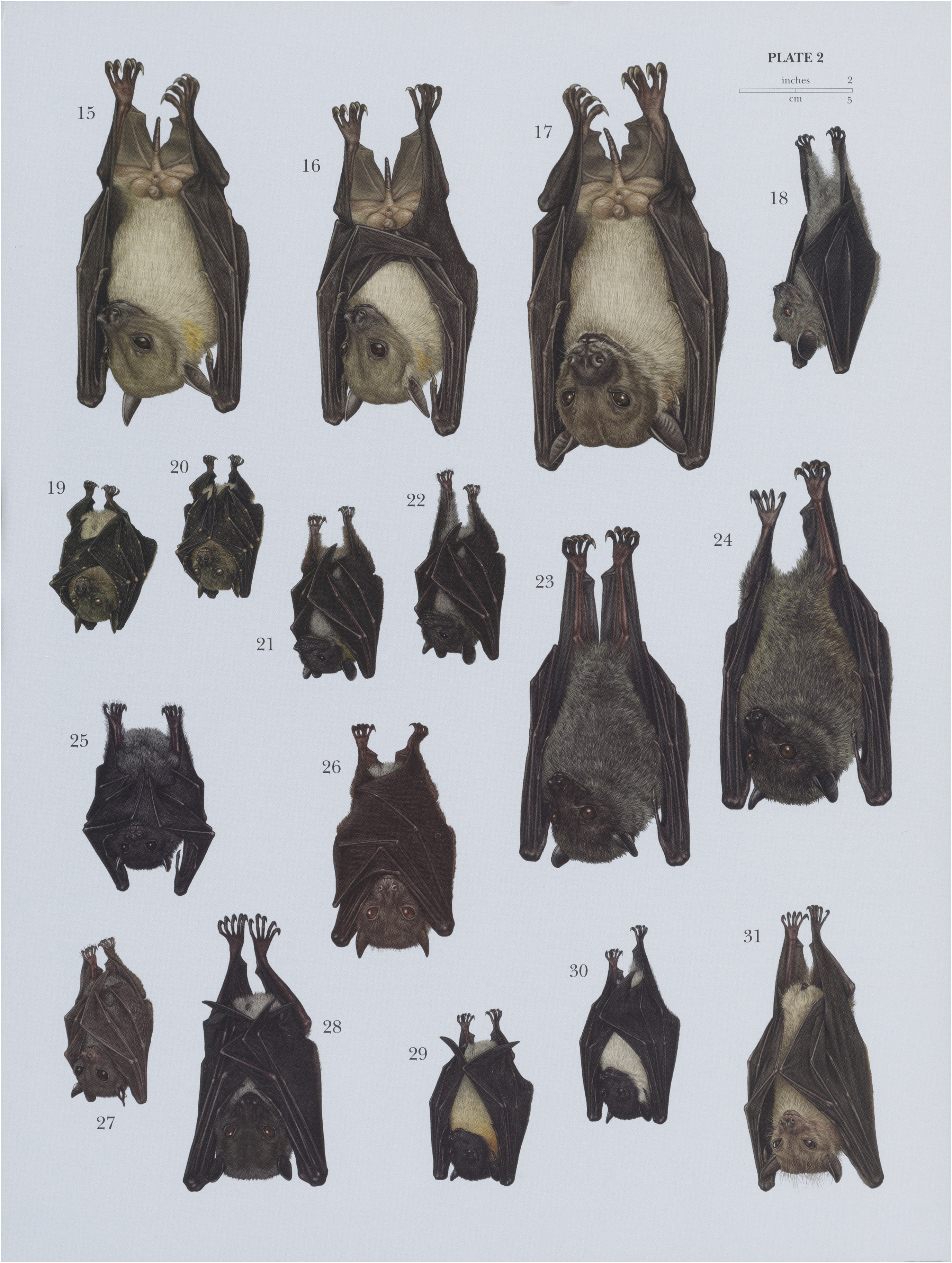
Foto: Don E. Wilson;Russell A. Mittermeier
Otoritas penamaan: (Thomas, 1893) (1893)
Status taksonomi: ACCEPTED
Status konservasi (IUCN): LC Risiko Rendah
Dipublikasikan dalam: Ann. Mag. Nat. Hist., ser. 6 vol.11 p.341
Total Catatan di Indonesia
0
Provinsi Ditemukan
0
dari 38 provinsi
Catatan Pertama
0
tahun pertama tercatat
Tren Tahunan
-0%
-50.0% vs 2022
Langai-isiq Totol (Balionycteris maculata) termasuk dalam famili Pteropodidae, ordo Chiroptera, kelas Mammalia. Berdasarkan data yang terhimpun, spesies ini telah tercatat sebanyak 38 kali di Indonesia, tersebar di 4 provinsi. Catatan pertama tercatat pada tahun 1894.
Kalimantan Timur merupakan provinsi dengan catatan observasi terbanyak untuk spesies ini, dengan 18 catatan (47.4% dari total). Data distribusi ini mencerminkan akumulasi dari berbagai kegiatan survei, penelitian, dan kontribusi citizen science. Pola distribusi yang tercatat mungkin tidak sepenuhnya menggambarkan persebaran alami spesies, karena dipengaruhi oleh intensitas pengamatan di masing-masing wilayah.
Tren observasi tahunan Balionycteris maculata menunjukkan penurunan signifikan (-50%) pada periode terakhir dibanding tahun sebelumnya, dengan catatan pertama pada tahun 1894.
Catatan deskriptif tentang Balionycteris maculata dari sumber literatur primer (via GBIF).
Habitat. Borneo lowland rainforest, including nutrient-poor heath and peat swamp forest and mangrove forests, and secondary forests up to elevations of ¢. 1000 m.
Sumber: Pteropodidae
Movements, Home range and Social organization. Feeding areas of Bornean Spottedwinged Fruit Bats occur within 1 km? * centered on the roost.
Sumber: Pteropodidae
Status and Conservation. Classified as Least Concern on The IUCN Red List. The Bornean Spotted-winged Fruit Bat can adapt to disturbed habitats.
Sumber: Pteropodidae
Descriptive notes. Head — body 50 - 74 mm (tailless), ear 7 - 11 mm, hindfoot 7 - 8 mm, forearm 38 - 43 mm; weight 11 - 14 g. Head of the Bornean Spotted-winged Fruit Bat is rounded, with short muzzle and sparse hair, and skin is brown; nostrils are shortly tubular and divergent; philtrum is divided into two separate lines from base of nostrils down to upper lip; and lower lip pads are large and fused. Lacrimal has white spot of bare skin. Eyes are large and bulging; iris is dark brown. Ears are short, rounded, and dark brown, with slightly swollen white spot at bases and small tubercles on dorsal surfaces. There is a line of swollen follicles of genal vibrissae. Head pelage is short, soft, and coffee-brown, and nape is sparsely haired; dorsum has longer, dark brown pelage. Uropatagium 1 s narrow and hairy at center, and calcar is short. Males have throat gland. Chest and belly have gray hair bases, washed with yellowish brown tips; sides of neck have longer, yellowish hairs. Wing membranes attach to first toe and are dark grayish brown, flecked with white; all wing digit joints are white and slightly swollen. Skull lacks basicranial deflection. Laterally, rostrum is short, sloping into forehead; orbit is very large; zygomatic root is slightly above upper alveolar line; zygoma is thin and arched posteriorly; and braincase is round. Dorsally, rostrum is broad, postorbital foramen is absent; postorbital processes are very short and blunt; paranasal recesses are inflated and extended posteriorly; temporal lines are low and separate; there is almost no postorbital constriction; braincase is almost rounded; nuchal crest is barely marked; and zygomatic arches are moderately wide. Ventrally, palate is flat; tooth rows are lightly arched; post-dental palate is long and moderately converging, with straight caudal edge; palatine spine is inconspicuous and connected to sphenoid crest; and ectotympanic is small and wider anteriorly, internally edged by ribbon-like entotympanic. Mandible is thin, sloping into a low coronoid with rounded tip; condyle is small, level with lower alveolar line; and angle is distinct and round. Dental formula for all species of Balionycterisis 12 / 1, C 1 / 1, P 3 / 3, M 2 / 2 (x 2) = 30. Upper dentition has two pairs of small incisors; C' is small and slightly decurved; P' is a spicule; next premolar (P?) is large and triangular; P * is low; molars are low, very small, and rectangular in occlusal outline; and M * is tiny and atavistic. Lower dentition has incisors that correspond to I, (I, absent), C, is very small, P, is peg-like, P, is large, posterior cheekteeth decrease in height and are rectangular, and M, is minute. Diploid numberis 2 n = 24.
Nama-nama ilmiah lain yang pernah digunakan untuk Balionycteris maculata dalam literatur taksonomi.
| Nama Sinonim | Otoritas | Status |
|---|---|---|
| Balionycteris maculata maculata | (Thomas, 1893) | SYNONYM |
| Cynopterus maculatus | Thomas, 1893 | SYNONYM |
| # | Provinsi | Catatan | % |
|---|---|---|---|
| 1 | Kalimantan Timur | 18 | 47.4% |
| 2 | Kalimantan Barat | 5 | 13.2% |
| 3 | Kalimantan Tengah | 2 | 5.3% |
| 4 | Kalimantan Utara | 1 | 2.6% |
Jumlah catatan observasi Balionycteris maculata di Indonesia per tahun
Balionycteris maculata
Foto: Don E. Wilson;Russell A. Mittermeier
Balionycteris maculata
Foto: Don E. Wilson;Russell A. Mittermeier
| Nama | Bahasa | Sumber |
|---|---|---|
| Balionicterio maculado | - | Pteropodidae |
| Bornean Spotted-winged Fruit Bat | Inggris | Pteropodidae |
| Borneo-Fleckenkurznasenflughund | Jerman | Pteropodidae |
| Cecadu Sayap Berbintik | Melayu | Catalogue of Life |
| Cynoptére tacheté | Prancis | Pteropodidae |
| Fleckenflügel-Flughund | Jerman | Catalogue of Life |
| Gefleckter Kurznasenflughund | Jerman | Catalogue of Life |
| Geflecktflügliger Flughund | Jerman | Catalogue of Life |
| Langai-isiq Totol |
Berdasarkan data 38 observasi, Kalimantan Timur adalah provinsi dengan catatan Langai-isiq Totol (Balionycteris maculata) terbanyak — 18 observasi (47.4% dari total catatan di Indonesia). Spesies ini tersebar di 4 provinsi.
Catatan pertama Langai-isiq Totol (Balionycteris maculata) di Indonesia tercatat pada tahun 1894. Hingga kini terdapat 38 catatan dari 4 provinsi, yang dihimpun dari survei lapangan, koleksi museum, dan platform citizen science.
Menurut IUCN Red List, Langai-isiq Totol (Balionycteris maculata) berstatus "Risiko Rendah" (kode LC). Status ini mencerminkan tingkat risiko kepunahan global spesies, bukan khusus Indonesia.
Di Indonesia dan Malaysia, Balionycteris maculata dikenal dengan beberapa nama lokal: Langai-isiq Totol. Penamaan dapat berbeda antardaerah dan bahasa.
Ya, Balionycteris maculata memiliki 2 nama sinonim ilmiah, di antaranya: Balionycteris maculata maculata, Cynopterus maculatus. Nama sinonim adalah nama-nama lain yang pernah digunakan untuk spesies yang sama dalam literatur taksonomi.
Balionycteris maculata diklasifikasikan sebagai berikut: Kingdom Animalia, Phylum Chordata, Class Mammalia, Order Chiroptera, Family Pteropodidae, Genus Balionycteris. Spesies ini dideskripsikan oleh (Thomas, 1893).
Sumber: Pteropodidae
New records Lampung Province: Sukaraja Forest, Way Canguk Forest. Previous records from Sumatra Aceh Province: Aceh; North Sumatra Province: Leuser; Riau Province: Siak and Seberida; Bengkulu Province: Bengkulu (Maryanto, 2003).
Sumber: A recent bat survey reveals Bukit Barisan Selatan Landscape as a chiropteran diversity hotspot in Sumatra
Records from Borneo Brunei: Batu Apoi NP, Mendaram, Tasek Merimbun (Kofron, 2002); Sabah: Batu- rong, Danum Valley, Gomantong, Gunung Kinabalu, Jesselton, Kasigui, Kota Kina- balu, Madai, Maliau Basin, Poring, Sepilok, Tawau, Tabin, Ulu Tomani, (Yasuma and Andau, 2000); Sarawak: Gunung Dulit, Kuching, Mulu NP (Payne et al., 2000); Bau Limestone formations (Mohd-Azlan et al., 2005); Kubah NP (I. Mackey, unpub- lished data); Gunung Penrisen (Jayaraj et al., 2006). WestKal: Betung Kerihun NP (Hariuchi, 1999), Gunung Kenepai (Payne et al., 2000); CentKal: Barito Ulu Research Area (McConkey and Chivers, 2004); Sebangau NP, Tanjung Puting NP (Struebig et al., 2006 b); EastKal: Gunung Limut (A. Suyanto, unpublished data); Kayan Mentarang NP (Mohd-Azlan et al., 2003); Sungai Wain PF (Struebig et al., 2006 a); Sungai Lesan PF (M. J. Struebig, unpub- lished data).
Sumber: Bats of the Sangkulirang limestone karst formations, East Kalimantan - a priority region for Bornean bat conservation
| Indonesia |
| Catalogue of Life |
| Skrzydłoplamek karłowaty | pol | Catalogue of Life |
| Spotted-winged Fruit Bat | Inggris | Mammal Species of the World |
| kaloň skvrnitokřídlý | ces | Catalogue of Life |
| täpläräpylähekko | fin | Catalogue of Life |
| Пятнокрылый крылан | rus | Catalogue of Life |
| ค้างคาวปีกจุด | tha | Catalogue of Life |
| ホシバネフルーツコウモリ | Jepang | Catalogue of Life |