
Deskripsieng
The B. anabatoides group is closely related to the B. waseri group established by Ng & Kottelat (1994). These two sister groups share the common characters of large adult size, drab coloration, diagnostic eye colour (see Tan, 1998) and the presence of a well marked black lower lip. However, members of the B. anabatoides group can be differentiated from those of the B. waseri group by having an unmarked (vs. a patterned) throat; absence (vs. presence) of silver distal edges on unpaired fins in life; and a distinct and uninterrupted (vs. indistinct and often interrupted) black postorbital stripe from the posterior edge of the eye to the edge of the opercle. The B. anabatoides group is presently known only from the southern half of Borneo. It consists of two species: B. anabatoides Bleeker, and B. midas, herein described.
Sumber: Redescription of Betta anabatoides Bleeker, and a new species of Betta from West Kalimantan, Borneo (Teleostei: Osphronemidae)
Deskripsieng
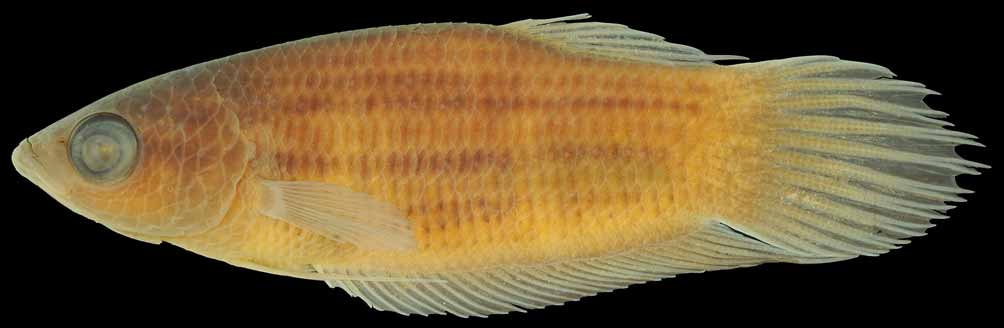
Description. General appearance as illustrated in Figs. 1 – 2. Meristic and morphometric data listed in Table 1. Head broadly pointed (anterior body reminiscent of Anabas: Fig. 1), relatively long (HL 32.8 – 34.9 % SL); body thick-set (body depth 30.5 – 33.7 % SL); pectoral fin rounded; pelvic fin filamentous; dorsal fin situated far back (predorsal length 66.8 – 69.7 % SL); dorsal and anal fins pointed, with elongated posterior rays; caudal peduncle deep (caudal peduncle depth 19.8 – 22.1 % SL); caudal fin lanceolate, some median rays projecting beyond fin margin. Large male specimens with longer unpaired fins and darker body coloration. Coloration in life. See Fig. 2, and refer to Vierke (1979: 389), Linke (1991: 26) and Kottelat et al. (1993: pl. 75) for colour illustrations. Dorsum of body brown, venter lighter brown. Dorsum of head brown with darker brown blotches behind eye; opercle with faint gold iridescence. Distinct pre- and postorbital black stripes on head; lower lip black; chin-bar absent. No iridescence on body. Sides of body plain brown, sometimes with 5 – 7 faint, irregularly-spaced vertical brown bars. Fins brownish, dorsal fin with 5 – 6 darkbrown transverse bars; caudal fin without pattern. Pectoral fin hyaline. Pelvic fin with a bright whitish distal tip. Coloration in preservative. See Fig. 1. Dorsum of body dark brown, venter lighter brown to whitish. Dorsum of head dark brown, opercular area whitish. Distinct pre- and postorbital black stripes on head; chinbar absent. Body with 5 – 7 irregularly spaced vertical dark-brown bars. Fins brownish; dorsal fin with 5 – 6 transverse black bars, caudal fin without pattern. Pectoral fin hyaline. Pelvic fin light brown, its filamentous second ray hyaline.
Sumber: Redescription of Betta anabatoides Bleeker, and a new species of Betta from West Kalimantan, Borneo (Teleostei: Osphronemidae)
Distribusieng
Distribution. Betta anabatoides is known from the lower Barito basin in South Kalimantan and the Kotawaringin, Katingan, Sampit, Mentaya and Kahayan basins in Central Kalimantan (Fig. 3; pers. obs.), in Indonesian Borneo. Field notes. The stream in which the neotype material of B. anabatoides was obtained in Banjarmasin was murky, up to 1.2 m deep and pH 7.5. The water was sluggish and drained from cultivated area upstream. Syntopic fishes included: Boraras brigittae, Rasbora agyrotaenia, R. einthovenii, R. gracilis (Cyprinidae), Lepidocephalichthys hasseltii (Cobitidae), Hemirhamphodon pogonognathus (Hemiramphidae), Calamiana paludosus (Gobiidae), Betta edithae, Trichopodus trichopterus, Trichopsis vittata (Osphronemidae). In Central Kalimantan, the streams in which B. anabatoides can be found lie within a mix of heath and peat swamp forest habitats. These habitats are usually typified by clear, highly tannified and very acidic waters (pH as low as 3.5). The substrate is a mix of silicate sand and peat.
Sumber: Redescription of Betta anabatoides Bleeker, and a new species of Betta from West Kalimantan, Borneo (Teleostei: Osphronemidae)