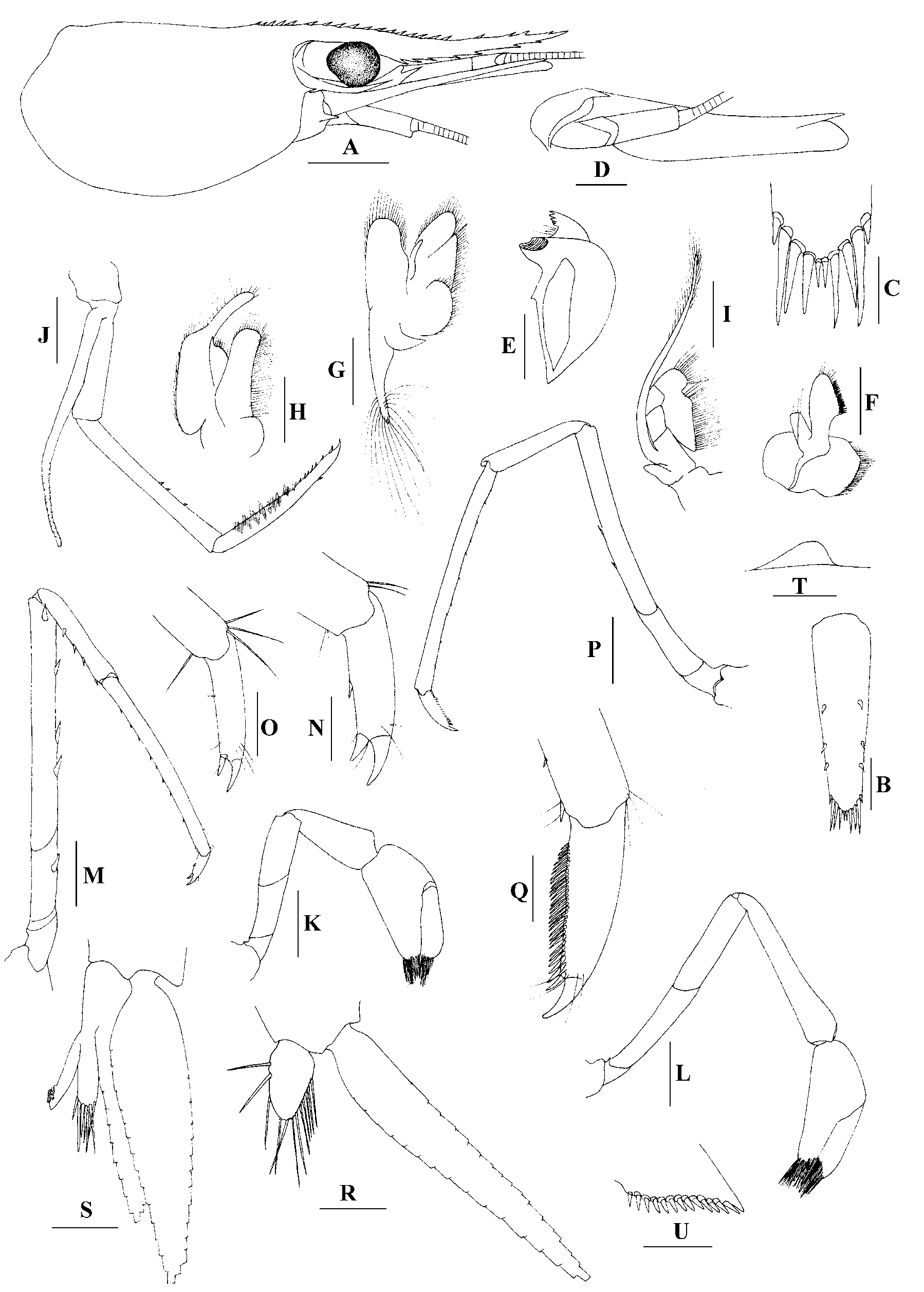
Description. Rostrum slender, reaching slightly beyond end of scaphocerite, slightly longer than carapace to twice as long as carapace, anterior half slightly upturned; rostral formula: 3 - 4 + 13 - 19 / 9 - 18, anterior teeth widely placed than posterior ones. Antennal spine placed below inferior orbital angle. Pterygostomian angle broadly rounded. Sixth abdominal somite 0.54 times of carapace, 1.8 times as long as fifth somite, distinctly shorter than telson. Telson 3.4 times as long as wide, not terminating in a projection, with 3 pairs of dorsal spinules and one pair of dorsolateral spinules; distal end with about 4 pairs of spines, lateral pair distinctly longer than intermediate pairs, median pair shortest. Preanal carina rounded, without spine. Eyes well developed, anterior end reaching to 0.8 times length of basal segment of antennular peduncle. Antennular peduncle as long as carapace; basal segment of antennular peduncle slightly longer than sum of second and third segment lengths, anterolateral angle reaching to 0.3 times length of the second segment, second segment twice as long as third segment. Stylocerite reaching 0.9 times length of basal segment of antennular peduncle. Scaphocerite slender, 5.0 times as long as wide. Incisor process of mandible ending in irregular teeth, molar process truncated. Lower lacinia of maxillula broadly rounded, upper lacinia elongated, with a number of distinct teeth on inner margin, palp slender. Upper endites of maxilla subdivided, palp elongated, scaphognathite tapering posteriorly with numerous long, curved setae at posterior end. Palp of first maxilliped rounded, ending in a finger-like projection. Podobranch of second maxilliped reduced to a small lamina. Third maxilliped reaching to end of antennular peduncle, with ultimate segment slightly shorter than penultimate segment. Epipods present on first pereiopod, lacking from last four pereiopods. First pereiopod reaching to distal end of eye stalk; merus 2.9 times as long as broad, shorter than carpus; carpus shorter than chela, 2.3 times as long as high; chela 2.0 times as long as broad, fingers 1.3 times longer than palm. Second pereiopod reaching to middle of second segment of antennular peduncle; merus distinctly shorter than carpus, 4.0 times as long as broad; carpus 1.2 times as long as chela, 4.7 times as long as high; chela 2.4 times as long as broad; fingers 1.2 times as long as palm. Third pereiopod reaching to end of antennular peduncle, propodus 14 times as long as broad, 5.6 times as long as dactylus; dactylus 3.5 – 4.2 times as long as wide (spines included), terminating in 1 claw, with 1 – 2 accessory spines on flexor margin. Fifth pereiopod reaching to middle of second segment of antennular peduncle, propodus 16 times as long as broad, 3.4 times as long as dactylus, dactylus 4.4 times as long as wide (spinules included), terminating in 1 claw, with 29 – 31 spinules on flexor margin. Endopod of male first pleopod subtriangular, with no appendix interna, 0.2 times length of exopod. Appendix masculina of male second pleopod about 0.33 times length of endopod, appendix interna distinctly reaching beyond end of appendix masculina. Uropodal diaeresis with 7 – 13 movable spinules. Eggs 0.90 x 0.50 – 0.55 mm in diameter. Color. Similar to C. spongicola which has been described by Zitzler & Cai (2006), but more prominent in color and better defined in colour pattern. Habitat. Lakes. It is only found in rocky area, a solitary species on rocky substractum.