
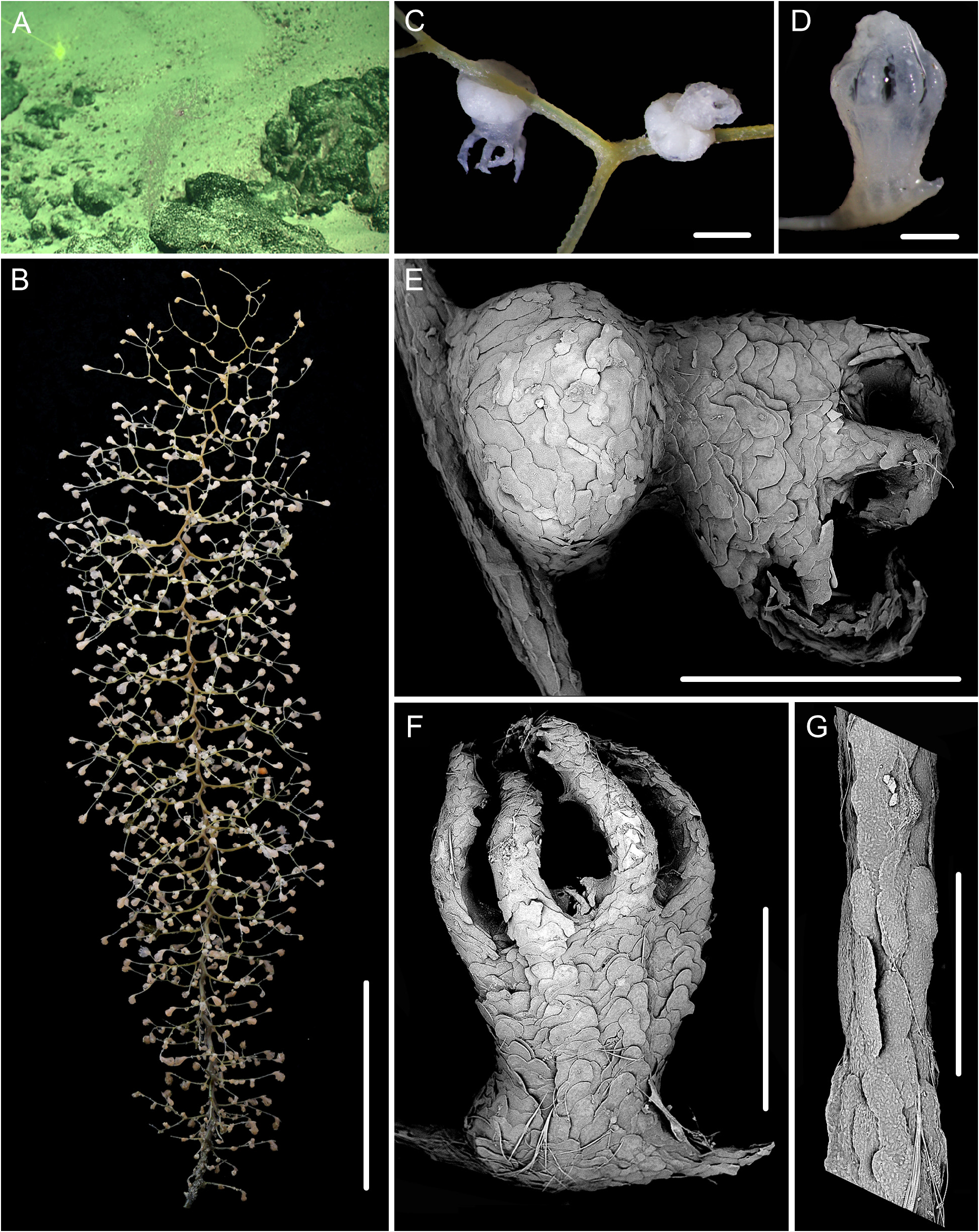
Description. Colony typical bottlebrush-shaped and attached to rocky substrate. Branching sequencing 2 / 5 L. Branches arranged closely at the stem base and became loose on the top. Branches usually slightly bend down and form an acute angle with the stem, and subdivided dichotomously. Distance between adjacent branch up to 15 mm, the first internode of branch up to 12 mm long and terminal branchlets up to 16 mm long. Nonterminal polyps usually with an oval body and became narrow at tentacle base, some of them pitcher-like, 1 – 2 mm tall. Terminal polyps usually cylindrical or conical with its base narrow, up to 3.5 mm tall. Polyps arranged one or two on first and medial internode, and up to four in terminal branchlets. Polyps in stem internodes very small and usually with opening mouth and eight tentacles. Eggs often observed in the oval body of polyps (e. g., Fig. 52 C, E). Some polyps and branches occasionally covered with flexible filaments, which could not be digested by sodium hypochlorite, and usually form a slender and sharp point above the head of polyps (Fig. 66 C, F – I). Scales in aboral face of tentacle rachis transversely arranged in a single row and a little curved with sparse fine warts, usually branched or forked with irregular shape, some of them nearly smooth and one end become narrow and sharp. Scales in pinnules longitudinally arranged, slender and a little curved, nearly smooth or with sparse fine warts, some of them with one end broad or forked and the other end narrow or sharp. Scales in polyp body wall obliquely or transversely arranged, elongate and nearly smooth with an obvious medial contraction, some of them lobed or forked with irregular shape, occasionally with finely toothed edges and protruding ridges on surface. Some small irregular scales often present and scattered on the outermost layer of the large scales on basal polyp body wall (Fig. 68 H). Scales in coenenchyme arranged along to the branch, small and smooth, usually biscuit-like or elongate with a slight medial contraction, some of them crosswise and lobed with irregular shape. Plates or scales in the polyp mouth area near the tentacles sometimes present, small and thick, usually a little curved and coarse with many warts and irregular shape. For the morphological measurements of the ten specimens, see Table 8.
Sumber: Studies on western Pacific gorgonians (Anthozoa: Octocorallia, Chrysogorgiidae). Part 1: a review of the genus Chrysogorgia, with description of a new genus and three new species