Biologi & Ekologieng
Host. Predominantly Tetraodontidae and Diodontidae. Tetraodontidae: Arothron stellatus (Anonymous, 1798) (see Monod, 1934; Trilles, 1975; Avdeev, 1978 b; Galzin & Trilles, 1979; Nagasawa & Uyeno, 2012; present material); Arothron meleagris (Anonymous, 1798) (see Galzin & Trilles, 1979). Diodontidae: Diodon holocanthus Linnaeus, 1758, see Shiino, 1951; Williams et al. 1996; Nagasawa & Uyeno, 2012); Diodon hystrix Linnaeus, 1758 (see Williams et al. 1996; Galzin & Trilles 1979); Diodon liturosus (Shaw, 1804) (see Williams et al. 1996) and Chilomycterus reticulatus (Linnaeus, 1758) (see Nagasawa & Uyeno, 2012). Cymothoa pulchrum has been reported from the Carangidae (Caranx sp., see Monod 1924) but until further evidence is available, this record is considered as uncertain.
Sumber: A review of the family Cymothoidae (Isopoda: Cymothooidea) infesting marine fishes from Malaysian waters, with new host and geographical records
Deskripsieng
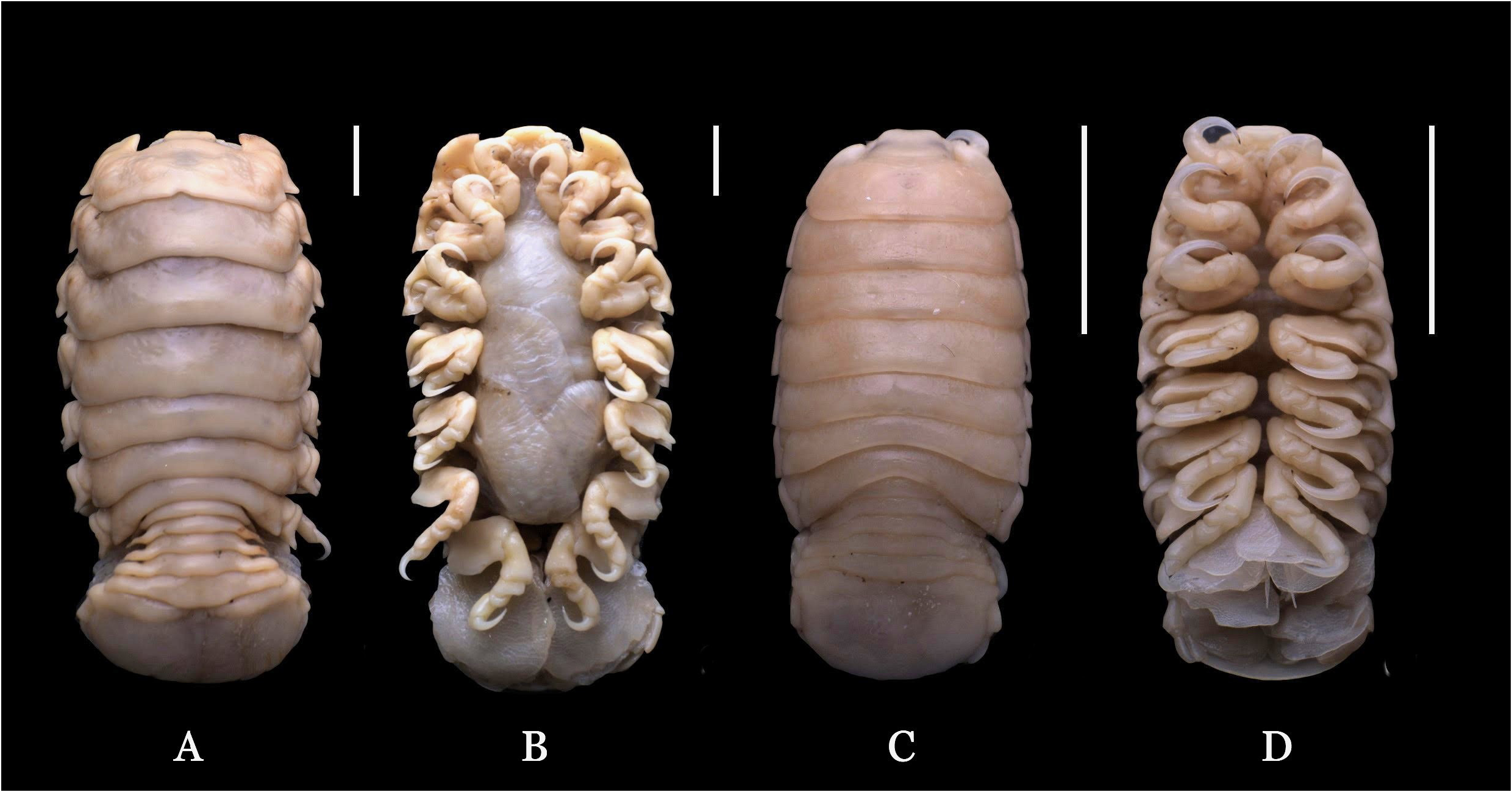
Body subparallel, 2.1 times as long as greatest width, dorsal surface smooth, widest at pereonites 3 – 5, most narrow at pereonite 1. Cephalon 0.3 times longer than wide, visible from dorsal view, subtruncate. Frontal margin rounded to form blunt rostrum. Eyes partially visible. Pereonite 1 anterolateral margins broad, nearly reaching cephalon anterior margin; pereonites 1 – 4 posterior margin irregular, subequal in length; pereonites 5 – 7 subequal in length, pereonite 7 posterolateral margin arched. Coxae visible from dorsal view, coxae 2 – 4 posteroventral margins subtruncate; 5 – 7 with moderately acute carinae. Pleon partially overlapped by pereonite 7; pleonites 1 – 4 subequal in length and width, visible in dorsal view; pleonites posterior margin smooth; pleonite 5 posterior margin straight. Pleotelson 0.6 times as long as anterior width, anterior margin moderately irregular, lateral margin weakly concave, posterior margin rounded, without median point. Antennula comprised of 7 articles; peduncle articles 1 and 2 distinct; article 2 0.6 times as long as article 1; article 3 0.5 times as long as combined lengths of articles 1 and 2, 1.0 times as long as wide; extending to middle of cephalon. Antenna comprised of 7 articles, peduncle article 3 0.8 times as long as article 2, 1.0 times as long as wide; article 4 0.8 times as long as wide; article 5 0.8 times as long as article 4, terminal article without setae. Labrum fleshy, lateral margins convex, anterior margin broadly acute, without small median point. Pereopod 1 basis 1.8 times as long as greatest width, superior proximal margin smooth, without raised carina; ischium 0.6 times as long as basis; merus proximal margin without bulbous protrusion; carpus with straight proximal margin; propodus 2.0 times as long as wide; dactylus slender, 1.1 times as long as propodus, 4.4 times as long as basal width. Pereopod 2 basis 1.3 times as long as greatest width, superior proximal margin smooth, without raised carina; propodus 1.7 times as long as wide; dactylus 1.6 times as long as propodus. Pereopod 6 basis 2.2 times as long as greatest width, superior proximal margin smooth, without raised carina; ischium 0.6 times as long as basis, propodus 2.1 times as long as wide, dactylus 1.3 times as long as propodus. Pereopod 7 basis 1.1 times as long as greatest width, superior proximal margin moderately raised carina; ischium 0.5 times as long as basis, with bulbous protrusion; merus proximal margin with slight bulbous protrusion, merus 0.3 times as long as ischium, 0.4 times as long as wide; carpus 0.5 times as long as ischium, without bulbous protrusion, 0.7 times as long as wide; propodus 0.9 times as long as ischium, 1.3 times as long as wide; dactylus slender, 2.0 times as long as propodus, 4.2 times as long as basal width. Pleopods without setae, depression present on central dorsal surface of pleopods exopods 2, 3 and 5; basal projections present, increasing in size from pleopods 1 – 5; exopod proximal mesial margins extending near peduncle, increasing in size from pleopods 1 – 5; exopod larger than endopod. Pleopod 1 exopod 1.0 times as long as wide, lateral margin convex, distally broadly rounded, mesial margin straight; peduncle 3.0 times as wide as long, without retinaculae. Pleopods 2 – 5 lateral margins becoming strongly convex, large fleshy folds present. Uropod not extending beyond posterior margin of pleotelson; peduncle 1.1 times as long as greatest width, 1.0 times as long as exopod rami, lateral margin straight, mesial margin straight. Exopod subequal length to endopod, 3.3 times as long as greatest width, apically rounded, lateral margin convex, terminating without setae, mesial margin concave. Endopod 3.2 times as long as greatest width, apically rounded, lateral margin weakly straight, terminating without setae, mesial margin straight. Male. Length 8 mm, width 4 mm (non-dissected, MTQ W 34289); length 9 mm, width 4 mm (dissected, ZRC 2015.0042). Body 2.2 times as long as greatest width. Cephalon subtriangular, 0.4 times longer than wide, visible from dorsal view, not deeply immersed in pereonite 1. Eyes partially visible. Pereonite 1 anterolateral minute, not reaching half cephalon length; posterior margins of pereonites 1 – 5 straight and smooth. Coxae 2 – 7 posteroventral margins rounded. Pleonites subequal in width, not overlapped by pereonite 7; pleonites 1 – 4 posterior margins linear, pleonite 5 posterior margin weakly bisinuate. Pleotelson weakly subtruncate. Antennula comprised of 9 articles; subequal in length to antenna. Antenna comprised of 8 articles. Pleopods exopod and pleopod margins smooth; pleopod 2 appendix masculina with parallel margins, 0.8 times as long as endopod, distally acute, pleopod 5 endopod with thick fleshy folds. Colour. Pale tan. Size. Ovigerous females: 34 – 39 mm; non-ovigerous females: 21 – 29 mm; males: 7 – 20 mm; pullus stage: 10 mm (Lanchester 1902; Nierstrasz 1915; Monod 1934; Trilles 1975; Galzin & Trilles 1979; present study). Remarks. Cymothoa pulchrum has a subparallel body, widest at pereonites 3 – 5; cephalon anteriorly subtruncate; wide and subtruncate pereonite 1 anterolateral margins which is nearly reaching rostrum; pleon partially overlapped by pereonite 7; pleotelson posterior margin round; basis of pereopods 6 and 7 superior proximal margin with raised carinae; pereopod 7 with prominent lobe on ischium; coxae visible from dorsal view and uropods reaching half the pleotelson length (visible from ventral view). The male specimens differ from the females in having a subtriangular cephalon that is not deeply immersed in pereonite 1, eyes partially visible (compared to the females with eyes absent), pereonite 1 anterolateral margins minute and not reaching half cephalon length, pleonites not subequal in width and not overlapped by pereonite 7, pleopod 2 appendix masculina with parallel margins, and pleopod 5 endopod with thick fleshy folds. Galzin & Trilles (1979) described and illustrated C. pulchrum at different life stages. Galzin & Trilles’s (1979) female specimens differ from the Australian females in having a more highly raised carina on pereopod 7 basis, straight inferior distal margin on pereopod 7 ischium, setae present on segments 5 – 7 on antennula and appendix masculina present on pleopod 2. The males from Galzin & Trilles’s (1979) illustration varies from the Singaporean material in having marginal setae on uropod peduncle; appendix masculina present on pleopod 2 and extending beyond the endopod margin; and setae present on segments of antenna and antennula. Cymothoa epimerica differs from C. pulchrum by the oval body, uropodal rami more narrow and slender, cephalon subtriangular, coxae 5 – 7 posteroventral margins acute and visible in dorsal view, and pereopods 6 and 7 basis with sharp and acute carinae (compared to the raised carina without an acute edge). Cymothoa eremita differs from C. pulchrum by having anterolateral margins of pereonite 1 more tapered, pleotelson more subtruncate, coxae posteroventral margins rounded and not visible from dorsal view. Yu & Li (2003 b) misidentified “ C. pulchra ” from Hainan Island, South China Sea, their drawings allowing identification of their material as C. epimerica (see remarks on C. epimerica).
Sumber: Review of the fish-parasitic genus Cymothoa Fabricius, 1793 (Crustacea: Isopoda: Cymothoidae) from Australia