Biologi & Ekologieng
Habitat. Primary and secondary semi-deciduous monsoon, dipterocarp, and tropical evergreen forest. They are found to about 1700 m above sea level in Sabah, but densities decrease at higher elevations. East Bornean Gray Gibbons have been studied by D. Leighton in Kutai National Park, East Kalimantan, north of the Mahakam River. The forest there is largely lowland dipterocarp (much ofit logged) but also includes tropical moist heath forest (“ keranga ”) on sandy acidic soils and, in the coastal area, mangroves. These gibbons can tolerate a degree of selective logging provided that sufficient tall, fruit-bearing trees are left standing.
Sumber: Hylobatidae
Biologi & Ekologieng
Movements, Home range and Social organization. At Kutai, seven family groups of East Bornean Gray Gibbons averaged 3 - 4 individuals; an adult male, adult female, and their offspring. The average home range size of four groups was found to be 36 ha (range 33 - 43 ha). The day range of the groups at Kutai averaged 800 m (350 - 1890 m). They use the ranges unevenly, but will generally visit all parts of it over a few days. They do not habitually patrol the range, but the simulation of an intrusion using playback does result in some monitoring of the range borders. Females initiate duets and lead joint approaches to playbacks of female solos, whereas males lead silent, joint approaches to playbacks of male solos. In general, males are aggressive toward other males and defend their territory, while females lead the group’s daily progressions and are aggressive toward other females. Females tend to be more aggressive than males, and are dominant over them. The female grooms the male much less frequently than vice versa. The male is the more aggressive during intergroup encounters. Densities, estimated using various techniques, range from 9 - 14 - 6 ind / km? at Kutai National Park to 6 - 9 - 9 - 9 ind / km * at Kayang Mentarang National Park.
Sumber: Hylobatidae
Konservasieng
Status and Conservation. CITES Appendix I. Classified as Endangered on The IUCN Red List (as H. mueller: funereus). The East Bornean Gray Gibbon is protected under Indonesian and Malaysian law. It is generally common where good forest remains, although logging activities have rendered the range patchy. The widespread fires in the El Nino years in the 1980 s and 1990 s devastated forests over a large part ofits range. Much of its habitat was also lost in colonial times and is being further impacted by oil palm plantations and logging activities. Deforestation, trade in illegal pets, and hunting are the predominant threats. East Bornean Gray Gibbons occur in the following protected areas: Kutai and Kayan Mentarang national parks in East Kalimantan (Indonesia); Tawau Hills, Kinabalu, and Crocker Range national parks in Sabah (Malaysia); Pulong Tau, Gunung Mulu, and Gunug Buda national parks in Sarawak (Malaysia); and Ulu Temburong National Park in Brunei. There is no population estimate for the East Bornean Gray Gibbon, but “ gray gibbons ” (Muller's, H. muelleri, East Bornean Gray, and Abbott's Gray, H. abbotti, gibbons) have been estimated at 250,000 - 375,000 individuals.
Sumber: Hylobatidae
Deskripsieng
Descriptive notes. Head — body 48 - 5 cm (males, n = 3) and 47.5 - 49 cm (females, n = 3); weight 5.6 - 4 kg. Pelage of the East Bornean Gray Gibbon is very dark brown or gray. Hands and feet are not darker than limbs and are sometimes lighter. The crown hair is directed fanwise from the front of the scalp and is markedly elongated over the ears.
Sumber: Hylobatidae
Distribusieng
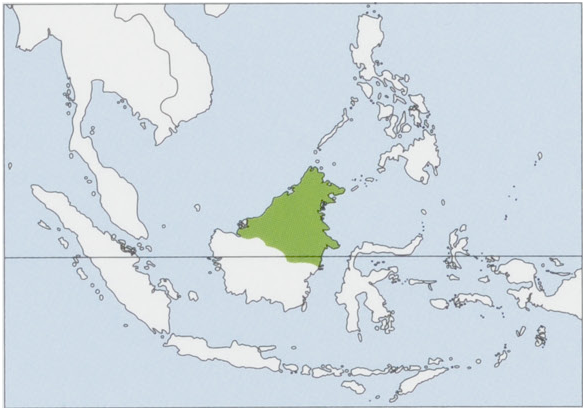
Distribution. N & NE Borneo, from Sabah State S to the Mahakam River in East Kalimantan Province and perhaps W to the Baram District and the IV Division of Sarawak State.
Sumber: Hylobatidae