
Konservasieng
PROTECTED STATUS: CITES - Appendix I as Hylobates spp. and U. S. ESA - Endangered as Hylobates spp. (including Nomascus spp.).
Sumber: Order Primates
Family Hylobatidae · Order Primates
Data diperbarui secara berkala dari berbagai sumber observasi biodiversitas.
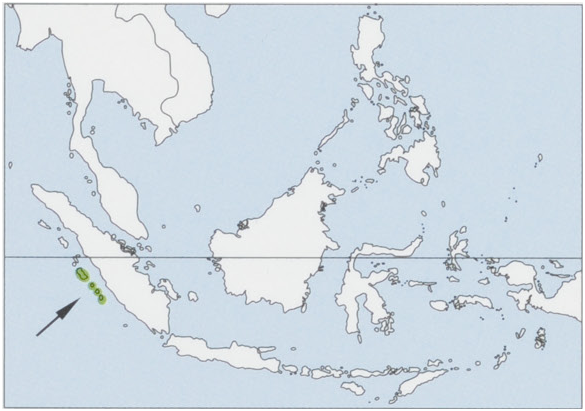
Foto: Russell A. Mittermeier;Anthony B. Rylands;Don E. Wilson
Otoritas penamaan: (Miller, 1903) (1903)
Status taksonomi: ACCEPTED
Status konservasi (IUCN): EN Terancam Punah
Dipublikasikan dalam: Smithson. Misc. Coll. vol.45 p.70
Total Catatan di Indonesia
0
Provinsi Ditemukan
0
dari 38 provinsi
Catatan Pertama
0
tahun pertama tercatat
Tren Tahunan
+0%
+33.3% vs 2024
Bilou or Siamang Kerdil Mentawai (Hylobates klossii) termasuk dalam famili Hylobatidae, ordo Primates, kelas Mammalia. Berdasarkan data yang terhimpun, spesies ini telah tercatat sebanyak 84 kali di Indonesia, tersebar di 1 provinsi. Catatan pertama tercatat pada tahun 1902.
Sumatera Barat merupakan provinsi dengan catatan observasi terbanyak untuk spesies ini, dengan 29 catatan (34.5% dari total). Data distribusi ini mencerminkan akumulasi dari berbagai kegiatan survei, penelitian, dan kontribusi citizen science. Pola distribusi yang tercatat mungkin tidak sepenuhnya menggambarkan persebaran alami spesies, karena dipengaruhi oleh intensitas pengamatan di masing-masing wilayah.
Tren observasi tahunan Hylobates klossii menunjukkan peningkatan signifikan (+33%) pada periode terakhir dibanding tahun sebelumnya, dengan catatan pertama pada tahun 1902.
Catatan deskriptif tentang Hylobates klossii dari sumber literatur primer (via GBIF).
PROTECTED STATUS: CITES - Appendix I as Hylobates spp. and U. S. ESA - Endangered as Hylobates spp. (including Nomascus spp.).
Sumber: Order Primates
DISTRIBUTION: Mentawi Isis, (off W. Sumatra).
Sumber: Order Primates
Habitat. Primary semi-deciduous monsoon and tropical evergreen forest at all elevations. Kloss’s Gibbons generally prefer to remain in the upper canopy. They have also been observed in swamp forest. Mentawai forests are ever-wet, with annual rainfall of up to 4000 mm. Throughoutits distribution, Kloss’s Gibbon is sympatric with the Pigtailed Langur (Simias concolor), and the Siberut Langur (Presbytis siberu) and the Siberut Macaque (Macaca siberu) on Siberut and the Mentawai Langur (P. potenziani) and the Pagai Macaque (Macaca pagensis) on the southern Mentawai Islands.
Sumber: Hylobatidae
Movements, Home range and Social organization. Home ranges of Kloss’s Gibbons are 7 - 32 ha, probably varying in relation to habitat quality and floristic composition. Average daily movement is 1514 m. Group size is typically 4 - 6 individuals. Groups as large as 10 - 15 individuals have been observed on North Pagai and Siberut, butit is unclearif these are stable units. In general, males are aggressive toward other males and defend their territories from predators (humans), while females tend to lead group’s movements during the day, and also exclude other adult females from the group. At about eight years old, Kloss’s Gibbons find a mate and establish their own territory. Young adult Kloss’s Gibbons may establish territories adjacent to their parents’ territories, with their parents’ assistance. They may also replace a deceased same-sex adult in their parental territory to live with the remaining opposite-sex adult; in the observed cases, it was not known whether that surviving adult was the genetic parent of the young adult. Disturbance levels in the habitats of Kloss’s Gibbons vary on the different islands, but recent surveys have detected similar densities in unlogged forests, forests logged ten years ago, and those logged 20 years ago. The highest densities have been observed in northern Siberut. Density in the Mentawai islands averages 12 ind / km?,
Nama-nama ilmiah lain yang pernah digunakan untuk Hylobates klossii dalam literatur taksonomi.
| Nama Sinonim | Otoritas | Status |
|---|---|---|
| Symphalangus klossii | G.S.Miller, 1903 | SYNONYM |
| # | Provinsi | Catatan | % |
|---|---|---|---|
| 1 | Sumatera Barat | 29 | 34.5% |
Jumlah catatan observasi Hylobates klossii di Indonesia per tahun
Hylobates klossii
Foto: Russell A. Mittermeier;Anthony B. Rylands;Don E. Wilson
Hylobates klossii
Foto: Russell A. Mittermeier;Anthony B. Rylands;Don E. Wilson
| Nama | Bahasa | Sumber |
|---|---|---|
| Beeloh | - | Phthiraptera.myspecies.info |
| Bilou or Siamang Kerdil Mentawai | Indonesia | Catalogue of Life |
| Dwarf Gibbon | Inggris | Catalogue of Life |
| Dwarf Sianang | - | Phthiraptera.myspecies.info |
| Dwergsiamang | Belanda | Catalogue of Life |
| Gibbon de Kloss | Prancis | Catalogue of Life |
| Gibbone delle Mentawai | Italia | Catalogue of Life |
| Gibon de Kloss | - | Hylobatidae |
| Gibão-de-kloss | Portugis |
Berdasarkan data 84 observasi, Sumatera Barat adalah provinsi dengan catatan Bilou or Siamang Kerdil Mentawai (Hylobates klossii) terbanyak — 29 observasi (34.5% dari total catatan di Indonesia). Spesies ini tersebar di 1 provinsi.
Catatan pertama Bilou or Siamang Kerdil Mentawai (Hylobates klossii) di Indonesia tercatat pada tahun 1902. Hingga kini terdapat 84 catatan dari 1 provinsi, yang dihimpun dari survei lapangan, koleksi museum, dan platform citizen science.
Menurut IUCN Red List, Bilou or Siamang Kerdil Mentawai (Hylobates klossii) berstatus "Terancam Punah" (kode EN). Status ini mencerminkan tingkat risiko kepunahan global spesies, bukan khusus Indonesia.
Di Indonesia dan Malaysia, Hylobates klossii dikenal dengan beberapa nama lokal: Bilou or Siamang Kerdil Mentawai, Siamang Kerdil. Penamaan dapat berbeda antardaerah dan bahasa.
Ya, Hylobates klossii memiliki 1 nama sinonim ilmiah, di antaranya: Symphalangus klossii. Nama sinonim adalah nama-nama lain yang pernah digunakan untuk spesies yang sama dalam literatur taksonomi.
Hylobates klossii diklasifikasikan sebagai berikut: Kingdom Animalia, Phylum Chordata, Class Mammalia, Order Primates, Family Hylobatidae, Genus Hylobates. Spesies ini dideskripsikan oleh (Miller, 1903).
Sumber: Hylobatidae
Status and Conservation. CITES Appendix I. Classified as Endangered on The IUCN Red List. Kloss’s Gibbon is protected under Indonesian law, but it occurs in only one protected area, Siberut National Park. The total population, based on limited survey effort using auditory sampling, is 20,000 - 25,000 individuals, with island totals of 18,210 - 21,345 for Siberut, 753 - 880 for Sipora, and 1680 - 1974 on North and South Pagai together (another estimate for these last two islands, using a transect-based approach, was 2029 individuals). The vast majority of the global population is believed to be in Siberut National Park, with 13,190 - 15,413 individuals, but this estimate is based on a survey of less than 0 - 1 % of the park and therefore needs to be viewed as preliminary. Total population decline of Kloss’s Gibbon may be ¢. 50 % since 1980. Threats include hunting, commercial logging, forest conversion for agroindustry, especially oil palm, and forest clearance and disturbance at the local scale. Selective logging is widespread across the distribution of Kloss’s Gibbon, but one study suggests that this may have limited impact on carrying capacity. Hunting pressure has been exacerbated by increased access to forested areas through logging infrastructure and a move away from traditional hunting methods in the use of guns. Infant Kloss’s Gibbons are often taken as pets by hunters after they kill a parent. Traded Kloss’s Gibbons mostly remain in the Mentawai islands but sometimes go to neighboring western Sumatra. Increased legal protection of the remaining populations, including those in the Peleonan Forest, increased commitment and planning for conservation from logging companies, and improved enforcement in Siberut National Park are key conservation interventions.
Sumber: Hylobatidae
Descriptive notes. Head-body 43.5 - 58.5 cm (males) and 42 - 58 cm (females); weight 5.7 - 8 kg (males) and 4.4 - 6.8 kg (females). Female Kloss’s Gibbonsare slightly smaller than males, but they have canine teeth that are similar in size. Kloss’s Gibbon is considered one of the smallest gibbons, although its body size is within the range observed in other species of Hylobates. Both sexes and all ages have completely black fur with no markings. Kloss’s Gibbon was originally described as a “ dwarf siamang ” due to its black fur, but morphologically it more closely resembles other species of Hylobates than the Siamang (Symphalangus syndactylus). One notable difference is that the fur is sparser than is typical of other species of Hylobates, and there is a nearly bare area on the throat. In some respects, the skull of the Kloss’s Gibbon also resembles that of the Siamang.
Sumber: Hylobatidae
| Catalogue of Life |
| Kloss Gibbon | - | Phthiraptera.myspecies.info |
| Kloss s Gibbon | Inggris | Catalogue of Life |
| Kloss' gibbon | dan | Catalogue of Life |
| Kloss's Gibbon | Inggris | Catalogue of Life |
| Kloss's gibbon | Inggris | The Paleobiology Database |
| Kloss-Gibbon | Jerman | Catalogue of Life |
| Klossgibbon | nob | Catalogue of Life |
| Kloss’s Gibbon | Inggris | Hylobatidae |
| Mentawai Gibbon | Inggris | Catalogue of Life |
| Siamang De Kloss | Prancis | Catalogue of Life |
| Siamang Enano | Spanyol | Catalogue of Life |
35 titik observasi Hylobates klossii di Indonesia
Memuat peta...
Setiap titik merepresentasikan satu lokasi observasi yang tercatat. Klik titik untuk melihat detail.