
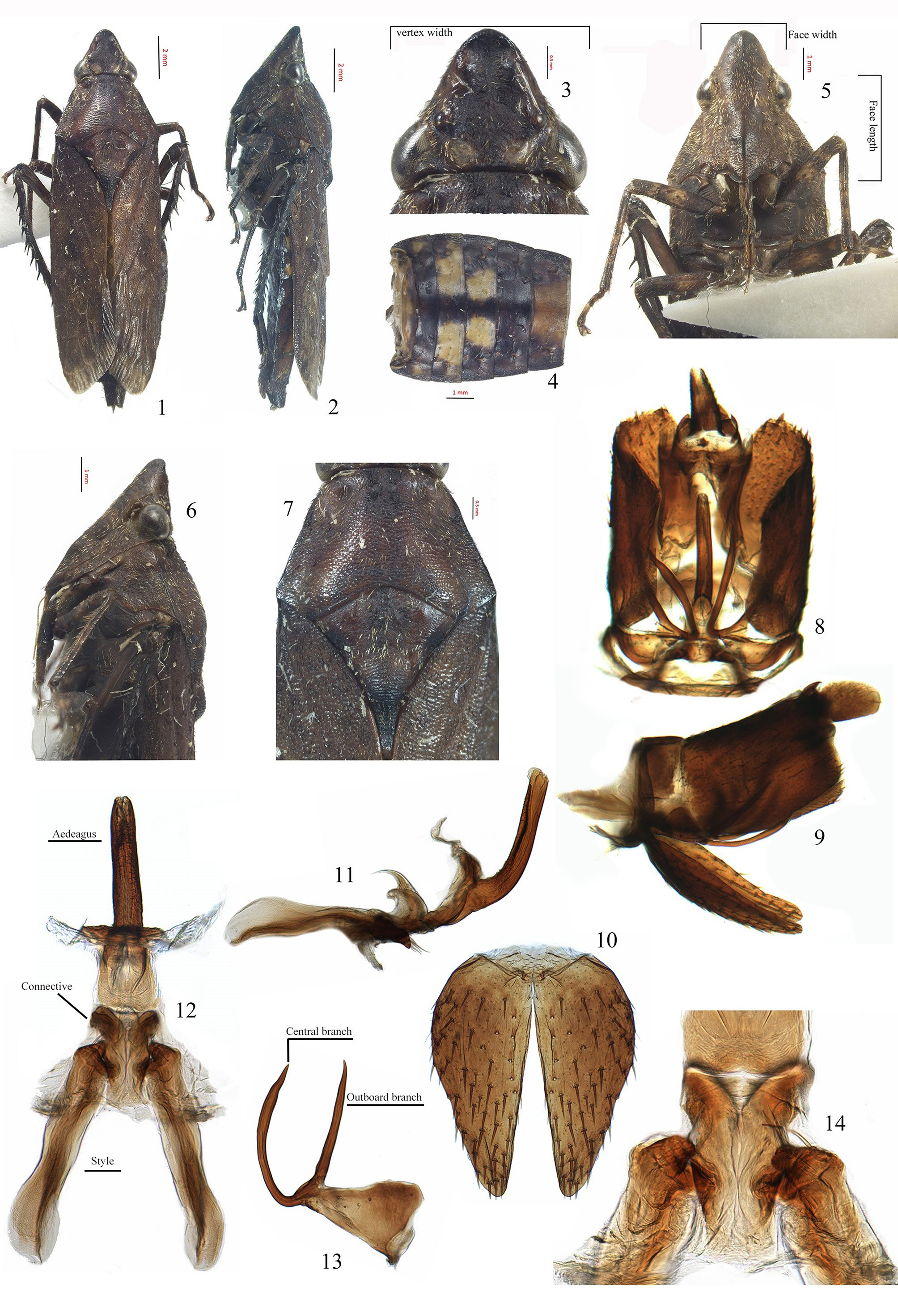
External morphology. Body yellow brown to black. Crown (Figs. 3, 15 – 17, 20) slightly longer than width across eyes. Face (Figs. 5, 22) clearly longer than width including eyes, lateral margin of gena almost straight and apex of gena arc-shaped. Pronotum (Figs. 6, 7, 15 – 18, 20, 21) with central part brown and sides usually tan, slightly longer than width of anterior margin, posterior margin about 2.0 x width of anterior margin and strongly concave. Exposed part of mesonotum and scutellum (Figs. 6, 7, 15 – 18, 20, 21) together longer than wide, swollen parts evident. Forewing with group of setae on inner discal cell center. Abdomen (Fig. 4) with pair of irregular yellow patches on 4 th and 5 th tergites submedially. Male genitalia. (Figs. 8 – 14) Pygofer ventral process (Fig. 13) with base subtriangular and expanded mesad, branches slender and well separated from each other in ventral view, lateral branch above and slightly shorter than central one in lateral view, approximately ten microsetae on base of branches. Subgenital plate (Figs. 9, 10) longer than 1 / 2 pygofer side. Connective (Figs. 11, 12, 14) length about 2.0 x width, vertical process apex not clearly surpassing anterior margin. Style slightly longer than 2.0 x connective length, apophysis disc-like apically and with 5 – 8 setae on ventral surface. Aedeagus (Figs. 11, 12) depressed in middle on dorsal surface, sides keeled and transversely rugose throughout length on dorsal surface; shaft long, slender and of nearly uniform width throughout length, gonopore at apex. Female. Larger than male. Abdomen (Fig. 19) ovoid and plumper than in male, coloration uniform, without yellow spots on tergites. Pygofer (Fig. 23) slightly emarginate apically rather than deeply bifid. Sternite VII (Fig. 23) with middle convex and both sides protruded backward in dorsal view. Ovipositor not reaching pygofer apex. First valvula (Figs. 25, 26) sword-like with many irregular punctations present along ramus, blade narrowest at base, dorsal sculpture area densely strigate. Second valvula (Figs. 27, 28) knife-shaped, narrow at base, broadened in distal two-thirds, dorsal margin slightly concave with numerous small teeth on distal half, ventral marginconvex, apex narrowly rounded with several ducts. Third valvula (Fig. 29) sheath-shaped with few small setae near ventral margin.
Sumber: Review of the leafhopper genus Kalasha Distant (Hemiptera: Cicadellidae: Hylicinae)