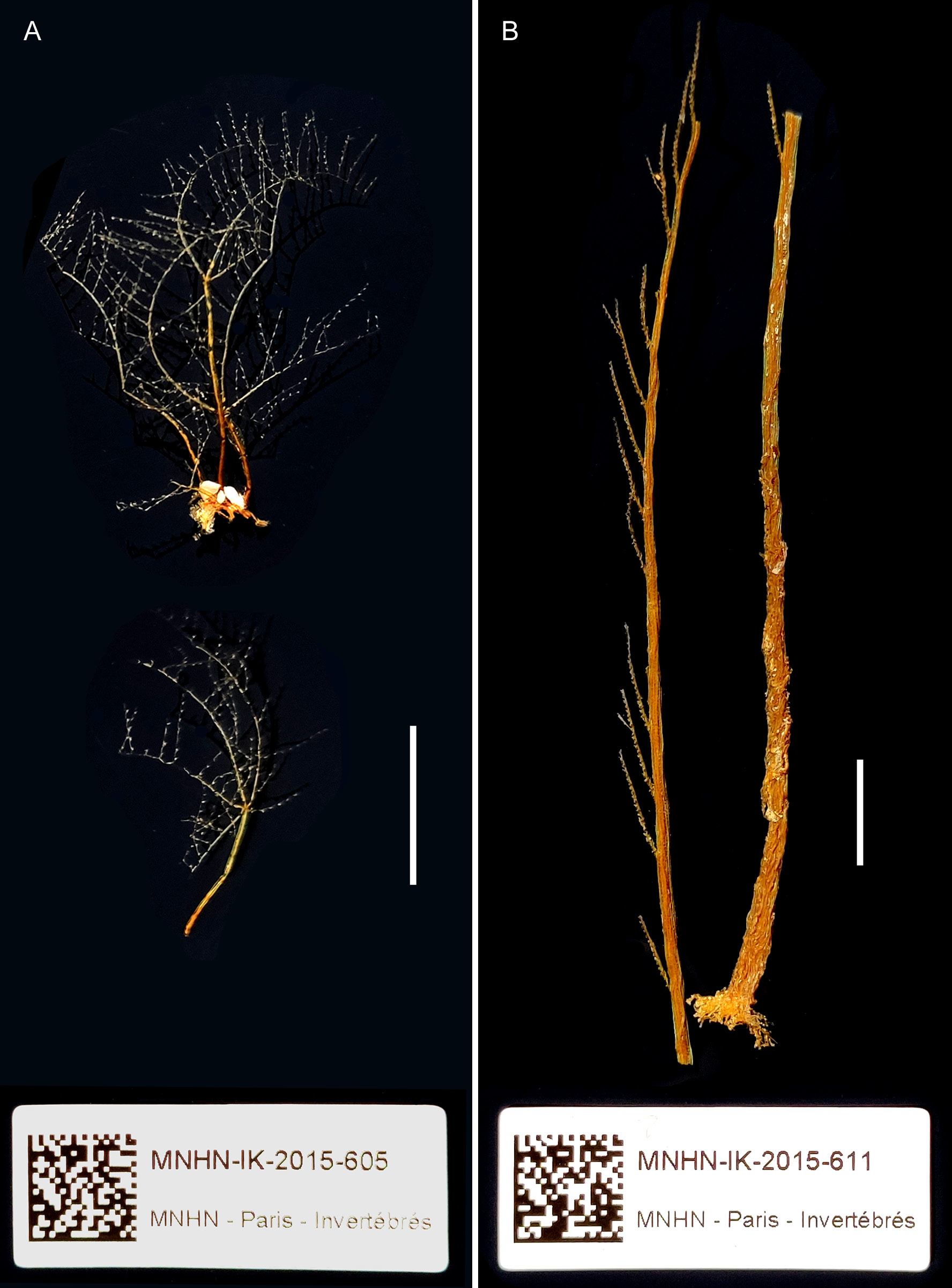
Description Colonies upright, up to 2 cm high, coplanar, rigid, with thick, brown perisarc, arising from creeping, branching, slightly flattened hydrorhiza. Stem monosiphonic; proximal part straight, irregularly divided into few internodes of varied length by means of transverse nodes; distalmost nodes with two parallel, closely-set rows of frontal nematothecae; remainder of stem divided into regular internodes by transverse nodes; each internode moderately long, straight, bearing one or two lateral apophyses and 4 – 6 frontal nematothecae in two closely-set rows; apophyses subterminal on internodes; when two of these are present on same internode, either opposite or subopposite; two types of apophyses: first type very short, ending in straight node and bearing secondary stem, and second type comparatively longer, ending in oblique node and bearing cladium; first regular thecate stem internode with either pair of dissimilar apophyses, one bearing secondary stem, the other a cladium, or with pair of apophyses supporting two secondary stem; in the latter case, following internode may bear two dissimilar apophyses; remainder of stem internodes with single apophyses supporting cladia only, distal part of stem assuming scorpioid shape, typical of genus. Secondary stems, like main stem, divided into regular internodes, each bearing nematothecae and upwardly-directed apophysis supporting cladium; consequently, all their cladia point upwards with respect to colony, and their hydrothecae all facing towards main stem. All cladia borne directly on main stem have their hydrothecae facing downwards in proximal part of colony and, as stem curves away in scorpioid manner, hydrothecal apertures of more distal cladia increasingly facing outwards or even upwards, depending of length of distal part of stem and number of cladia it bears. Cladia up to 8 mm long, heteromerously divided into hydrothecate and ahydrothecate internodes; up to 10 hydrothecate internodes per cladium, relatively short, each with proximal node oblique and distal node transverse, bearing hydrotheca in middle and its complement of nematothecae: one mesial, a pair of laterals, as well as axillar one on one side of hydrotheca; hydrotheca deep, tubular, half adnate, free adaxial wall and abaxial wall nearly straight, aperture circular, rim smooth; all nematothecae movable and bithalamic; laterals conical, borne on conspicuous apophyses, whole set reaching hydrothecal rim; upper chamber of lateral nematothecae lowered on adaxial side, and there with sinusoid margin. Cladial ahydrothecate internodes of varied length, with proximal node straight and distal node oblique, each bearing frontal nematotheca proximally. Stems either mono- or dioecious; gonothecae sexually dimorphic, borne exclusively on cladia by means of 2 - segmented pedicel, given off laterally between base of hydrotheca and its mesial nematotheca; female gonothecae large, piriform, slightly flattened laterally, distally truncate and there with broad, thickened, ovoid aperture, proximally with 2 – 3 nematothecae; male gonothecae, comparatively smaller, ovoid, circular in transverse section, distally with small, rounded aperture, proximally with a nematotheca.