Biologi & Ekologieng
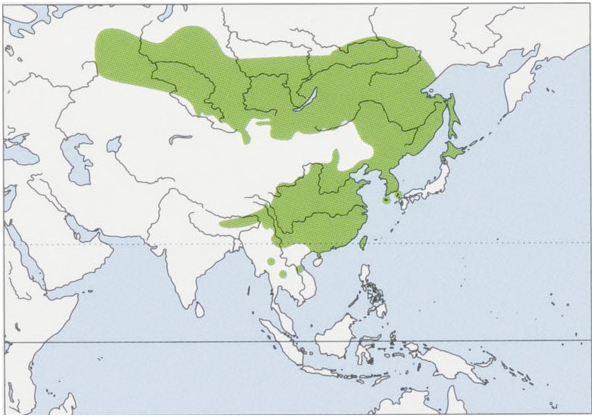
ECOLOGY Population characteristics. — The range of Mustela sibirica is extensive across Palearctic Asia, with natural populations ranging from west of the Ural Mountains of Siberia to the Far East and south to Taiwan and the Himalayas (Abramov et al. 2016). Food abundance is hypothesized to determine the population and distribution of M. sibirica, and Siberia and northeast China are believed to contain the highest densities of M. sibirica because of large densities of several rodent species (Heptner et al. 2001). Mustela sibirica is a common game species in western Siberia, and records of population censuses are largely based on fur trapping records (Bakeev 1971). Long-term records reveal great annual and multi-annual fluctuations in population density. Increases in population densities were preceded by large increases in rodent abundance (Bakeev 1971). The mean total number of M. sibirica trapped during the early to mid- 1900 s are 25 in the Kostroma Oblast, 437 in the Orenburg Oblast, 422 in the Republic of Tatarstan, 525 in the Sverdlovsk Oblast, and 86 in the Tyumen Oblast (Bakeev 1971). Since the 1950 s, the decline in successful fur trappings suggested that population densities in several regions decreased, which may be attributed to the combination of deforestation and reduction in rodent abundance (Bakeev 1971). Low fur prices also may reduce number of individuals trapped (Abramov et al. 2016). In the Sverdlovsk Oblast, Russia, M. sibirica experienced a 39 – 71 % decline in total population abundance from 1987 to 2011 (Monakhov 2011 a). In Kyushu, Japan, population density of introduced M. sibirica is 4 – 15 individuals per km (Sasaki et al. 2014). The mean longevity for wild M. sibirica is calculated to be 2.1 years (Miyagi and Shiraishi 1978). Space use. — Mustela sibirica is found in a wide variety of habitats including dense primary and secondary deciduous, coniferous, and mixed forests; woodlands; open grasslands; and river valleys (Heptner et al. 2001; Abramov et al. 2016). M. sibirica prefers regions near lakes and swamps covered with bushes and fallen trees where small rodents are abundant (Novikov 1962). M. sibirica is well documented at high elevation: 1,400 – 1,700 m in the secondary forests of Guandaushi Forest, Taiwan (Wu 1999); 2,700 – 3,700 m in the primary forests of the Tawu Mountains, Taiwan (Chiang et al. 2012);> 3,000 m in Nepal (Ghimirey et al. 2014); 1,500 – 4,800 m in Bhutan (Abramov et al. 2016); and up to 5,000 m in China (Abramov et al. 2016). Mustela sibirica uses fallen logs, empty stumps, and brushwood piles as shelters and nests (Heptner et al. 2001). Individuals also inhabit the burrows of their prey, such as voles, mice, and pikas (Heptner et al. 2001). Near Lake Baikal in Russia, burrows ranged from 0.6 to 4.2 m in length and from 0.2 to 1.3 m in depth, and the nesting chamber located in the middle of the burrow was lined with feathers or fur from prey (Fetisoff 1936). Each individual usually has 1 primary burrow as well as many secondary refuges across its range, which may extend for several kilometers (Fetisoff 1936). Diet. — Mustela sibirica exhibits a mesocarnivorous (50 – 70 % vertebrate prey) to hypercarnivorous (> 70 % vertebrate prey) diet that is largely dependent on the habitat and location. Small voles, mice, and pikas constitute the basic diet of M. sibirica in most locations (Fetisoff 1936; Novikov 1962; Heptner et al. 2001). Larger sized rodents such as chipmunks, invasive muskrats, and other squirrels are also preyed upon (Heptner et al. 2001). Birds, amphibians, fish, eggs, berries, and nuts are consumed when rodents are not available (Novikov 1962). On the Tsushima Islands of Japan, scat analyses (n = 218) reveal that M. sibirica exhibits a mesocarnivorous diet: small mammals (35 %, average percentage of relative occurrence), insects (20 %), berries and seeds (13 %), birds (10 %), other plant material (10 %), earthworms (7 %), and amphibians and reptiles (5 % — Tatara and Doi 1994). The Shannon – Weaver’s diversity index (H ′) of the prey items was 1.869 (Tatara and Doi 1994). M. sibirica exhibits seasonal differences in diets. Caterpillars and beetles are common in spring and summer (24.4 – 31.8 %), and earthworms (19.8 %) are consumed during the autumn (Tatara and Doi 1994). During winter, tetrapods comprise nearly 80 % of the diet, including an increase in bird consumption (24.5 %). Small mammals remain the most common prey throughout the year (22.6 – 48.9 %), and a large portion consists of mainly house mice, Mus musculus, and wood mice, the large Japanese field mouse Apodemus speciosus and the small Japanese field mouse Apodemus argenteus (Tatara and Doi 1994). Surprisingly, plant materials also occur throughout the year (12.8 – 28.6 % — Tatara and Doi 1994). Scat (n = 115) from the grasslands of Aoshima, Japan, also reveal a mesocarnivorous diet; insects (68.7 %, average percentage of absolute occurrence), mammals (48.7 %), amphibians (13.0 %), fish (12.2 %), and reptiles (9.6 %) are the dominate prey items (Sasaki and Ono 1994). In the Guandaushi Forest of Taiwan, scat analyses (n = 157) reveal that arthropods (43.6 %, average percentage of relative occurrence), small mammals (26.0 %), and earthworms (17.6 %) are the dominant prey items in this region (Wu 1999). The Chinese white-toothed shrew Crocidura kurodai and the lesser Taiwanese shrew Chodsigoa sodalis are the most important mammalian prey, occurring in one-third of all analyzed scats (Wu 1999). On the other hand, in high elevation alpine grasslands in Taiwan, M. sibirica exhibits a hypercarnivorous diet where small mammals, particular rodents including the Oldfield white-bellied rat Niviventer culturatus, the Taiwan field mouse Apodemus semotus, Kikuchi’s field vole Microtus kikuchii, and Père David’s vole Eothenomys melanogaster (92.0 %, average percentage of relative occurrence), are the most dominant prey (Ma 1990). Diseases and parasites. — In Hokkaido, Japan, intestinal parasitic worms found in Mustela sibirica include 3 nematodes Capillaria putorii, Strongyloides, and Spiruidea (larva); 1 trematode Echinostoma hortense; and 1 acanthocephalan Centrorhynchus elongatus (juvenile) (Kamiya and Ishigaki 1972). In addition, the nematode Filaroides martis was found in the lungs (Kamiya and Ishigaki 1972). In the Tohoku region, the intestinal fluke E. hortense was found in 2 M. sibirica individuals (Sato et al. 1999). Lung fluke infections caused by Paragonimus miyazakii and P. ohirai were found in animals from the Miyazaki Prefecture, Japan (Ashizawa et al. 1980). Other parasites found in Japanese M. sibirica populations include the trematodes Clonorchis sinensis, Echinostoma trigonocephala, Heterophyes heterophyes, Isthmiophora melis, and Paragonimus westermani; the tapeworms Sparganum mansoni and Dipylidium caninum; the nematode Gnathostoma spinigerum; the roundworm Dioctophyme renale and Trichinella; and the acanthocephalan Centrorhynchus itatsinis (Yoshida et al. 1932). Intestinal parasitic worms found in M. sibirica in Taiwan include 7 nematodes Filaroides (94.4 %, frequency of occurrence from 16 individuals), Ancylostoma (77.4 %), Uncinaria (35.5 %), Trichuris species 1 (35.5 %), Trichuris species 2 (19.3 %), Capillaria (6.5 %), and Physaloptera (3.2 %); 1 trematode Platynosomum (74.1 %); and 1 acanthocephalan Macracanthorhynchus (10 % — Chen 2003). Two species of ticks were also observed: Ixodes ovatus and Haemaphysalis (Chen 2003). In Hoengseonggun, South Korea, the tapeworm Spirometra erinaceieuropaei was found in 1 M. sibirica individual (Lee et al. 2013). The nematode Gnathostoma nipponicum has also been found in populations in Jejudo, South Korea (Woo et al. 2011). Some South Korean populations of M. sibirica have also been identified to carry vector-borne diseases through infections from Ehrlichia and Anaplasma species (Chae et al. 2003). Parasites found in M. sibirica in Russia include mites Ixodes persulcatus and Dermacentor caina and the nematodes Agamospirura, Filaroides orientalis, Scriabingulus nasicola (Romanov 1960; Kontrimavichus and Kazakov 1966; Heptner et al. 2001). The 1 st reported cases of neoplasia in M. sibirica occurred in 2 nonwild individuals in Lower Saxony, Germany game reserve (Zöller et al. 2008). The male specimen exhibited an interstitial cell tumor in the right testicle, and subsequent necropsy revealed tumor lesions within the abdominal cavity and spleen (Zöller et al. 2008). The female specimen exhibited a fibrosarcoma on the upper left hind limb; the tumor had developed multiple times after removal of the original tumor (Zöller et al. 2008). M. sibirica can also be infected by canine distemper virus (Kameo et al. 2012). Interspecific interactions. — Mustela sibirica occurs sympatrically with other carnivorans including felids, canids, and other mustelids such as martens, ferret-badgers, weasels, and polecats (Shaposhnikov 1956; Novikov 1962; Bakeev 1971; Tatara and Doi 1994; Wu 1999; Chiang et al. 2012). Spatial, dietary, and temporal variation in resource use have been suggested to limit competition among these carnivores, but no study to date has truly investigated interspecific interactions between M. sibirica and other carnivorans Mustela sibirica exhibits great dietary overlap with the yellow-throated marten Martes flavigula chrysospila in Tawu Mountain Nature Reserve, Taiwan, suggesting interspecific competition for food (Chiang et al. 2012). Despite the similar diets, yellow-throated martens exhibit almost exclusively diurnal activity patterns, whereas M. sibirica is almost exclusively nocturnal, thus suggesting that the 2 mustelids limit competition by avoiding each other temporally (Chiang et al. 2012). Similarly, although sympatric M. sibirica and Chinese ferret-badgers Melogale moschata have substantial dietary overlap in the Guandaushi Forests of Taiwan, the relative abundance of prey items for each differed significantly (Wu 1999). In addition, M. sibirica occur at higher elevations (1,400 – 1,700 m) characterized by secondary forest and flat terrain, whereas Chinese ferret-badgers occur at lower elevations (850 – 1,400 m) characterized by primary forests (Wu 1999). In the Tsushima Islands of Japan, M. sibirica occurs sympatrically with 2 other species of carnivores: the Tsushima leopard cat Felis bengalensis euptilura and the Tsushima marten Martes melampus tsuensis (Tatara and Doi 1994). Scat analyses reveal that the 3 carnivores do not compete for food: martens are the most hypocarnivorous and consumed mainly fruits and berries, whereas leopard cats are the most hypercarnivorous and consumed small mammals and birds. M. sibirica exhibits an intermediate, mesocarnivorous diet (Tatara and Doi 1994). Mustela sibirica co-occurs with the sable Martes zibellina in the taiga forests of the Altai, the Far East, and eastern Siberia (Bakeev 1971). Sables generally eat small mammals, birds, and vegetation matter such as nuts and berries (Monakhov 2011 b). However, during periods of poor vegetation growth, sables directly compete with M. sibirica for small rodents (Shaposhnikov 1956). In this situation sables display agnostic behaviors toward M. sibirica and often drive them into open habitats which results in decreased populations of weasels (Shaposhnikov 1956; Bakeev 1971). Fur of M. sibirica is occasionally found in sable excrement (Shaposhnikov 1956). Mustela sibirica is sympatric to 3 other mustelines in the Baraba steppe of Western Siberia: M. erminea, M. nivalis, and M. eversmanii (Abramov and Puzachenko 2012). Gut-content analyses found that rodents comprised of 100 % of each of these 4 mustelines, with great overlap in the consumption of smaller rodent species such as mice and voles (Ternovsky and Danilov 1965). However, analyses on cranial traits suggest that these 4 mustelines occupy different regions of cranial morphospace and thus may utilize different resources (Abramov and Puzachenko 2012). A more comprehensive study is needed to understand patterns of resource partitioning between these 4 Mustela species. Natural hybridization between M. sibirica and M. eversmanii is observed, resulting in hybrids known as “ giant kolonoks ” that are much larger than typical M. sibirica individuals (Heptner et al. 2001). Invasive populations of M. sibirica in Japan are now sympatric with some populations of M. itatsi, and some researchers have postulated that the 2 weasels compete for resources (Sasaki et al. 2014). No comprehensive study has tested this hypothesis. Recent distribution studies suggest that M. itatsi occurs in grasslands and plantations and avoids urban areas, whereas M. sibirica is more abundant in locations with greater human activity (Sasaki et al. 2014). Sasaki et al. (2014) speculates that the presence of M. itatsi prevents range expansion of M. sibirica. M. sibirica primarily occurs in western Japan, and although the distribution is slowly expanding eastward, the range cannot expand past the Aichi Prefecture where M. itatsi is dominant (Sasaki et al. 2014). Known predators of M. sibirica include foxes and large falconiformes (Novikov 1962). HUSBANDRY Mustela sibirica is rarely held in captivity because of the difficulty in raising them. M. sibirica is currently found in only a few zoos such as the Longleat Safari Park in Britain, the Poznan Zoo in Poland, and the Dresden Zoo in Germany. The Experimental Research Station in Novosibirsk, Russia, is the most successful in breeding M. sibirica (Ternovsky and Ternovskaya 1994). Captive breeding can result in interspecies hybrids between M. sibirica with M. eversmanii, the European mink M. lutreola, and the European polecat M. putorius (Ternovsky and Ternovskaya 1994). However, whether these hybrids are reproductively viable is unknown. Individuals of M. s. coreana from South Korea were kept in Japanese fur farms in the late 1920 s to early 1930 s (Long 2003; Sasaki 2009). M. sibirica are kept in Chinese fur farms (European Society of Dog and Animal Welfare 2015). Mustela sibirica and kohhosiks (hybrids between M. sibirica and M. eversmanii) are kept as pets in Russia (Russian Ferret Society 2007). The oldest known captive individual lived for 8 years and 10 months (Jones 1982). BEHAVIOR The behavior of Mustela sibirica is not well studied compared to other Palearctic mustelines. M. sibirica is typically crepuscular or nocturnal (Heptner et al. 2001; Chiang et al. 2012). Nocturnal activities are believed to limit resource competition with other carnivorans such as yellow-throated martens (Chiang et al. 2012). M. sibirica is solitary with the exception of females raising young (Nowak 2005). Males do not assist in raising kits (Novikov 1962). Like other mustelines, M. sibirica uses anal glands for scent communication, marking territory, and defense (Pocock 1941). The presence of sex-specific compounds in the anal glands suggests that chemical secretion could be used to code for information between males and females (Zhang et al. 2003). Individuals caught in traps exhibit ear-piercing screams and anal-gland secretion (Pocock 1941). Both daily movements and seasonal migrations are dependent on fluctuations of prey population (Heptner et al. 2001). M. sibirica can move up to 8 km in a single night (Nowak 2005). M. sibirica is reportedly a good swimmer and climber and is able to pursue water voles in lakes and chase squirrels in trees (Novikov 1962).
Sumber: Mustela sibirica (Carnivora: Mustelidae)