
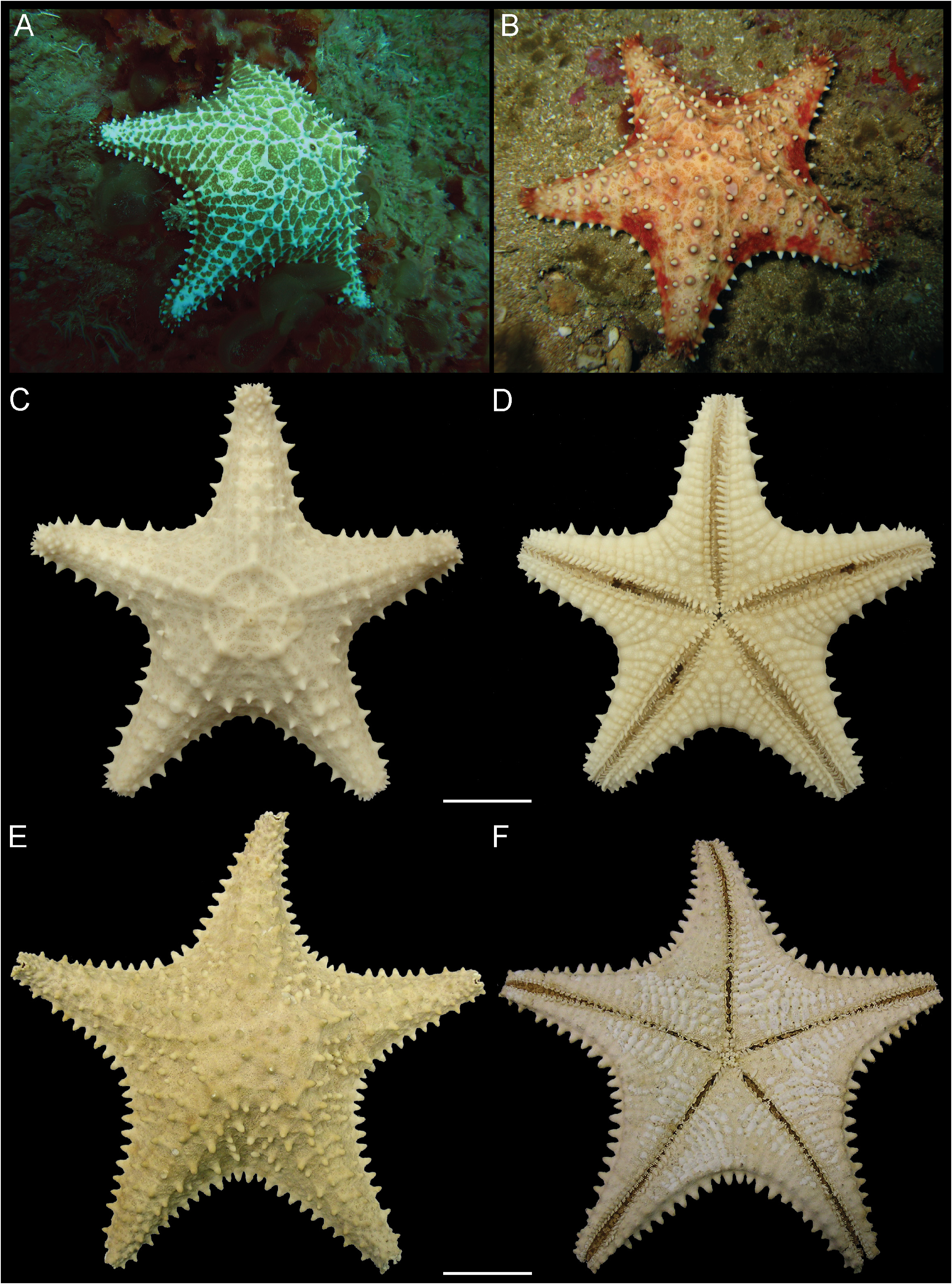
Description (R 98 mm). Body stellate, disc inflated; R / r 1.7 (Fig. 28 A – B). Five short arms, distally tapering (Fig. 28 E – F). Abactinal plates reticulate, connected by elongated and narrow secondary plates. Abactinal region with granules, large papular pores, and robust tubercles and spines with blunt tips. Madreporite small, subcircular, covered with shallow gyres. Superomarginal plates large, covered by granules and with a tubercle or a short, robust spine. Inferomarginal plates large, confined to actinal surface, covered by granules and with a tubercle; distal plates with a short and robust spine. Actinal surface with tumid plates covered by granules. Interradial actinal area large. Adambulacral plate with 5 – 6 unequal spines, spines on extremities smallest. One robust subambulacral spine. Oral plates with five pairs of robust, prismatic spines; inner pair shorter and wider than others. Tube feet in two rows, sucking disc with many perforated plates. Bivalve pedicellariae on both surfaces, more numerous in actinal region, never in alveoli. Ontogenetic variation (R 49 mm). R / r 1.9 (Fig. 28 C – D). Some of the abactinal primary plates form an elevated circle from which five rays radiate towards tip of arm (Fig. 28 C); this pattern was not observed in the larger specimen. Also, the small specimen has five unequal adambulacral spines (Fig. 29 H), being the proximal spine the smallest, and the third and fourth spines the largest, and the inner pair of spines in the oral plate is longer than the adjacent spines (Fig. 29 I). Finally, the small specimen has fewer abactinal spines than the largest specimen, which are mostly confined to arms and interradial region (vs. throughout abactinal region), and fewer pedicellariae in the actinal region (Fig. 29 E). Coloration. Specimens in vivo have beige to orange abactinal surface, beige to yellowish actinal region and sometimes red spots in the margins. Specimens in ethanol are beige to light brown.
Sumber: Taxonomy of the sea stars (Echinodermata: Asteroidea) from Bahia State, including ontogenetic variation and an illustrated key to the Brazilian species