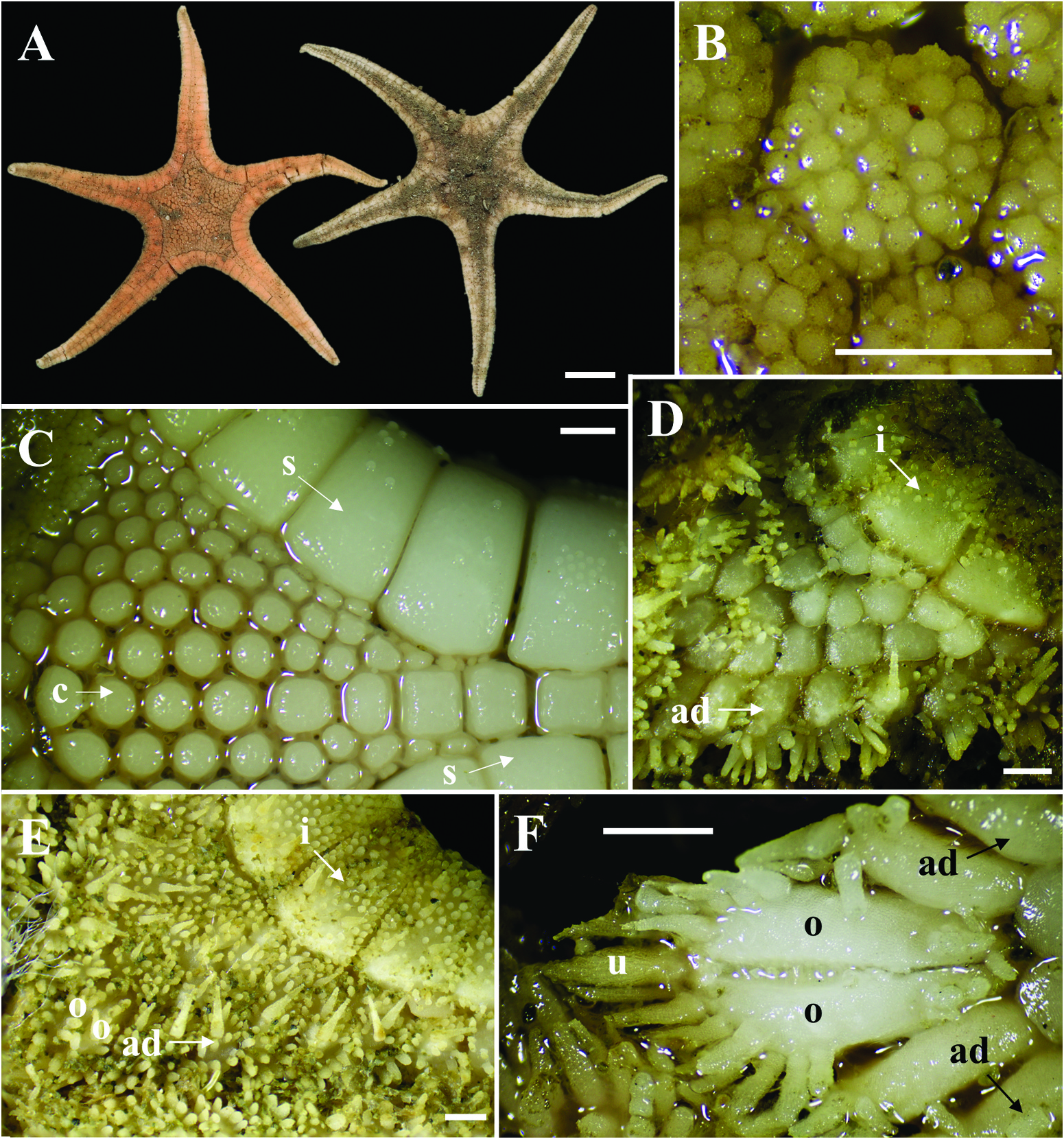
Description. Body stellate, flat (Figure 3 A). Arms five, broad proximally, gradually tapering to arm tips. R / r 3.6. Abactinal surface densely covered with numerous abactinal paxillae comprising abactinal plates and granules (Figure 3 B, C). Abactinal plates in two types, larger carinal and smaller lateral abactinal plates (Figure 3 C). Lateral abactinal plates mostly hexalobate, with cylindrical to prismatic paxillar columns, arranged in 5 – 6 regular longitudinal series on each side of arm. Paxillar columns wider than spaces between neighbouring paxillar columns. Adradial-most lateral abactinal series longest, extending to 29 % of R. Carinal abactinal plates on proximal 30 % of R, hexagonal with cylindrical paxillar columns and those on distal 70 %, rectangular with prismatic paxillar columns. Carinal abactinal plates arranged in one regular longitudinal series extending to arm tip, wedged between two superomarginal series in distal 71 % of R. Hexagonal carinal abactinal plates as narrow as length and gradually increase in width towards first rectangular plates. Rectangular carinal abactinal plates wider than length at first several plates but mostly narrower than length, gradually decreasing in width distally. Lateral and carinal abactinal plates bear mushroom-shaped granules without spines (Figure 3 B). Papular areas mostly contain one papula, every six surrounding one lateral abactinal plate (Figure 3 C). Madreporite single, round, convex, with radiated tortuous grooves, located at interradial disc. Supero- and inferomarginal plates wide rectangular with oblong to oval ridges and arranged in longitudinal series along body margin (Figure 3 A, C – E). Superomarginal plates gradually increase in width up to 3 rd – 4 th plates, and beyond these plates, gradually decrease in width distally (Figure 3 A, C). Inferomarginal plates gradually decrease in width distally (Figure 3 A, D). Supero- and inferomarginal series comprise 54 plates per interradius, without odd plates. Fascicular grooves narrow, shorter than ridges of neighbouring supero- and inferomarginal plates (Figure 3 C, D). Supero- and inferomarginal plates covered with mushroom-shaped granules and proximal to middle inferomarginal plates bear 1 – 5 conical spines arranged in one zigzag to two transverse series (Figure 3 E). Actinal plates oval to rectangular, convex, and arranged in three longitudinal series (Figure 3 D). Actinal series confined within 26 % of R. Each actinal plate bears mushroom-shaped to clavate granules and typically one major conical spine (Figure 3 E). Pedicellariae absent. Adambulacral plates oval and arranged in one longitudinal series along the ambulacral furrow (Figure 3 D). Adambulacral series comprises 44 plates, extending to arm tips. Each adambulacral plate bears 6 – 7 furrow spines arranged in longitudinal curved series, one major subambulacral spine on plate centre and 12 – 15 minor subambulacral spines on plate margin (Figure 3 D, E). Each pair of oral plates, forming jaw, bears one unpaired oral spine on its proximal edge (Figure 3 F). Each oral plate bears 25 – 28 oral spines arranged in three longitudinal series. Tube feet biserial, with suckered discs.