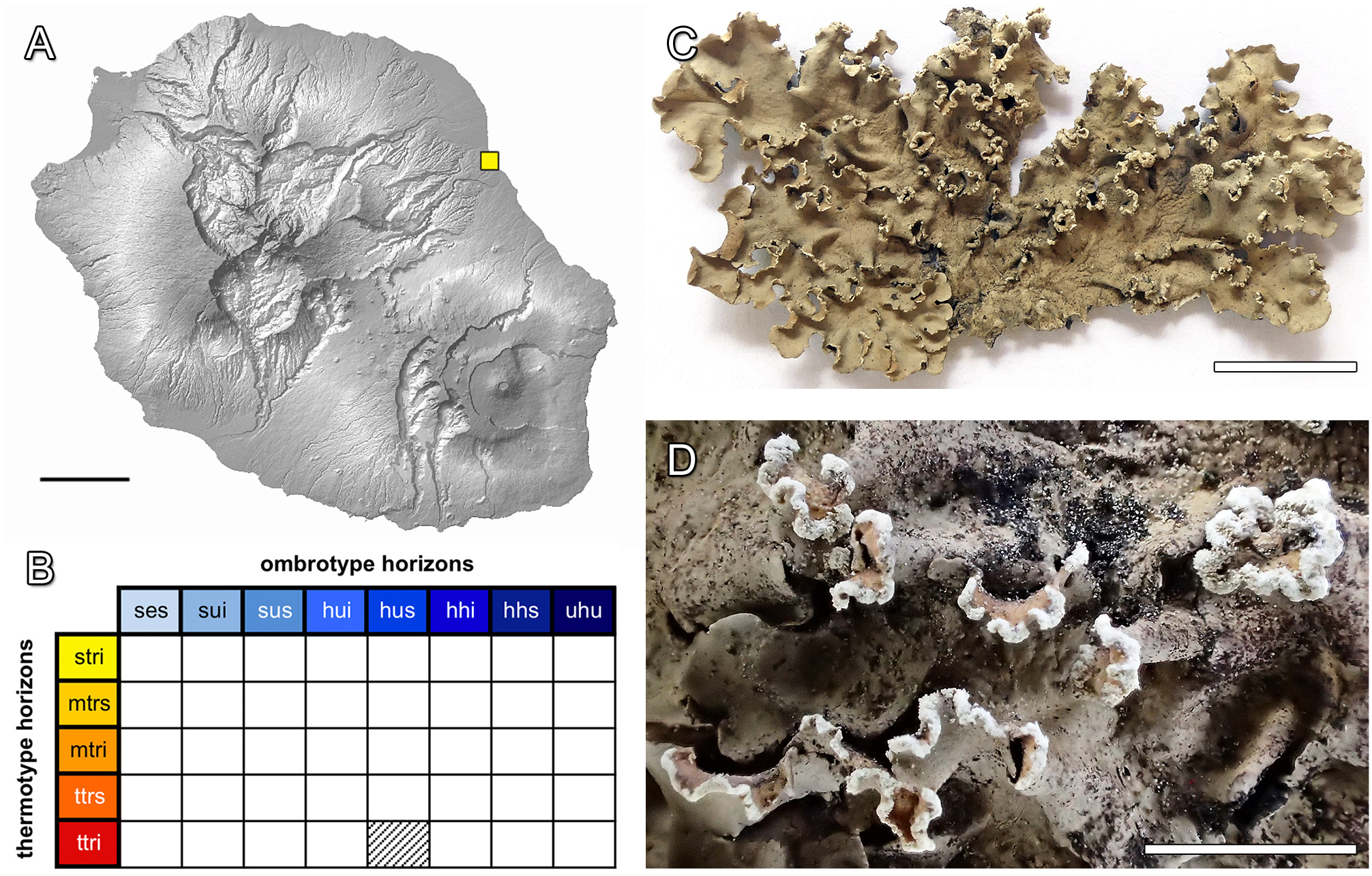
Ecology: — According to the literature, Parmotrema praesorediosum is corticolous or saxicolous (e. g. Krog & Swinscow 1981, Elix 1994, Divakar & Upreti 2005). On trees, the species can grow on twigs, branches, as well as on trunks (Martins & Marcelli 2011). It is found at low elevations in fairly dry, generally well-lit sites, often in areas disturbed by human activity, where it is sometimes considered a weedy species (Hale 1965 a, Smith 1993, Elix 1994, Lai 2001, Bungartz & Spielmann 2019). The species can be found on wind-exposed trees growing near the sea (Marcelli 1991); this is the case on Réunion at the only documented locality where P. praesorediosum was collected on smooth bark of several Pandanus utilis growing in a recreational area just near the sea. The bioclimatic features of this locality are: bioclimate: pluvial tropical, thermotype belt: lower thermotropical (It = 660), ombrotype belt: upper humid (Io = 11.8) (Fig. 34 B). Notes: — The two major aliphatic acids occurring in the medulla of Parmotrema praesorediosum were described as praesorediosic and protopraesorediosic by David et al. (1990). We were unable to identify these two acids with any certainty in the Reunionese specimens, as the TLC performed did not allow us to differentiate them from those of the constipatic acid group. Spot tests with K applied to the medulla and soralia of the specimens collected gave results ranging from a distinctly yellow colour to no reaction (Table 10), suggesting the occurrence of atranorin in variable concentrations in these anatomical structures. Hale (1971 a) distinguished P. mordenii (Hale) Hale from P. praesorediosum by its substrate ecology (saxicolous vs corticolous), the presence (vs absence) of atranorin in the medulla, and by some minor morphological differences (size of the lobes, size of the soredia, morphology of the soralia). In East Africa, Krog & Swinscow (1981) found no clear difference in medullary reactions and morphology between corticolous and saxicolous specimens, and therefore reduced P. mordenii to synonymy with P. praesorediosum. Some later authors did not accept their proposal (e. g. Spielmann & Marcelli 2009, Benatti & Marcelli 2010 b, Gerlach & Eliasaro 2012, Bungartz & Spielmann 2019), mainly because of the presence of atranorin in the medulla of P. mordenii, a feature considered diagnostic by these authors. The concentration of atranorin in the cortex of lichen thalli, including Parmotrema, was shown to vary with environmental factors (e. g. Armaleo et al. 2008, Shukla et al. 2015). The same may be assumed for medullary atranorin, which could explain the variability observed in Reunionese material, even between corticolous specimens (Table 10). Evidence of the existence of P. mordenii on Réunion is further complicated by the uncertainty surrounding the identity of the fatty acids present in its medulla. Hale (1971 a), Nash & Elix (2002) and Nash et al. (2016) reported caperatic and protolichesterinic acids. Marcelli & Benatti (2010) and Benatti (2014) reported caperatic, protolichesterinic, praesorediosic, protopraesorediosic and two undetermined acids. Flakus et al. (2014) reported the constipatic acid group, and Bungartz & Spielmann (2019) cited praesorediosic and protopraesorediosic acids. We were unable to identify the 2 − 3 fatty acids present in the Reunionese material by TLC, but they are neither caperatic acid nor protolichesterinic acid. We echo Benatti’s (2014) conclusion that indepth morpho-anatomical, chemical, molecular and ecological studies are needed to clarify the relationship between P. praesorediosum and P. mordenii. Lacking such studies, all the material collected on Réunion is assigned to P. praesorediosum. Unfortunately, we have not been able to study the DNA of specimens from Saint-Benoît, despite two attempts. Specimens examined: — FRANCE. Réunion: Saint-Benoît, Pointe du Bourbier, elev. 20 m, 21 ° 01 ’ 13 ” S, 55 ° 42 ’ 13 ” E, coastal recreational area with many Pandanus utilis, on bark of P. utilis, 11 June 2008, P. & B. van den Boom 40992 (Hb. van den Boom); ibid., 12 August 2013, D. Masson 974.4214, 974.4215 (Hb. DM); without locality, April 1989, G. Follmann & I. Follmann-Schrag s. n. (B).