
Biologi & Ekologieng
Habitat. Swamp, lowland, and mangrove forest.
Sumber: Cercopithecidae
Family Cercopithecidae · Order Primates
Data diperbarui secara berkala dari berbagai sumber observasi biodiversitas.
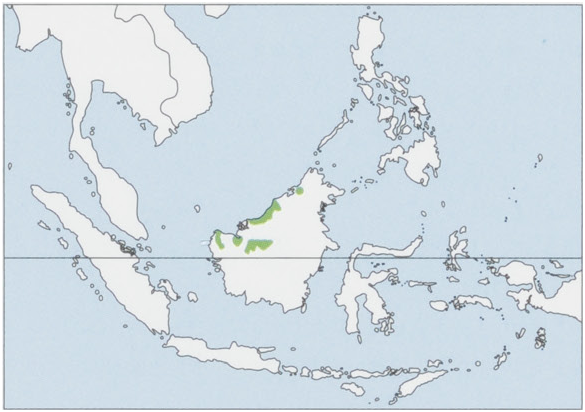
Foto: Russell A. Mittermeier;Anthony B. Rylands;Don E. Wilson
Otoritas penamaan: (Müller, 1838) (1838)
Status taksonomi: ACCEPTED
Status konservasi (IUCN): CR Kritis
Dipublikasikan dalam: Tijdschr. Nat. Gesch. Physiol. vol.5 p.138
Total Catatan di Indonesia
0
Provinsi Ditemukan
0
dari 38 provinsi
Catatan Pertama
0
tahun pertama tercatat
Tren Tahunan
-0%
-50.0% vs 1937
Bornean Banded Langur (Presbytis chrysomelas) termasuk dalam famili Cercopithecidae, ordo Primates, kelas Mammalia. Berdasarkan data yang terhimpun, spesies ini telah tercatat sebanyak 24 kali di Indonesia, tersebar di 1 provinsi. Catatan pertama tercatat pada tahun 1826.
Kalimantan Barat merupakan provinsi dengan catatan observasi terbanyak untuk spesies ini, dengan 10 catatan (41.7% dari total). Data distribusi ini mencerminkan akumulasi dari berbagai kegiatan survei, penelitian, dan kontribusi citizen science. Pola distribusi yang tercatat mungkin tidak sepenuhnya menggambarkan persebaran alami spesies, karena dipengaruhi oleh intensitas pengamatan di masing-masing wilayah.
Tren observasi tahunan Presbytis chrysomelas menunjukkan penurunan signifikan (-50%) pada periode terakhir dibanding tahun sebelumnya, dengan catatan pertama pada tahun 1826.
Catatan deskriptif tentang Presbytis chrysomelas dari sumber literatur primer (via GBIF).
Habitat. Swamp, lowland, and mangrove forest.
Sumber: Cercopithecidae
Movements, Home range and Social organization. The Cross-marked Langur has never been studied in the wild. It generally lives in groups of 3 - 7 individuals, with one male, 1 - 3 females, and their offspring.
Sumber: Cercopithecidae
Status and Conservation. CITES Appendix II. Classified as Critically Endangered on The IUCN Red Last, including both subspecies. The Cross-marked Languris legally protected in Sarawak. According to the published distributions, the Tricolored Langur occurs in Maludam, Similajau, and Tanjung Datu national parks and Samunsam Wildlife Sanctuary. It is also present in the Lingga area of Sarawak, which has been proposed as a protected area, and it may be found in Betung Kerihun National Park in Indonesia. A recent survey by K. Aken and J. W. Duckworth and colleagues has, however, reported that the Bornean Banded Langur, not the Tricolored Langur, occurs in Similajau National Park, so the respective distributions of the two subspecies (and perhaps their validity as distinct taxa) require further studies. According to its known and supposed distribution, the Bornean Banded Langur may occur in Lanjak-Entimau Wildlife Sanctuary in southwestern Sarawak near the border with West Kalimantan. The majority of the remaining populations are found in these areas, and the combined estimates for their numbers are very low, c. 200 - 500 individuals. Known populations of Cross-marked Langurs are believed to have been reduced by ¢. 80 % over the past 30 years, and certainly the area of occupancy has been reduced dramatically. It was once considered common, but now, after 100 years of intense persecution and habitat loss, it is among the rarest primates in the region, and among the rarest in the world. It occurs in less than 5 % ofits historical distribution. In recent years, it has been particularly affected by expanding plantations, particularly oil palm. Additional conservation measures are urgently needed. The Crossmarked Langur could soon go extinct if current trends continue.
Nama-nama ilmiah lain yang pernah digunakan untuk Presbytis chrysomelas dalam literatur taksonomi.
| Nama Sinonim | Otoritas | Status |
|---|---|---|
| Presbytis femoralis chrysomelas | (Müller, 1838) | SYNONYM |
| Semnopithecus chrysomelas | Muller, 1838 | HOMOTYPIC_SYNONYM |
| # | Provinsi | Catatan | % |
|---|---|---|---|
| 1 | Kalimantan Barat | 10 | 41.7% |
Jumlah catatan observasi Presbytis chrysomelas di Indonesia per tahun
Presbytis chrysomelas
Foto: Russell A. Mittermeier;Anthony B. Rylands;Don E. Wilson
Presbytis chrysomelas
Foto: Russell A. Mittermeier;Anthony B. Rylands;Don E. Wilson
| Nama | Bahasa | Sumber |
|---|---|---|
| Bornean Banded Langur | Inggris | Catalogue of Life |
| Cross-marked Langur | Inggris | Cercopithecidae |
| Goudkleurige Langoer | Belanda | Catalogue of Life |
| Langur Mitrado | Spanyol | Catalogue of Life |
| Langur de Bornéo | Prancis | Cercopithecidae |
| Langur de Sarawak | - | Cercopithecidae |
| Presbite del Sarawak | Italia | Catalogue of Life |
| Red-banded Langur | Inggris | Catalogue of Life |
| Sarawak Langur | Inggris |
Berdasarkan data 24 observasi, Kalimantan Barat adalah provinsi dengan catatan Bornean Banded Langur (Presbytis chrysomelas) terbanyak — 10 observasi (41.7% dari total catatan di Indonesia). Spesies ini tersebar di 1 provinsi.
Catatan pertama Bornean Banded Langur (Presbytis chrysomelas) di Indonesia tercatat pada tahun 1826. Hingga kini terdapat 24 catatan dari 1 provinsi, yang dihimpun dari survei lapangan, koleksi museum, dan platform citizen science.
Menurut IUCN Red List, Bornean Banded Langur (Presbytis chrysomelas) berstatus "Kritis" (kode CR). Status ini mencerminkan tingkat risiko kepunahan global spesies, bukan khusus Indonesia.
Ya, Presbytis chrysomelas memiliki 2 nama sinonim ilmiah, di antaranya: Presbytis femoralis chrysomelas, Semnopithecus chrysomelas. Nama sinonim adalah nama-nama lain yang pernah digunakan untuk spesies yang sama dalam literatur taksonomi.
Presbytis chrysomelas diklasifikasikan sebagai berikut: Kingdom Animalia, Phylum Chordata, Class Mammalia, Order Primates, Family Cercopithecidae, Genus Presbytis. Spesies ini dideskripsikan oleh (Müller, 1838).
Sumber: Cercopithecidae
Descriptive notes. Head — body 43 - 61 cm, tail 61 - 84 cm; weight 5.9 - 8.2 kg. Forehead whorls of the Cross-marked Langur, of which there is nearly always a pair, are very small and nearer the brow than in other langur species. Crest is high, upstanding, and narrow, and there is no defined fringe over eyes. There is a U-shaped parting on nape rather than a restricted whorl. Chest hairs are directed backward, meeting forward-directed belly hairs in a ridge. The “ Bornean Banded Langur ” (P. c. chrysomelas) is quite variable but generally jet-black above (sometimes with a few brown hairs on back). Underside is pale whitish or fawn, the tone extending to cheeks, chin, wrists, lower thighs, and ventral surface of tail. Cheeks are brown-gray to white. The “ Tricolored Langur ” (P. c. cruciger) is mainly brown, with a white or creamy-fawn underside (latter tone extending to wrists, ankles, and tail tip). Forehead whorls are relatively elongated, and crest is low. There is also a strikingly different and fairly common “ crossbearing ” morph, in which the characteristic black cross pattern of infants is retained into adulthood. Legs, flanks, and crown are bright red. The isolated population found in south-eastern Sarawak has a less sharp dividing line between the black dorsum and red flanks, a dull creamy underside rather than white, and the chest is a more pronounced red. Black patches on knees are also more conspicuous and there is always black patching on shanks. There are two small whorls on the forehead, with a tall crest between them.
Sumber: Cercopithecidae
Subspecies and Distribution. P. c. chrysomelasS. Miller, 1838 — WBorneo, fromtheIVDivisioninWSarawak, StotheKapuasRiverinWKalimantanProvince. P. c. cruciger Thomas, 1892 — N Borneo, from Melalap in Sabah State to the Baram District in N Sarawak.
Sumber: Cercopithecidae
Conservation: CITES – Appendix II; IUCN – Data Deficient as Presbytis femoralis chrysomelas and P. f. cruciger.
Sumber: Order Primates
| Cercopithecidae |
| Sarawak Surili | Inggris | Mammal Species of the World |
| Sarawak Surili; Bornean Banded Langur (chrysomelas) | Inggris | Cercopithecidae |
| Sarawak-Langur | Jerman | Catalogue of Life |
| Semnopithèque chrysomèle | Prancis | Catalogue of Life |
| Tricolored Langur | Inggris | Catalogue of Life |
| Tricolored Langur (crucigen | Inggris | Cercopithecidae |
| crucigen | Inggris | Cercopithecidae |
| langur sarawaski | pol | Catalogue of Life |
| surili de Sarawak | Spanyol | Catalogue of Life |
| Саравакский сурили | rus | Catalogue of Life |
| لنغور ساراواك | ara | Catalogue of Life |
11 titik observasi Presbytis chrysomelas di Indonesia
Memuat peta...
Setiap titik merepresentasikan satu lokasi observasi yang tercatat. Klik titik untuk melihat detail.