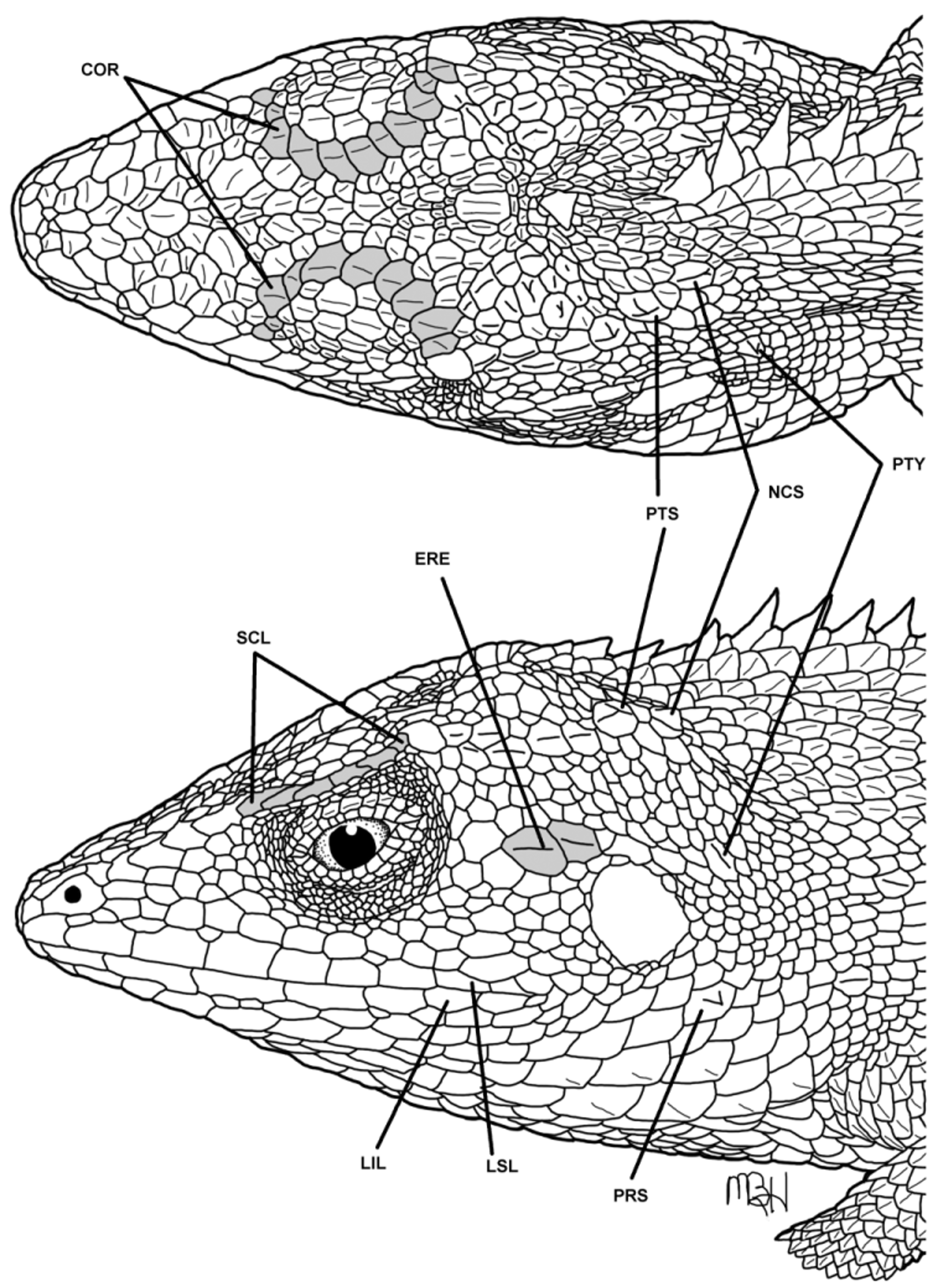
Description. Males reaching at least 310.0 mm (SVL 93.7 mm, n = 8) and females 251.8 mm (SVL 79.7 mm, n = 5) in length; smallest juvenile 72 mm (SVL 25 mm, n = 2); SVL 30.2 – 32.7 % (31.3 ± 0.7, n = 13) and tail 67.3 – 69.8 % (68.7 ± 0.7, n = 13) of total length; tail 2.05 – 2.31 X (2.20 ± 0.07, n = 13) as long as SVL; distance from axilla to groin accounting for 43.5 – 52.2 % (47.7 ± 2.4, n = 13) of SVL; head 60.5 – 76.2 % (69.7 ± 4.3, n = 12) as wide as long, accounting for 22.0 – 27.2 % (24.3 ± 2.0, n = 12) of SVL; snout subacuminate in dorsal view and in profile, sloping upward at about 30 ° to horizontal; dorsal head scales imbricate, keeled; rostral wider than mental, about three times as wide as tall, contacting postrostral series and first supralabials; postrostrals small, usually five (80 %, n = 15), rarely four (7 %, n = 15) or six (13 %, n = 15); postrostral series separating nasal from rostral; occasionally (20 %, n = 30), extra scale intercalated between postrostral and nasal; in prefrontal region, 2 – 3 larger scales at midline followed by pair of laterally positioned enlarged scales in front of orbits (arrangement of enlarged scales forming an inverted Y); scales of frontal and parietal region small, keeled; key-hole shaped depression in interparietal region better developed in larger specimens due to hypertrophy of the jaw muscles; interparietal scale heptagonal, about twice as long as wide, usually with two parallel keels, distinctly flatter and 2 – 3 X as long as small scales surrounding it; parietal eye not visible; supranasal scale single, elongate; circumorbital scales 9 – 13 (11 ± 1, n = 30) distinctly enlarged, roughly pentagonal or hexagonal, fractured into smaller scales where they contact canthal series; canthals keeled, 5 (37 %, n = 30) or 6 (63 %, n = 30); supraciliaries 4 – 7 (usually 5, n = 30), elongate except for last one or two; 1 / 1 large swollen and heavily keeled to subpyramidal scale behind supraciliaries at dorso-posterior edge of orbit, broadly contacting last circumorbital; angulate, keeled scale of temporal region interrupted by 3 – 5 larger scales with noticeably higher keels in line with scale at dorso-posterior border of orbit or slightly below that position; one (45 %, n = 16) or two (55 %, n = 16) enlarged, subpyramidal to heavily keeled posttemporal scales on neck just behind bulge produced by hypertrophy of the jaw muscles, first of these in line with enlarged temporals; similar enlarged modified nuchal scale separated from posttemporal scales by 1 – 3 small dorsals and positioned closer to nuchal crest in 4 th – 6 th paravertebral row. Nasal trapezoidal, separated from supralabials by small lorilabials (7 %, n = 30) or contacting first (70 %, n = 30) or first and second (23 %, n = 30) supralabials; nostril large, oval, directed laterally, positioned at dorsal edge in center of nasal with its upper margin contributing to canthus; distance from posterior border of nostril to anterior ocular angle 36.4 – 43.7 % (39.6 ± 2.3, n = 11) of head length; loreal region vertical; scales of loreal region weakly keeled; eye 15.8 – 27.8 % (22.2 ± 4.0, n = 10) of head length; palpebrals granular, showing noteworthy differentiation in two places: (1) second row of palpebrals above eye with 4 – 7 heavily keeled scales in center, and (2) patch of thin scales, cream with melanic centers forming opaque window in lower eyelid; lower margin of orbit separated from supralabials by one small and one larger row of scales; large subocular scale row bordering supralabials; row of one (3 %, n = 30), two (43 %, n = 30), three (50 %, n = 30) or four (3 %, n = 30) distinctly enlarged, keeled, roughly hexagonal scales between tympanum and orbit, followed by one or two smaller though similarly heavily keeled scales above tympanum; tympanum subcircular, superficial (i. e., not sunken into external auditory meatus), 12.7 – 16.3 % (15.3 ± 1.1, n = 10) as long as head and 51.7 – 103.3 % (71.3 ± 17.2, n = 10) as long as ocular aperture, its distance from orbit 21.5 – 27.1 % (24.5 ± 1.9, n = 10) of head length; tympanic membrane clearly visible, opaque where it attaches to extracolumella, its antero-ventral one-fourth to one-eighth semitransparent, though heavily speckled with melanophores; scales surrounding meatus small, weakly keeled, triangular; prominent posttympanic subpyramidal scale (doubled on both sides of some specimens) separated from tympanum by three or four scales and positioned above similar much larger, heavily keeled postrictal scale. Supralabials weekly keeled, seven (1 %, n = 30), eight (43 %, n = 30), nine (43 %, n = 30) or ten (10 %, n = 30); infralabials smooth, seven (30 %, n = 30), eight (60 %, n = 30), or nine (10 %, n = 30); two (7 %, n = 30), three (20 %, n = 30), four (60 %, n = 30), or five (13 %, n = 30) enlarged postmentals contacting infralabials; thereafter, sublabial scales separating enlarged postmentals from infralabials; first pair of postmentals in contact medially (100 %, n = 8); gulars feebly keeled, 17 – 25 (20 ± 2, n = 15) from posterior tip of mental to preaxial margin of arm; gular pouch well developed, longitudinal; scales of distal edge of gular pouch much smaller than very large gulars at level of tympanum (only about one-tenth size of large gulars lateral to them). Nuchal crest consisting of 9 – 13 (10 ± 1, n = 15) elongate scales separated from one another by much smaller, short scales, similar in size to paravertebrals; dorsal crest prominent in males, serrate with all scales projecting; scales of dorsal crest flattened, triangular, 26 – 33 (30 ± 2, n = 15) to posterior margin of thigh; posterior to midbody, scales of crest only slightly projecting in females; both nuchal and dorsal crests low in juveniles; scales of dorsal crest not separated from one another by small scales of paravertebral series except as occasional anomalies; scales of dorsal crest separated from nuchal crest by gap of 4 – 7 (6 ± 1, n = 15) low, keeled dorsals; dorsals smaller than ventrals, paravertebral three or four longitudinal rows pointing posteriorly and upward, remaining dorsals directed downward and posteriorly (Fig. 5); orientation of scales on neck same as that between limbs; scales of flanks feebly keeled, heterogenous with some enlarged heavily keeled scales scattered among smaller feebly keeled scales; dorsolateral row of widely spaced, heavily keeled scales located in eighth or ninth row of dorsals below dorsal crest; dorsolateral keeled scales usually six (64 %, n = 28) or seven (32 %, n = 28), rarely 8 (4 % each, n = 28) between limbs, separated from one another by 2 – 7 feebly keeled dorsals; dorsolateral series of heavily keeled scales extending in front of arm as 2 – 6 large keeled scales contacting one another or separated by one or two smaller, weekly keeled scales (one specimen with five scales separating the first keeled scales of series from two others); all specimens with single spinose or heavily keeled and enlarged scale on lower neck in front of arm; scales around midbody 51 – 65 (58 ± 4, n = 15); no sharp transition to ventrals so that ventrals in a transverse row not countable; ventrals smaller in area between arms, 33 – 43 (39 ± 3, n = 15) from preaxial edge of arm to preaxial edge of leg; preanal scales keeled, similar to, though somewhat smaller than ventrals, 7 – 10 (8 ± 1, n = 15) from preaxial edge of leg to vent; scales around vent unspecialized; scales around base of tail (counted five subcaudals behind vent) 15 – 22 (18 ± 2, n = 15); except for very short rictal fold, folds and pockets absent. Scales of brachium, antebrachium, thigh, and shank imbricate, keeled; on thigh, two enlarged scales with more developed, somewhat blade-like, keels positioned slightly postaxial to middorsal, larger of two in center of thigh, second one positioned more postaxial and distal to it; keels on dorsal surface of thigh pointing distally, except for these two enlarged scales where keels point about 15 ° postaxial to distal; palmar scales very small, keeled with spinose mucrons; palmar subdigital lamellae bicarinate with spinose mucrons, proximal two or three divided or multicarinate at bases of Fingers III – V, 22 – 29 (25 ± 2, n = 15) under Finger IV; plantar scales heavily keeled, mucronate, imbricate, those proximal to Toes III – IV noticeably larger than other plantar scales; pedal subdigital lamellae bicarinate, their keels similar except at base of Toe III where preaxial keel much larger than postaxial keel and postaxial keels entirely absent on some lamellae in this region; digital lamellae 24 – 30 (27 ± 2, n = 15) under Toe IV, divided longitudinally under proximal phalangeal articulations of Toes III and IV, entire under all other phalangeal articulations; subdigital lamellae subequal in size and bicarinate under distal phalanges of all fingers and toes; on each digit, single subdigital and single supradigital ungual lamellae contacting one another; ungual lamellae much longer than other subdigital lamellae; proximal to the ungual scales, supradigital scales four; in relative length, Finger III> IV> II> V> I and Toe IV> III> V> II> I; when adpressed, tip of claw on Toe V not reaching proximal phalangeal articulation of Toe IV; leg relatively long, 43.5 – 52.2 % (47.9 ± 2.4, n = 14) as long as SVL; length of foot accounting for 36.9 – 41.0 % (38.6 ± 1.3, n = 13) of length of leg. Scale surfaces covered in macrohoneycomb; scale organs lenticular, single and positioned subterminally atop keel on body (dorsal and ventral surfaces), more numerous and also concentrated on keels on head; prominent bristled sense organs single, positioned below distal tip of keel, well developed on scales of digits, distal antebrachium and shank, and base of tail, absent from dorsal body and head; at least some scales with both types of sense organs on same scale; callous glands, pigmented generation glands (sensu Maderson and Chiu, 1970), and femoral and precloacal pores absent. Coloration: In life, head, body, limbs, and tail bright green with darker markings; few scales (without regular pattern) on head and body dark brown; scales of gular pouch green grading to sky blue with green apexes medially; skin of pouch bright purplish blue so that throat appears to have oblique purplish blue stripes when pouch partially extended; postrictal and posttympanic modified scales partially to almost entirely bluish white; most of tympanum same shade of green as rest of head and body, its antero-ventral margin bluish white; eyelids yellow green, contrasting with green on side of head; iris uniform light gold with pale ciliary ring; buccal epithelium orange; throat and roof of mouth black; dorsolateral series of heavily keeled scales green proximally, their keels, distal edges, and apexes white to sky blue; heavily keeled scales of dorsolateral series on neck mostly or entirely green; bluish white ventrolateral stripe one scale row wide, extending from arm to leg usually present; bluish white postfemoral stripe, extending from middle of thigh onto base of tail above cloaca; some heavily keeled scales along postaxial margin of antebrachium with bluish white keels and apexes; digits banded dark and light green; limbs apparently capable of developing bands; limbs, tail, and vertebral region capable of color change to shades of brown; caudal bands 11 – 15 (13 ± 1, n = 9), indistinct near base of tail and becoming bold distally; caudal bands dark and light green to black and light green proximally, usually darker bands grading to brown with black edging and light green bands grading to grayish cream, often with black blotch positioned vertebrally in center of band; ventral head, body, limbs, and proximal portion of tail distinctly lighter shade of green than dorsum; soles and palms charcoal. In preservative, dorsum faded to light bluish gray and venter pale blue; bluish white markings still evident; lower flanks blackened in all specimens; proximal caudal bands difficult to distinguish.