Biologi & Ekologieng
Habitat. Greater One-horned Rhinos flourish in what are arguably the world’s tallest grasslands, in protected areas along the main river systems in the lowlands of the Himalayas. The rhinos generally avoid upland Shorea robusta forest, a dominant forest type, except during monsoon inundations, when these forests serve as temporary refugia. Oxbow lakes and other water features are important for wallowing and feeding on aquatic plants; this species is rarely found more than 2 km from water.
Sumber: Rhinocerotidae
Biologi & Ekologieng
Movements, Home range and Social organization. In prime habitat, adult females rarely travel more than 5 km during a 24 hour period in any season. Adult breeding males travelled slightly longer distances during a 24 hour period. Their movements were sufficient to allow them to cover most of their core areas of occupancy in a few days. Rarely does this species venture farther than 2 km from the river’s edge or another source of water. Translocated animals wandered over long distances (sometimes more than 25 km) before establishing a permanent home range. Home range data for radiocollared individuals revealed that Greater One-horned Rhinos may have the smallest annual and seasonal home ranges of any large herbivore. Annual home ranges of breeding females averaged 3 - 5 km? *; males’ ranges were only only 4 - 3 km ®. The smallest home ranges were recorded for females during the monsoon, two females occupying core areas of only 22 ha and 28 ha, respectively. Females congregate in areas of excellent grass forage close to river banks. Males are notstrictly territorial, but form dominance hierarchies and attempt to defend areas where females congregate. Subadult males sometimes group together on the fringes of the best grazing areas. Adult males frequently fight, often resulting in serious injury and sometimes death.
Sumber: Rhinocerotidae
Konservasieng
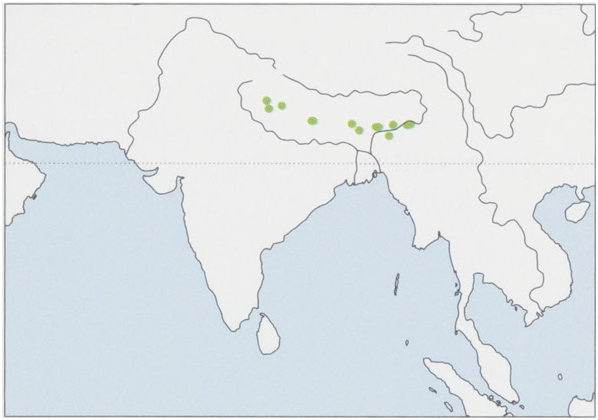
Status and Conservation. CITES Appendix I. Classified as Vulnerable on The IUCN Red List. The Greater One-horned Rhino was once to be found right across the northern part of the Indian subcontinent, its range taking in the Indus, Ganges, and Brahmaputra river basins, and extending from Pakistan to the Indo-Burmese border, including parts of Nepal, Bangladesh, and Bhutan. It is also possible that it existed in Myanmar, southern China and Indochina, though this is unconfirmed. Common in north-western India and Pakistan up to about 1600, the species vanished from the region not long after that date. From 1600 to 1900 it suffered a sharp decline in numbers in the rest of its range, coming close to extinction at the start of the 20 " century. The number of populations (13) and the total global population of this species (now approaching 2700 individuals) have climbed steadily over the past two decades. Intensive translocation efforts since 1984 and natural dispersal have expanded the western populations from the single source population, Chitwan, in Nepal, to two other reserves in western Nepal and three in India. Translocations from some of the smaller reserves in Assam and Bengal are also underway. Despite these accomplishments, only two populations currently contain more than 100 individuals, Kaziranga, with about 2000 rhinos, and Chitwan, with about 420. In some parts of the range, poaching has been intense. All of the 85 animals translocated to the Babai Valley in Bardia National Park were poached during the ten-year Maoist insurgency that ended in 2008. A small population remains in another part of Bardia and Sukla Phanta. Nevertheless, this species is much better off than the other two Asian species. Its recovery is still in question because populations occupy what could become prime agricultural habitat (floodplains), and the species still faces intense poaching pressure for its body parts. Nevertheless, the increases in Chitwan and Kaziranga and the establishment of new populations provide some of the best evidence that large, slow-breeding mammals can still undergo rapid expansion. This offers hope for the restoration of other endangered large mammals if they enjoy similar efforts at protection.
Sumber: Rhinocerotidae
Deskripsieng
Descriptive notes. Head-body 335 - 346 cm, tail 66 cm, shoulder height 175 — 200 cm; weight of adult males ¢. 2000 kg; females less. Few data exist on body mass of wild individuals. Males born in zoos are often more than 25 cm taller at the shoulder and considerably larger in mass than females. Like other perissodactyls, wild adult males and females show near monomorphism. Reduced size dimorphism in free-ranging animals may be explained by greater stress on males, and poor nutrition during the long non-breeding interval, when young adults are harassed by dominant males and excluded from prime grazing areas. Adult males develop longer mandibular incisors (tusks) and greater neck musculature than females. The lower outer incisors are 4 - 5 cm long, more than 3 cm at the base (females) and longer in males (if entire, 5: 1.8 - 9 cm) or often broken. Long incisors (rather than horns), powerful neck and shoulder muscles, and extensive neck and shoulder skin folds figure prominently in fights and displays between breedingage males. The incisors are formidable offensive and defensive weapons, and are used rather than the horn in combat. Horn length averages 25 cm in adult males and 24 cm in adult females, but females often have longer (though slightly narrower) horns than the males that breed with them. Horn wear in adult males is common. This species has two distinct skin folds that drape over the sides of the front and hindlegs. Deep scars on anal folds, extra skin folds known as epidermal knobs, cuts on the ears, and missing tail tips allow for easy recognition of adults. Hair is limited to fringes ofears, eyelashes, and tail tip. Body color is gray and a mosaic-like pattern on the skin is quite noticeable on rump. Pedal scent glands are present.
Sumber: Rhinocerotidae
Distribusieng
Distribution. Nepal and India.
Sumber: Rhinocerotidae
Deskripsideu
R. cornu unico conico. Syst. nat. 11. n. 1. Rhinoceros. Jonst. quadr. 98. t. 38. Bont. jav. 50. t. 51. Bergen. orat. 1746. t. 1. Gesn. quadr. 842. Aldr. bisulc. 878.
Sumber: Systema Naturae per regna tria naturae: secundum classes, ordines, genera, species, cum characteribus, differentiis, synonymis, locis