Biologi & Ekologieng
Habitat. Wet forests, parkland, and dense primary montane forests to elevations of 2200 m. The Southern Purple-faced Langur is found in low and middle elevation rainforests, plantations, and home gardens with adequate canopy cover. The Western Purple-faced Langur is found in low-elevation tropical rainforest, with refugee populations in semi-urban and rural home gardens, rubber plantations, and any areas with groves of trees and adequate canopy cover. The Highland Purple-faced Langur occurs in montane tropical rainforest. The Northern Purple-faced Langur occurs in dry evergreen and deciduous forests, restricted to moister areas with closed canopy and permanent water sources in dry-zone forests. In the southern part ofits distribution near Galle, the Southern Purple-faced Langur forages on rocky, treeless coastal slopes.
Sumber: Cercopithecidae
Biologi & Ekologieng
Movements, Home range and Social organization. Purple-faced Langurs generally live in small unimale-multifemale groups that average 8 - 4 individuals, with 3 - 5 females and their offspring. Multimale-multifemale groups have been observed in the Western Purple-faced Langur. Groups as large as 20 individuals have been recorded, butrecent (2007) range-wide surveys of the Western Purple-faced Langur found that groups were small in many areas, averaging 4 - 4 (range 1 - 10, n = 9) — believed to result from deforestation and hunting. Unimale-multifemale groups of Highland Purple-faced Langur average 8 - 9 (range 3 - 14, n = 27), and those of the northern and eastern subspecies, the Northern Purple-faced Langur, average 8 - 4 individuals (range 3 - 14, n = 33). They occupy small home ranges, and males are very territorial, giving spectacular displays of dropping leaps accompanied by loud harsh calls and “ whooping ” to advertise their residency when they meet other males. Home range sizes are 0 - 9 - 8 - 6 ha (average 3 - 1 ha) for bisexual groups of Southern Purple-faced Langurs and 1 - 1 - 10 - 9 ha (average 5 - 8 ha) for Highland Purple-faced Langurs. Two groups of Western Purplefaced Langurs in semi-urban landscapes occupied areas of 3 - 9 ha and 9 - 6 ha. Males disperse and live in predominantly all-male groups. Male group takeovers are violent, and a successful male expels resident males and subadults and juveniles and kills the infants. Subadults and juveniles join the predominantly male groups, which are nonreproductive and notat all cohesive; they generally occupy marginal habitats, degraded with low and disrupted canopies. In one case, a female with an older infant left the group when a new male entered and stayed with the deposed male until her infant was fully grown. Male tenure of a heterosexual group lasts c. 3 years. Females will mate with subadult males, which is largely tolerated by the alpha male — presumably such matings are non-conceptive.
Sumber: Cercopithecidae
Konservasieng
Status and Conservation. CITES Appendix II. Classified as Endangered on The [UCN Red List (as Trachypithecus vetulus), including the subspecies vetulus, philbricki, and monticola, but the subspecies nestor is classified as Critically Endangered. The Purple-faced Langur is threatened by hunting and is particularly sensitive to deforestation. The Western Purple-faced Langur has been severely affected by the almost total loss of forest in the Sri Lankan Wet Zone. All subspecies have small distributions and have suffered major declines in numbers over the last 20 years through the fragmentation and degradation of their forests. In the absence of hunting, however, their ability to adapt to human-modified landscapes is astonishing. They make use of electricity pylons, powerlines (electrocution is frequent), roof tops, and fences in mosaics of tea plantations, rice paddy, rubber plantations, cinnamon and cardamom plots, and home gardens to move through their home ranges and to find food and sleeping sites. Sometimes Purple-faced Langurs are forced to use the ground and run the risk of being killed by dogs or caughtto be reared as pets. Antagonism toward Purple-faced Langurs is high when they raid home gardens and destroy rooftiles. Feeding on garbage is also a threat because food waste is undoubtedly unhealthy for them and a means of disease transmission. Surveys have shown that more than 50 % of the population of Western Purple-faced Langurs now comprisesisolated pockets of one or two groups in matrices of urbanized landscapes, village settlements, fields, and plantations. Their crop raiding means that conflict with humansis prevalent, even though they are generally not hunted. Thissituation cries out for proactive management and conservation measures such as improving the management of existing protected areas, creating new protected areas, and mitigating the discomfort of humans and langurs when they are in such close and constant contact. Purple-faced Langurs occur in a number of protected areas including Angamedilla, Flood Plains, Horton Plains, Kaudulla, Madura Oya, Minneriya-Giritale, Moragasawe, Somawathie, Udawalawe, Wasgamova and Wilpattu national parks; Anuradhapura, Kitulgala, Kurulukale, Mihintale, Peak Wilderness, Polonnaruwa, and Rantembe sanctuaries; Hakgala and Ritigala nature reserves; and Dombaghakanda and Knuckles forest reserves. Ingiriya Forest Reserve is an important refuge for the Western Purple-faced Langur. The two largest forests remaining in the distribution of the Purple-faced Langur surround two reservoirs, Kalatuawa and Labugama, which supply water to Colombo, the country’s capital. These forests encompass 2100 ha, part of which have already been turned into pine plantations. Preservation of these forests should be a very high priority in any conservation strategy on behalf of the Purple-faced Langur.
Sumber: Cercopithecidae
Deskripsieng
Descriptive notes. Head-body 50 - 65 cm (males) and 45 - 60 cm (females), tail 67 — 85 cm (males) and 62 - 82 cm (females); weight 3.4 - 9.4 kg (males) and 3.8 - 9.3 kg (females). The Purple-faced Languris generally brown or blackish-brown, with a whitish throat, interramal region (under the chin), and tail. Tail has a gray or white triangular patch at its root. Face is purplish-black (not actually purple) and lined with a ridge of black fur on forehead. In adults, there are long, pale, backswept, white (sometimes brown-tipped) cheek whiskers, contrasting with a brownish crown. Females have a white pubic patch. The “ Southern Purple-faced Langur ” (S. v. vetulus) is small and sexually dimorphic. Its fur is generally grayish-black, with whitish-brown on lower back, haunches, and distal part oftail. Its head is brown or grayish-brown, contrasting with its body. Its cheek whiskers are also grayish-brown and only cover lower half of ears. The “ Western Purple-faced Langur ” (S. v. nestor) is a somewhat small, pale form, with little or no sexual dimorphism. Its back and sides are predominantly grayish-brown, rump is silvery-gray, forearms and shanks are nearly black, and crown and nape are pale brown. Its tail is slightly tufted at its tip. The “ Northern Purple-faced Langur ” (S. v. philbricki) is a brown form, very like the Western Purple-faced Langur, exceptit has a less conspicuous rump patch. Lower parts of limbs are black, and tail tip is pale tawny or white and untufted. Its cheek whiskers are very long. The “ Highland Purple-faced Langur ” (S. v. monticola) is a large, robust, montane subspecies. Its fur is thick and brown, with only slightly contrasting crown and rump patch. Its cheek whiskers are long and white, and they hide its ears. Its tail is notably short. A population of the Southern Purple-faced Langur was recently discovered in the districts of Galle and Matara in far south-western Sri Lanka that has extraordinary and beautiful variations in pelage color and patterns, with different extents and patterns of white; they are collectively called “ white-color morphs. ”
Sumber: Cercopithecidae
Distribusieng
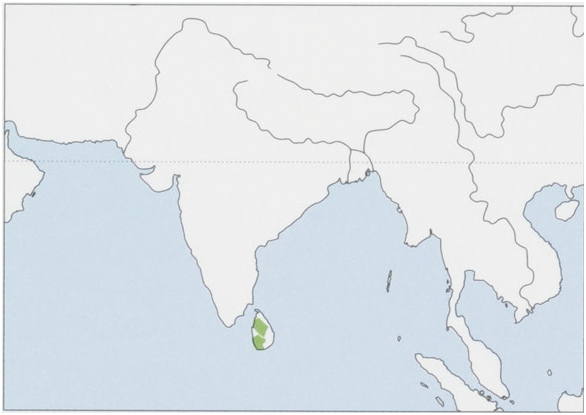
Subspecies and Distribution. S. p. vetulusErxleben, 1777 — SWSriLanka (WetZone), fromKaluRiverStoRama, toanelevationof 1000 m; thedistributionislessthan 5000 km?. S. p. monticolaKelaart, 1850 — MtsofCSriLankaatelevationsof 1000 - 2200 m. S. p. nestorBennett, 1833 — WSriLanka (WetZone), NoftheKaluRiveratelevationsupto 1000 m. S. p. philbricki Phillips, 1927 — N & E Sri Lanka (Dry Zone) up to elevations of 1500 m in E Matale and Madulkele Hills.
Sumber: Cercopithecidae