Deskripsieng
Associated mysid species. Of the 23 species found with S. distinguenda, only 4 co-occurred regularly. Anisomysis laticauda was present in 11 of the 14 samples, Pseudanchialina inermis in 10, Doxomysis acanthina Talbot, 1997 in 9 and Anisomysis incisa W. M. Tattersall, 1936 a in 8. Habitat. Pelagic, sublittoral in coral reef areas.
Sumber: A survey of Mysida from the Lizard Island area, Great Barrier Reef, Australia, Subfamily Siriellinae (Crustacea, Mysida, Mysidae)
Deskripsieng
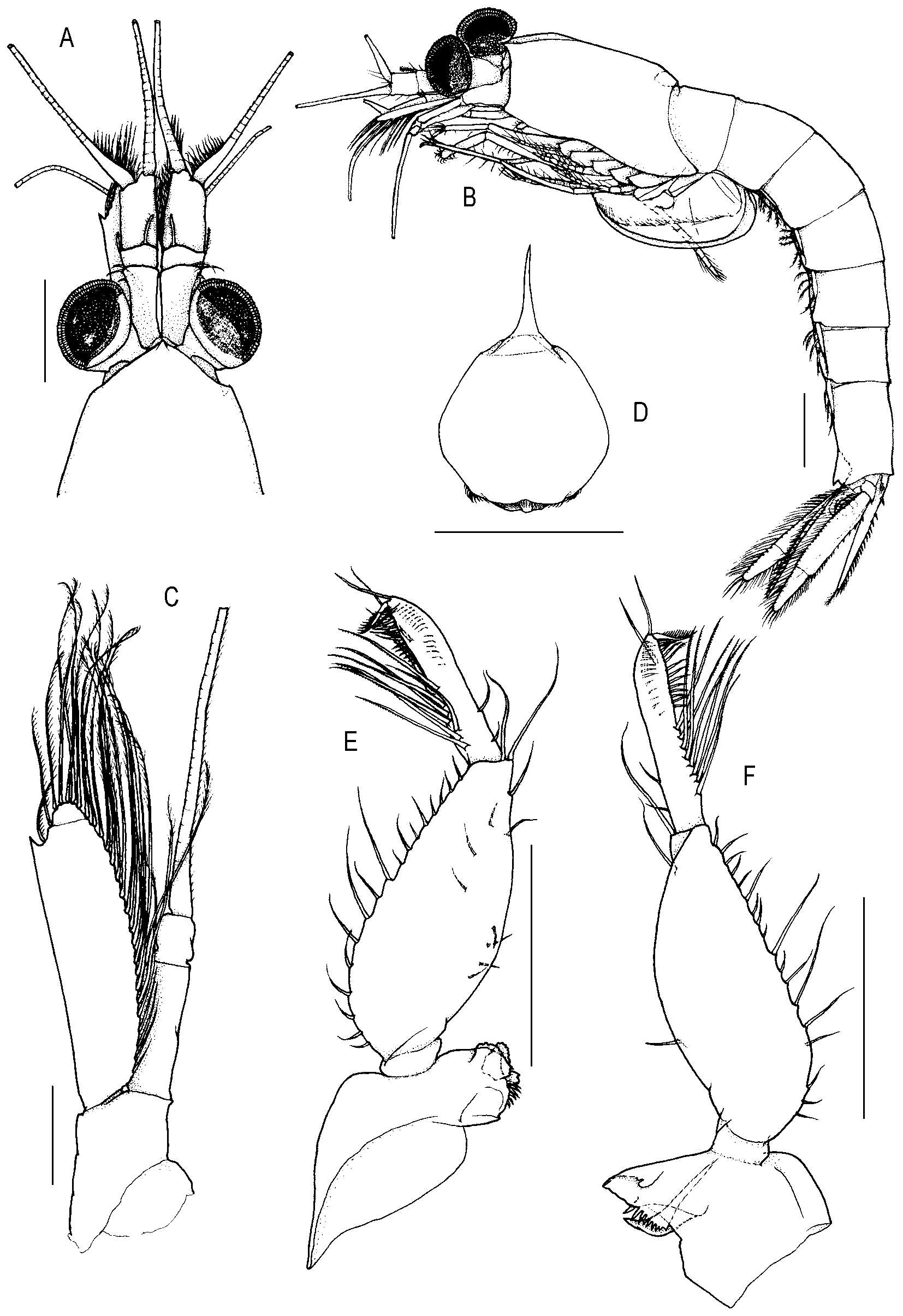
Description. Head: eyes stalked, prominent, large, black globose (adult male cornea 0.9 mm in diameter). Rostrum triangular with small acute point (Figs 7 A, B). Antennal scale as long as antennular peduncle, scale fairly narrow, (length about 4 x maximum width), anterolateral spine towards distal end of outer margin, apical suture present (Fig. 7 C). Labrum rounded with long anterior medial spiniform process, slightly more than 0.5 x length of labrum proper (Fig. 7 D). Mandibular palp with expanded basal article (length about 2.5 x maximum width) (Figs 7 E, F). Maxillule and maxilla typical of the genus (Figs 8 A, B). Maxilla markedly setose, endopodal palp ovate. First thoracic somite fused with head, endopod of limb stout, modified as a gnathopod, exopod natatory, epipodite leaf-like (Fig. 8 C). Pereon: endopod of second thoracic limb moderately robust, functioning as a gnathopod (Fig. 8 D), endopods of thoracic limbs 3 – 8 long and slender, dactylus ending in a long nail, exopods natatory, genital organ at base of 8 th limb in males (Fig. 8 E). Pleon: male pleopods with straight pseudobranchial rami, pleopod 3 unmodified, exopod and endopod subequal, both terminating in plumose setae (Fig. 9 A), pleopod 4 modified, endopod markedly larger and longer than exopod, exopod terminating in plumose setae, endopod terminating in 3 large acutely pointed robust setae (Figs 9 B, C, D). Uropodal exopod with diaresis, 10 – 14 robust setae on outer margin of proximal article, distal article and inner margin of proximal article fringed with plumose setae, endopod slender, lacking diaresis, slightly shorter than exopod, margins fringed with plumose setae, row of robust setae on inner margin extending from statocyst to tip. Telson slender, linguiform, reaching slightly beyond level of diaresis in uropodal exopod, 3 stout robust setae on either side of base, more distally a slight marginal concavity, or ‘ waist’, beyond which each margin is lined with 41 robust setae increasing in size towards tip, terminal margin with 3 small simple setae and a pair of long delicate plumose setae (Figs 9 E, F). FIGURE 8. Siriella distinguenda Hansen, 1910. A, maxillule. B, maxilla. C, 1 st thoracic limb. D, 2 nd thoracic limb. E, 8 th thoracic limb (male). Scalebars = A, B, C, D, E: 0.2 mm.
Sumber: A survey of Mysida from the Lizard Island area, Great Barrier Reef, Australia, Subfamily Siriellinae (Crustacea, Mysida, Mysidae)
Distribusieng
Distribution. Described by Hansen from Indonesian waters, S. distinguenda has also been found in the Philippines (W. M. Tattersall 1951). In Australia it is recorded from the vicinity of Heron Island in the Great Barrier Reef (Bacescu 1979; Fenton 1982). The Lizard Island specimens were caught at night. Apart from 6 netted near Osprey Island, they were all found in the lagoon, usually in plankton hauls, but also in traps set on or above living coral and in one instance, in a light trap on coral rubble.
Sumber: A survey of Mysida from the Lizard Island area, Great Barrier Reef, Australia, Subfamily Siriellinae (Crustacea, Mysida, Mysidae)