
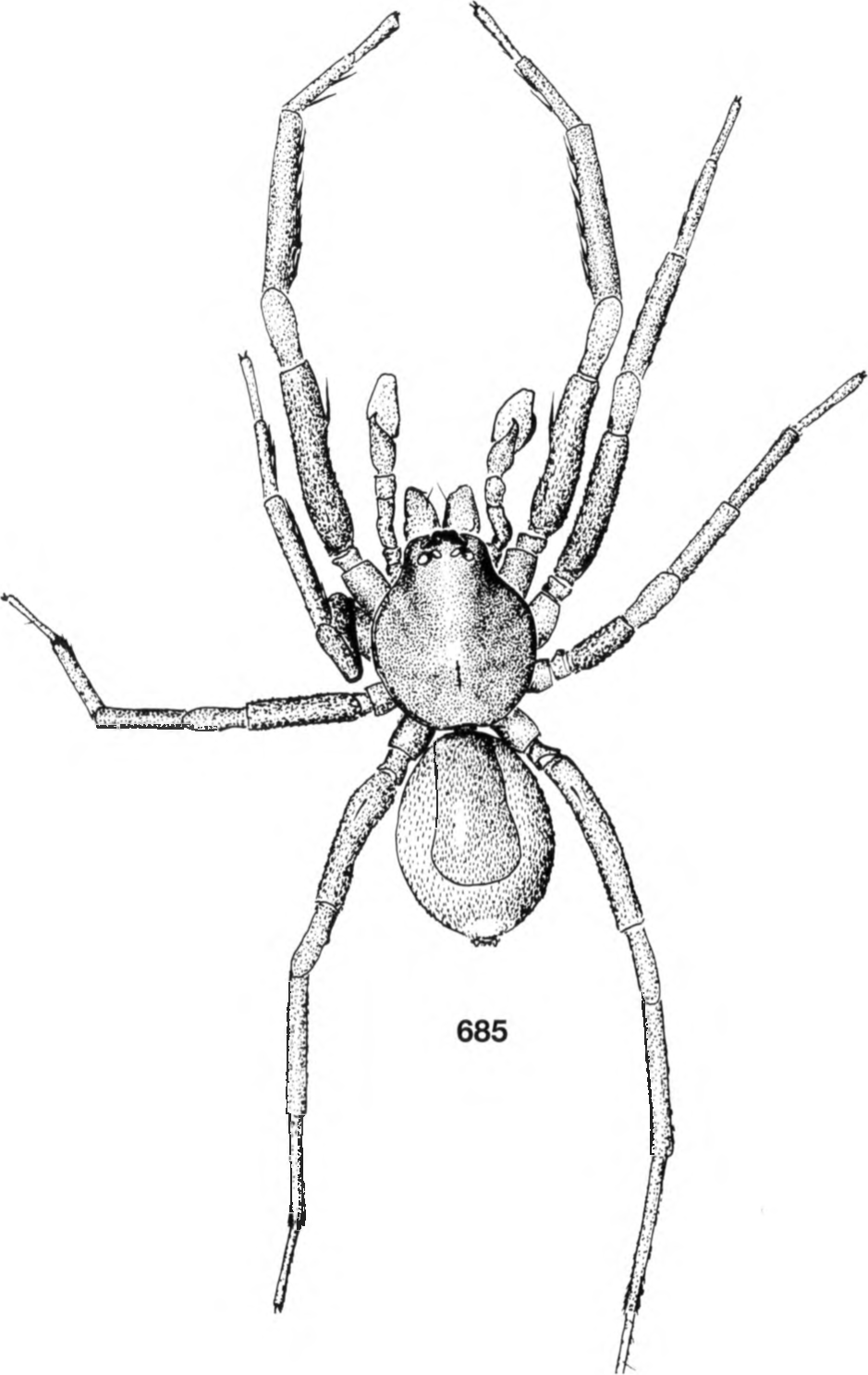
Description. — MALE (fig. 685). Total length 2.10 mm. Carapace length 0.90 mm, width 0.60 mm, height 0.25 mm, head width 0.40 mm, width eye group 0.27 mm; abdomen 1.00 mm long, 0.70 mm wide. Leg lengths: leg I 3.40 mm (1.00 - 1.30 - 0.65 - 0.45), leg II 2.90 mm (0.85 - 1.00 - 0.60 - 0.45), leg III 2.35 mm (0.65 - 0.70 - 0.55 - 0.45), leg IV 3.55 mm (1.00 - 1.15 - 0.80 - 0.60), palp 0.35 - 0.20 - 0.20 + apophysis 0.10 - 0.40 mm. Carapace (fig. 685), mouthparts and legs orange, carapace sometimes with greyish radiating streaks and a submarginal dark band, anterior femora and tibia I a little darker in both sexes; abdomen pale buff with a white patch dorsally in front of spinnerets, with a dorsal scutum, covering the abdomen over 2 / 3 of its length and width. Anterior eyes close together, PME the smallest and not surrounded with black, variable in size and shape, often slitlike or oval, two times or more their diameter apart. Chelicerae figs 687 - 688. Spines of anterior legs very strong (fig. 686). Leg spination: femora I, II and IV with 1 short dorsal spine proximally, femur I with 0 - 0 - 1 pd, tibia I with 7 pair of ventral spines, tibia II most often with 6 pv and 5 rv in a row; metatarsus I and II with 2 - 2 v. Palp figs 689 - 690, femur with slight excavation ventro-distally, sperm duct thin, encircling tegulum, embolus an enormously enlarged and sclerotized bifid sclerite, tegular apophysis small, lanceolate. FEMALE (fig. 686). Total length 2.25 mm. Carapace length 1.00 mm, width 0.85 mm, height 0.30 mm, head width 0.45 mm; abdomen 1.20 mm long, 0.84 mm wide, epigyne 0.35 mm wide. Leg lengths: leg I 3.35 mm (0.90 - 1.30 - 0.70 - 0.45), leg II 2.85 mm (0.85 - 1.05 - 0.55 - 0.40), leg III 2.10 mm (0.60 - 0.60 - 0.50 - 0.45), leg IV 3.75 mm (1.00 - 1.20 - 0.85 - 0.70), palp 0.40 - 0.16 - 0.20 - 0.35 mm. Carapace, eyes, mouthparts and legs as in male. Epigyne figs 691 - 692, heavily sclerotized, with centrally one and laterally two circular dark structures. Vulva fig. 693; a bifid structure laterally seems to represent coiled tubes.
Sumber: Forest Spiders of South East Asia With a revision of the sac and ground spiders (Araneae: Clubionidae, Corinnidae, Liocranidae, Gnaphosidae, Prodidomidae and Trochanteriidae).