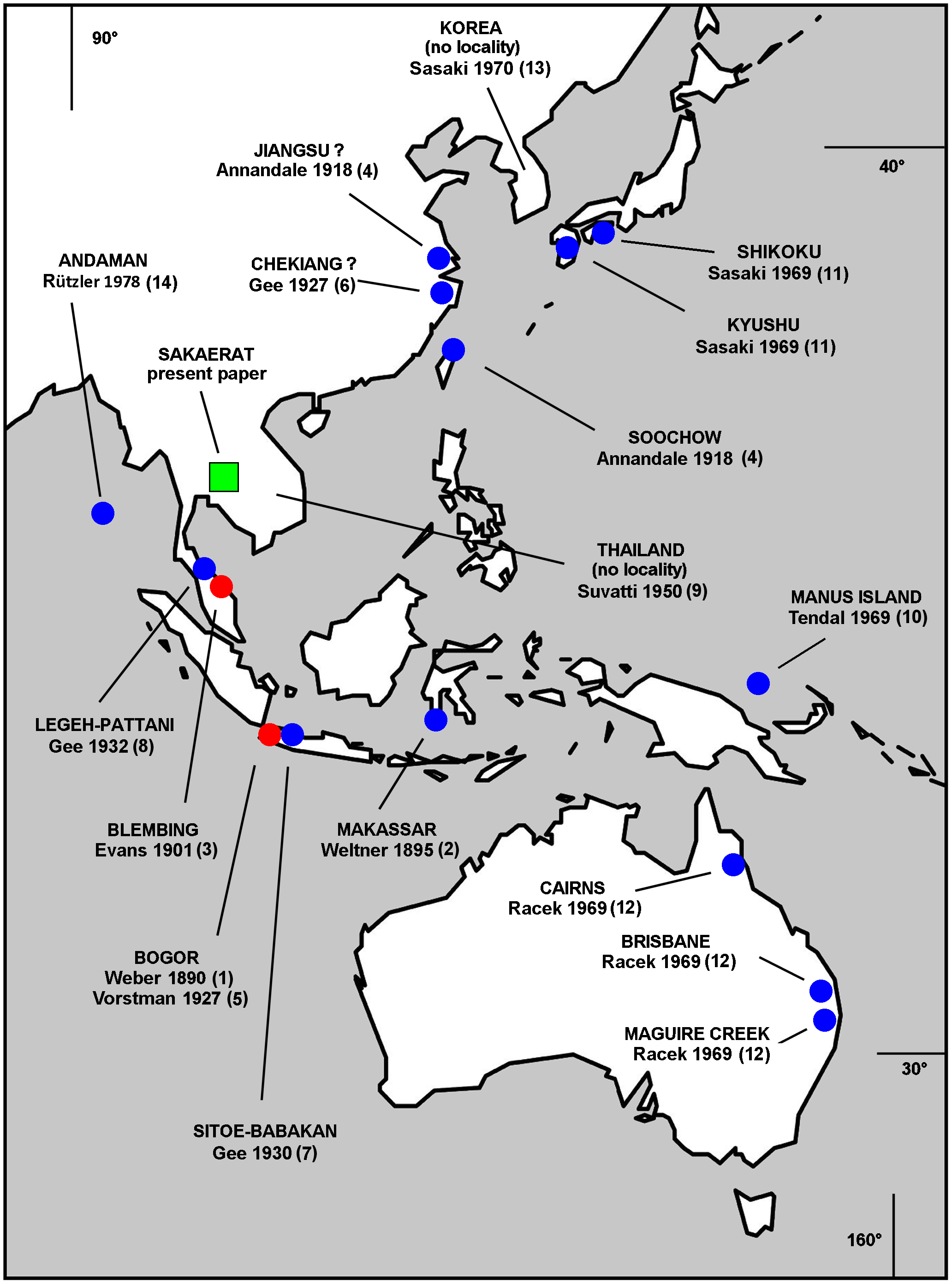
Description Growth form thin, encrusting (ca 4 cm), on stick and rocky substrata. Colour yellowish in vivo, light brown in dry condition. Consistency soft, fragile. Texture loose. Oscules inconspicuous. Surface slightly hispid for spicules. Ectosomal skeleton as emerging fibre tips supporting the dermal membrane. Choanosomal skeleton as loose reticulate network, anisotropic, paucispicular, with ascending fibres evident only towards the surface; ill-defined, irregular network towards the basal portion. Spongin scanty except for gemmular theca and basal plate. Megascleres oxeas (265.1 – 348.8 × 9.3 – 14 µm) from abruptly pointed to acerate, from straight (dominant) to bent; abruptly pointed acanthoxeas (dominant), with small microspines scattered along the shaft and more dense towards the smooth apical tips; spine apices oriented towards the tips; spines from smooth to ornate by microspines. Smooth oxeas also present. Rare malformations. Microscleres absent; free gemmuloscleres abundantly scattered in the skeletal network. Gemmules not abundant and scattered singly from surface to basal portion within meshes of the fibrous network. Gemmules subspherical (413 – 546 µm in diameter), slightly flattened at the foramen side. Foramen single short foraminal tube with a short simple collar in a depression surrounded by a thickening of the gemmular wall. Gemmular theca trilayered. Outer layer thin, armed with a robust continuous layer (mosaic-like) of distal rotules; frequently with distal rotules of gemmuloscleres notably emerging from outer layer. Pneumatic layer (60 – 80 µm in thickness) fibrous, without chambers, as a network of anastomosing very thin spongin fibres. Inner layer multilayered of compact spongin. Gemmuloscleres umbonate birotules of a single size class, radially and densely embedded in pneumatic layer, with overlapping umbrella-shaped rotules in contact with both inner and outer layer. Rotules of equal diameter (20 – 25 µm), distally convex and proximally concave, sometimes irregular. Margins incised, serrate, recurved bearing dense, short hooks. Hooks here and there in a double layer with simple, smooth tips (recurve spines) of variable length. Birotule shaft (55.1 – 76.9 × 4.4 – 5.8 µm) entirely spiny, with large, perpendicular conical spines. Spines straight in middle axis bending towards rotules, notably variable in length and density, with tips acute and sometimes bent, from smooth to ornate by microspines, rare tubercles also present. Young gemmuloscleres as birotules with scarcely developed rotules. Rare birotules (not young) with very short shaft (ca half length) and well developed rotules also present.