
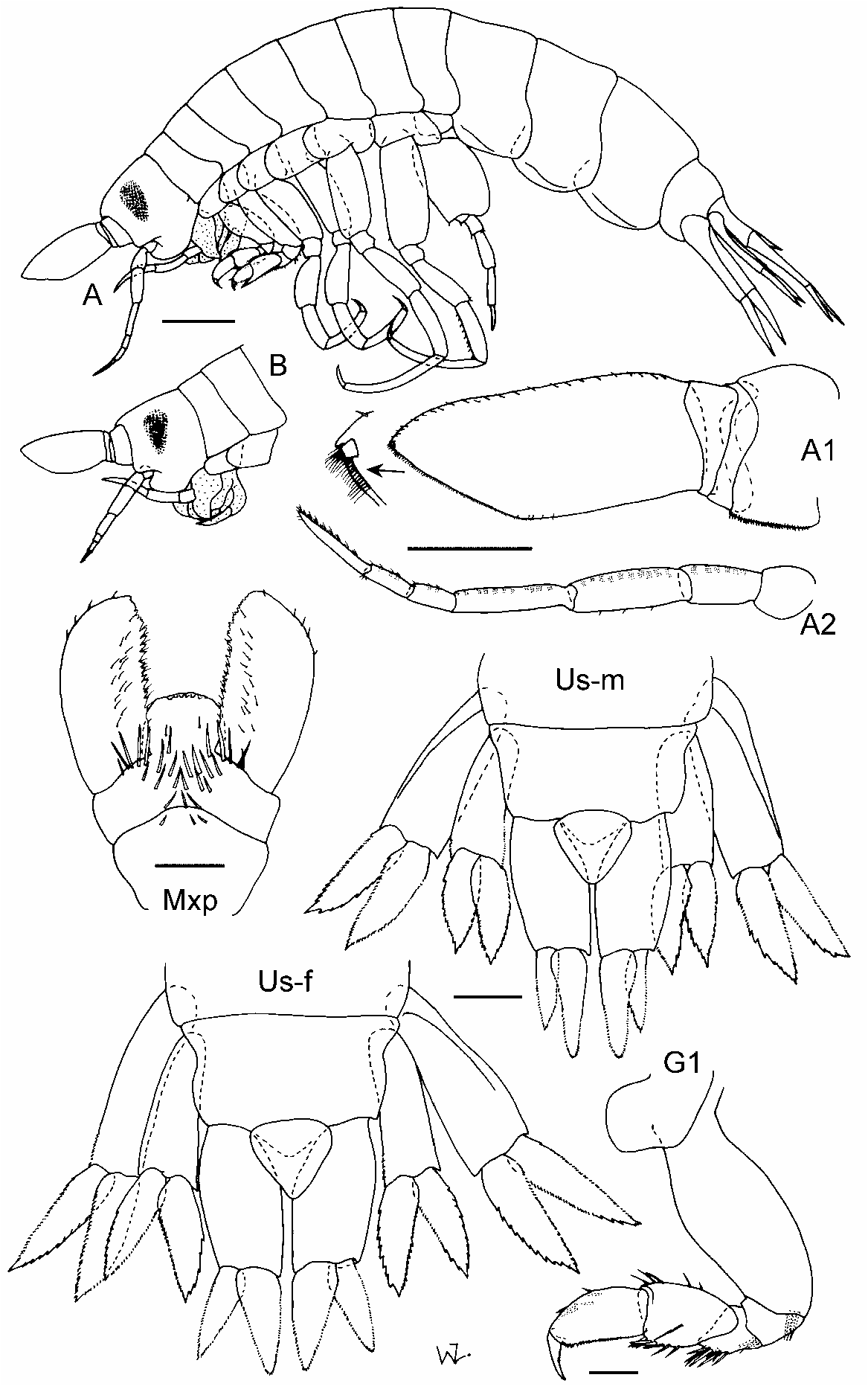
<table style="width: 479px;" border="0" cellspacing="0" cellpadding="0"><tbody><tr height="17"><td class="xl66" width="479" height="17">Vibilia edwardsi Bate, 1862 and V. longipes B., 1887 are possibly also related to this species. V. edwardsi was described on the basis of a single specimen from the South Orkney Islands; in shape of antennae I (acutely truncate in front), highly elongated distal segments of pereopods V-VI, and proportions and ornamentation of the uropods, it is closer to V. antarctica. It is distinguished from the latter mainly by a shorter process on the 5th segment of pereopods II, which is still within the limits of individual variability of this character. Bovallius, who described V. lonipes (from the South Atlantic Ocean), considered it closer to V. edwardsi. In fact, these two species are quite close in several characters and basically differ in the anteriorly highly rounded antennae I of V. longipes. The process of the 5th segment of pereopods II is the same length in V. antarctica and the highly elongated distal segments of pereopods V-VI also relate V. longipes to V. antarctica. A very cogent argument for the identity of V. antarctica and V. longipes is the morphology of the urosome of the latter species, particularly the presence of sexual dimorphism in VIS uropods III. Bernard (1932) also indicated the proximity of relationship between V. edwardsi and V. longipes with V. antarctica.</td></tr></tbody></table>
Sumber: Pelagic Invertebrates