Biologi & Ekologieng
Habitat. Alpacas are raised in the Andean highlands; regionally known as the Altiplano and Puna. The Puna ecosystem is rolling grassland and isolated wetlands typically at c. 3500 - 5200 m altitude with two marked periods: the rainy season from October to April and the dry season from May to September. Most (75 %) precipitation falls from November to March in the form of both hail and rain. In Peru the annual precipitation varies from 800 mm in the south to 1200 mm in the central mountains. The mean annual temperatures are less than 10 ° C and nocturnal frosts are common, especially during the dry season. Diurnal fluctuations can be as much as 20 ° C in the mesic Altiplano and even greater in the dry or desert Altiplano. The short growing season, as determined by moisture and night-time cloud cover, occurs between December and March. Vegetation is dominated by herbaceous grasses and forbs. Few trees exist and shrubs are only locally abundant. Perennial bunchgrasses are common including the genera Festuca, Poa, Stipa, and Calamagrostis, as well as the grass-like sedges Carex and Scirpus. High-quality forage is more abundant during the rainy season and scarcer during the remainder of the year. A critical habitat and principal source of forage for Alpacas in the Andes that allows intensive-localized foraging are bofedales or mojadales. Providing lush forage and moist vegetation that Alpacas thrive on, bofedales are localized islands of perennial greenery with deep organic soils moistened by subterranean and considerable surface water often forming small pools. Both natural and artificial bofedales exist, some man-made ones dating back to pre-Inca times. These high-altitude marsh areas can provide year-round forage, allowing herders and their animals to remain in the same area for extended periods. Depending upon water availability, they are productive only during the rainy season or throughout the year. As a result, their carrying capacity is highly variable, from 2 - 8 Alpacas / ha / year. Natural mojadales compared to irrigated artificial ones, typically have greater plant cover with more palatable and nutritious forage. Vegetative composition of bofedales in the humid Puna varies between several dominant species, including Distichia muscoides, Eleocharis albibracteata, Hypochoeris taraxacoides, Hidrocotilo ranunculoides, Liliaopsis andina, and others. A percentage cover of 64 - 72 % of desirable species (Werneria nubigena, Werneria pymaea, Hipochoeris stenocephala, Ranunculos sp., Carex fragilaris) is excellent Alpaca forage. Reported total accumulated bofedal forage (dry weight) from January to August was 1021 kg / ha that grew at an average rate of 4 - 2 kg / ha / day. Protein ranged 8 - 3 - 13 - 4 % and crude fiber 19 - 2 - 34 - 1 %. Annual bofedal growth varies with season: 60 % during the summer growing season (January-April), 21 % during the transition to the dry season (May-June), and 19 % in the dry season (July-December). Wet artificial bofedales have greater sustained productivity than natural bofedales with 10 - 11 % protein in both the wet and dry seasons and capable of supporting 3 — 4 Alpaca / ha / year. Continuous year-round grazing of native grasslands is the most common grazing management practice used by indigenous herders, but technicians are encouraging enhancement of rangeland conditions through rotational grazing and reducing stocking rates of Alpacas and competing sheep. Recommended stocking rate for Alpacas on Andean native pastures is 2 - 7 animals / ha / year on excellent range, 2 good, 1 average, 0 - 33 poor, and 0 - 17 very poor. However, intensively managed, irrigated pastures of grasses and legumes at 3850 m altitude can support 25 Alpacas / ha / year. Research indicates that despite the high elevations and low night-time temperatures, it is possible to increase considerably the sustained carrying capacity of Andean rangeland by the introduction of improved forage species. Managed pastures of irrigated ryegrass (Lolium perenne) and white clover (Trifolium repens) with application of nitrogen fertilizers can carry up to 30 adult ind / ha compared with the usual rate of 1 - 1 - 5 ind / ha on natural grasslands. On Andean rangelands grazed by Alpaca, tall grass communities are commonly set on fire during the dry season (June — October) by native indigenous herders. The objective is the destruction of bunch grasses that will encourage the growth of ground forage preferred by Alpaca and sheep. However, studies have shown that annual burns are not beneficial because they not only stimulate the rapid regrowth of bunchgrasses, but promote hillside soil erosion and encourage the growth of undesirable invasive plant species. Burning every third or more years during the wet season is a more effective approach for improving Alpaca range and habitat.
Sumber: Camelidae
Biologi & Ekologieng
Movements, Home range and Social organization. Seasonal patterns of Alpaca movement are determined by herders as influenced by the availability of forage, varying from one locality to next. One common annual movement of Alpacas in the Andes is to graze herds during the rainy season (generallyJanuary to April) in lower mountains (3600 - 4100 m) areas characterized by pampas, slopes, and rounded ridges. Then in the dry season (generally May to December) they are moved up to the high altitudes (4100 - 5200 m) to find favorable forage, bofedales, and water. When the rainy season begins, they are moved back to lower areas where grasses are beginning to grow and to avoid severe hailstorms and other weather at higher altitudes. Herders, however, without access to two seasonal sites maintain their animals in the same area year-round. Indigenous families that raise livestock in the Peruvian Andes on the average have 70 Alpacas (30 - 120), 30 Llamas (4 - 50), and 50 sheep (10 - 80). More importance is placed upon Alpacas because they offer greater economic diversity. Most (90 - 95 %) of the Alpaca woolis sold, the balance used for home use. Many of the young males one to two years old are sold for meat production, and old animals are culled to make jerky. In three Peruvian Alpaca farms that were cooperatively, family, and individually owned, percent herd composition was females: 60 / 65 / 70; gelded males: 25 / 30 / 25; breeding males: 3 / 4 / 5; white animals: 70 / 70 / 90; and colored animals: 30 / 30 / 10. With Alpacas that are owned as private property, each member of the family owns animals but herd control is under the family. Ownership is designated by ear markings or colored yarn. Animals are often given as presents or ceremonial gifts. They play an important role in the rituals, symbols, mythology, and ceremoniesin the life of Andean people. Individual animals are recognized and described by physical characteristics and usually given a name. Alpacas have feminine attributes in the Andean cosmic vision oflife and the world, and generically referred to as “ mothers ” and “ dear mothers. ” Alpacas are highly social with strong herding behavior, making them easier to drive when necessary. In small, mixed-sex herds, dominance is clear with a few adult males as the leaders. Alpacas are more skittish and shy with strangers than Llamas. When a free-ranging flock is approached on foot, they will distance themselves more quickly than a herd of Llamas. Once they become familiar with you, however, they are docile and easier to handle than sheep. There are no known unmanaged or feral populations of Alpaca that would allow us to assess their social organization and full repertoire of behavior. However, a number of subtle-contrasting characteristics exist in Alpaca behavior that turn out to be, not surprisingly, very similar to the Vicuna: tighter grouping, vocal communication more common, less communicative with their tails, love water and bathe regularly, greater susceptibility to heat stress, higher site fidelity, males more protective of females, less cooperative, and more distant and stand-offish.
Sumber: Camelidae
Konservasieng
Status and Conservation. Alpacas and Llamas were important to ancient Andean civilizations such as the Tiwanaku Culture that dominated the Lake Titicaca region from ¢. 300 BC to 1000 Ap, and the Inca Culture that dominated the Central Andes in the 15 % and 16 " centuries. When the Incas captured the cameloid-rich kingdoms near Lake Titicaca and south, they acquired giant herds of Llamas and Alpacas. The Incas then sent “ seed herds ” throughout their empire and commanded that they be reproduced. State-controlled husbandry of Alpacas produced vast herds that numbered into the millions. The Incas placed special emphasis on avoidance of crossbreeding with Llamas and selective breeding of pure-colored Alpacas (brown, black, and white) for quality wool and sacrifice to deities. The Spanish invasion in the 16 ™ century destroyed that advanced management system and there ensued a breakdown of controlled breeding. Today, the raising of Alpacas in the high altitudes of Peru and Bolivia contributes substantially to the economy of the region. However, animal production is limited by the low level of technology, adverse climate, disease, herders with scarce resources, and frequent over utilization of native rangelands. The Andean grazing system is extensively based upon utilization of native high-altitude grasslands by mixed herds that include not only Alpacas, but sheep and Llamas as well. Pastoralism and mixed agropastoralism form the subsistence base for the agricultural segment of the high Andes. Indigenous communities control the greatest number of camelids and sheep, as well as half of the native rangelands, which comprise ¢. 95 % ofthe land area above 3800 m. The Alpaca population in South America is c. 4 - 5 million, down some 20 % since the mid- 1960 s, but up 25 % from the early 2000 s. Today, numbers are at least stable, if not increasing. Most Alpacas are in Peru with 91 %, followed by Bolivia 8 % and Chile 1 %. Few Alpacas occur in Argentina because of the lack of moist Puna and the dominance of the dry Puna. More than 73 - 87 % are in southern Peru (Arequipa, Cuzco, Moquegua, Puno, and Tacna), with nearly half of the world’s Alpaca in the Department of Puno. Females represent c ¢. 70 % of the total Alpaca population. A high percentage (85 - 95 %) of Alpacas are owned and managed by native herders in small flocks ofless than 50 animals, but some commercial Alpaca herds are as large as 30,000 - 50,000 individuals. Although indigenous herders raise most Alpacas, productivity traditionally has been the lowest due to over stocking, improper health care, and inbreeding. Peru has ¢. 789,775 producers raising Alpacas; Bolivia has 13,603, and Chile 916. Starting in the early 1980 s Alpacas were exported from Chile, Bolivia, and Peru to the USA, Canada, Australia, New Zealand, and Europe, where cottage industries in Alpaca wool have developed. In the USA the Alpaca Owners & Breeders Association numbered over 4500 members with 143,000 registered Alpacas in 2010. Peru exports c. US $ 24 million worth of Alpaca products (wool, tops, yarns, woven fabrics, and knitwear) annually to countries around the world, especially China, Germany, and Italy. Annual Alpaca wool production in South America is 4 - 1 million kg (90 % from Peru), yet only represents 0 - 6 % of the world’s fine-fibered wool production (fine sheep wool is ¢. 90 - 95 % followed by cashmere at 5 - 10 %). Because of a high market demand for white wool from Huacaya Alpaca, which can be dyed to any desired color, the Alpaca population has become dominated (80 - 87 %) by white individuals. The result has been a scarcity of individuals with pure natural colors and a reduction of genetic diversity in the species. Pure black Alpacas are the rarest. The problem has been recognized and pure natural colors are now beginning to recover. Alpaca wool prices were at their peak from the 1960 s- 1980 s then declined due to land reforms and competition from synthetics. Prices, however, still remain high at four times the value of sheep wool. In North America in its raw state, an ounce of Alpaca varies from US $ 2 to US $ 5. Each stage of the process (cleaning, carding, spinning, knitting, finishing, etc) adds more value to the wool. As a finished garment, it can sell for US $ 10 / 0 z. In addition to its importance as a producer of fine wool, Alpacas have been a valuable source of meat and hides in South America. In the late 1990 s some eleven million kilograms of Alpaca meat were produced annually in Peru, representing 10 - 15 % of the country’s total Alpaca population. The best yield and tenderest meat is from animals 1 - 5 - 2 years old, but most are slaughtered at 7 - 8 years old because their wool has become too coarse for economic production. Alpaca meat is healthful, rich in protein and low in cholesterol and fat. Prime cuts are 50 % of the carcass and sold either fresh or frozen to meat markets, restaurants, hotels, and supermarkets. Hides are tanned for soft leather products or sold with the fleece intact as wall hangings, rugs, and toys. For indigenous peoples that raise most Alpacas, family income from these animals is primarily from meat (44 % fresh, 16 % dried) and secondarily from the wool (31 %). Despite its excellent quality, the price received for Alpaca meat is 50 % less than that for sheep and beef, due to long standing prejudice towards camelid meat. Beginning in the 1960 s Peru was the world leader in quality Alpaca research, especially by the progressive staff and visiting scientists working at the La Raya Research Station from Cuzco University. With the export of Alpacas around the globe starting in the 1990 s, serious science on this longneglected species and family expanded to a number of countries. Universities in the USA and Australia pursued vigorous research programs into reproduction, disease, genetics, and nutrition. The future for the Alpaca is encouraging. Wide opportunities exist for improved successful Alpaca production in the highlands of Peru and Bolivia, especially if the stewardship of the Alpaca’s principle habitat, bofedales, is improved towards sustained and balanced use.
Sumber: Camelidae
Deskripsieng
Descriptive notes. Head-body 114 - 150 cm, tail 18 - 25 cm, shoulder height 85 - 90 cm; weight 55 - 65 kg. Alpacas have long necks; relatively short, straight ears (c. 15 cm), thin and agile legs, and fluffy-appearing bodies because of their long wool. When shorn, however, the bodyis slender and Vicuna-like. There are two distinct breeds. HUACAYA ALPACA: Huacayas are the more common (¢. 90 %) of the two breeds. Its body, legs, and neck are covered by wool that is long, fine (27 - 5 microns), and wavy; the head and feet are covered by short wool. Wool grows 5 - 15 cm / year depending upon nutrition and decreases with age. Huacaya wool is crimped (regular and successive undulations) and similar in appearance to Corriedale sheep wool. Huacayas are bigger in size, have shorter and relatively coarser wool, and lighter fleeces than Suris. There are three general categories of wool: “ Baby Alpaca ” (20 - 23 microns some as low as 16 - 17 microns) is the finest and most expensive wool from recently born animals; “ Tui ” wool is from the first shearing at 12 - 18 months; and “ Standard ” Alpaca wool (c. 24 microns) is from animals of two years of age and older. White Huacayas are the most common (c. 80 %), especially on large commercial Alpaca ranches, compared to 30 % white animals in indigenous flocks. White wool accounts for over 80 % of the total annual Alpaca wool production. Although most Alpaca wool has little cortex in its fibers, it can be easily dyed just as sheep wool, giving woollen mills greater flexibility with white Alpaca wool. Huacaya Alpaca crossed with a Vicuna produces a Paco-Vicuna, which resembles a large-bodied Vicuna and has 17 - 19 micron wool. Resource managers are concerned that accidently escaped Paco-Vicunas could have harmful genetic consequences on populations of pure Vicunas. SURI ALPACA: Suris arise from a very small percentage (2 %) of Huacaya x Huacaya crosses, thus the origin of the breed. Because of their long-hanging wool, phenotyically Suris are quite distinct from Huacayas. Suri wool is silky (24 - 27 microns), straight, without crimp, generally finer, longer, more lustrous, softer to the touch, less elastic, less resistant to tension, and faster-growing compared to the Huacaya. The wool parts on the animal’s back create a mid-body line that is capable of growing up to 15 cm / year. Some individual Suris, called “ wasis ” by Andean herders, are not shorn for years, resulting in the fleece growing until it touches the ground; only a few such special animals are kept and are revered by the indigenous people. Around 17 % of the offspring from Suri x Suri crosses produce Huacaya types. In their South American homeland, Suri Alpacas are considered to be longerlived, more delicate, less hardy, and to have lower fertility than Huacaya Alpacas. Recent research has found thatjuvenile mortality is high because of lack of wool coverage on the midline. However, when given the right management and equally good pastures, they thrivejust as well and with similar fertility as Huacayas. During lactation Suri Alpacas lose weight more than Huacayas because they produce more milk (udders are larger on Suri females). As a result, Suri young are heavier than Huacayas because they have a greater availability of milk. Body wool is uniform or multicolored; 22 natural colors have been categorized, ranging from white to black, with intermediate shades of grays, fawns, and browns. The upperlip is split for grasping forage. The eyes are large, round, and slightly forward looking. The feet have soft-padded soles and two toes, each ending with large pointed nails. Testes are small, oval-shaped and located in the perineal region under the tail. Life span is 15 - 20 years. The cuticle on individual wool fibers is made up of poorly developed, elongated, and flattened cells. While such rudimentary cuticle scales without ridges results in poor felting qualities, it makes the Alpaca wool extraordinarily smooth and soft to the touch. Still, Alpaca wool is 3 - 6 times stronger than human hair. Based upon strand diameter and morphology, the fleece (pelt) of this ungulate is made up of two types of hair: wool and hair. Similar to fine sheep wool, the medulla can be non-existent in unusually fine Alpaca wool, but has been observed in Peruvian Alpaca fibers averaging 17 microns. Such pure Alpacas are considered “ one coated ” because their fleece consists only of the fine undercoat hairs and lack the outer coarser guard hairs. As the proportion of medullation increases (as it does with age), wool diameter increases and fineness decreases, thatis, the proportion of the medulla progressively increases with the thickness of the individual wool strand. Woolis of the cortex type of fineness, and hair is of the medullar type with larger diameter. Hair is especially common on the chest, face, and extremities, but it is not unusual to find individual hairs intermixed throughout the fleece. This is especially common in “ Huarizos, ” hybrids between an Alpaca female and a Llama male. Huarizos show intermediate physical characteristics of the two parents, and relatively coarse wool (c. 32 microns in diameter). Their fleeces contain as much as 40 % guard hair. Huarizos are considered undesirable by the Alpaca wool industry and are being selected against on commercial Alpaca farms. Nearly all (90 %) Alpacas on large farms are shorn annually and done indoors with shearing scissors or by mechanized clippers. In indigenous family herds in the Andes only half of the animals are shorn each year, and done under rustic conditions in the out-of-doors with hand shears. Shearing of males, geldings, non-pregnant and some pregnant females takes place in November and December, while new mothers with young, yearlings, and thin males and females are done in February to April. Annual shearing yields 1.5 - 2. 8 kg of wool per Alpaca in South America (enough to make four sweaters), and up to 3 - 6 kg in USA and Australia. Fineness of Alpaca fleeces vary from farm to farm in Peru (24 - 7 - 32 - 3 microns, averaging 28 - 9 microns), but in other countries where it has been introduced, 16 - 24 microns is more typical. In the Andes Alpaca wool increases in diameter from 17 - 4 microns to 27 - 5 microns from the first shearing at ten months to six years of age. Large Alpaca farms in Peru are able to practice better husbandry through pasture management, selective breeding, and health care. Of 3762 shorn Alpacas on one such farm in Puno, Peru, in the 1980 s, wool was sorted and classified into the following five quality categories: X 3 % at 19 microns, AA 52 % at 25 microns, A 17 % at 37 microns, LP 23 % at 44 microns, and K 5 % at 49 microns. Still, nearly half was considered “ thick ” relative to the Alpaca’s potential for producing fine wool. Now, two decadeslater, better management and selection is beginning to improve wool quality. Alpaca wool production and quality is strongly influenced by artificial selection (genetics) and nutrition. Seasonally wool production varies under the extreme conditions of the Alpaca’s high-altitude habitat: fiber or strand length has been shown to be 25 % longer during the rainy season in the Andean highlands, reflecting the percentage of crude plant protein that decreases from 11 % in the wet season to 3 - 5 % in the dry season. Wool quality decreases (increase in diameter) when Alpacas are grazed on high-quality pasture compared to native range of poor to very poor quality. For example during a 15 month feeding trial relative to controls, Alpacas on diets in Andean rangeland vs. managed pastures of alfalfa, increased the body weight of mothers and young 10 kg and 22 kg respectively, fleece weight 0 - 4 kg and 0 - 8 kg, staple length 2 - 3 cm and 1 - 8 cm, fiber diameter 5 - 2 microns and 6 - 9 microns, and yield 4 - 1 % and 10 - 8 %. In another study adult Alpacas on high-feeding regimes resulted in increased stand diameter (fine 21 - 22 microns to thick 27 - 28 microns), but wool production per head / year increased from 1 - 1 kg to 2 - 4 kg. But, because there is little commercial difference in value per kilogram in the two wool diameters, total monetary value was doubled on the higher feeding regime. Contrary to the long-time belief that Alpacas produce finer wool at higher elevations in the Andes, recent studies with controls have shown that when on the same diet wool quality was similar. Commercially, the majority of Alpaca wool is made into carded and semi-carded thread. In the textile industry it is often blended with merino sheep wool to be made into overcoats and high-fashion knitwear. In general, Alpaca wool quality in the Andes is lower than its potential due to poor management and the extensive Alpaca / ILlama hybridization that has occurred over the past 400 years since Spanish colonization. DNA studies have revealed that today’s Andean Alpaca population shows a high (80 - 92 %) level of hybridization. Along with a significant reduction in Peru’s Alpaca population during colonization, pure colored animals significantly decreased to the point that they became rare. The difference between Alpaca and Llamas and between Huacaya and Suri Alpacas has also been impacted. Alpaca husbandry is now addressing these problems. Additionally, in the 1970 s the Alpaca population in Peru dropped resulting in a 40 % decline of wool production due to land and agrarian reforms. A number of revealing physiological parameters have been measured in Alpaca. Body temperature of normal adult males (n = 50) and females (n = 50) is the same (38 - 7 ° C), pulse rate / minute in males (83 - 2 + 2 - 2) is higher than females (76: 6 + 1 - 9), and respiration rate / minute is similar for males (29 - 2 + 1 - 1) and females (28 - 3 + 0 - 79). For young Alpaca 10 - 12 months old (n = 50) body temperature is 38 - 5 + 0 - 04, pulse rate 83 - 8 + 2 - 9, and respiration rate 33 - 1 + 0 - 19. For femalesin the last days of gestation body temperature (38 - 3 + 0 - 07) is the same as non-pregnant females, but pulse rates (83 - 5 + 2 - 3), and respiration rates (34 - 8 + 1 - 9) were higher.
Sumber: Camelidae
Distribusieng
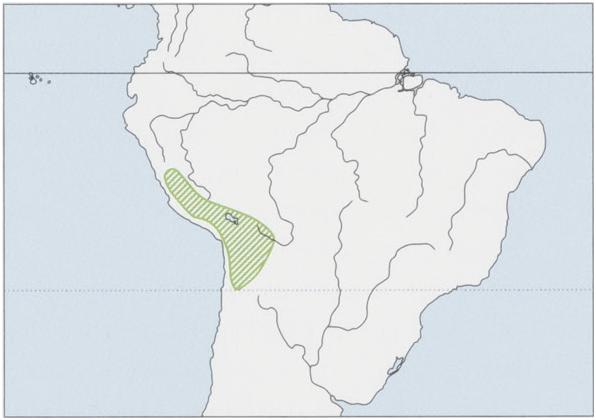
Distribution. Alpacas are found in the Central Andes from C Peru into mid-Bolivia and N Chile. In the 1980 s — 1990 s Alpacas were imported into the USA, Australia, New Zealand, Canada, and Europe. There are no known wild / feral populations of Alpacas.
Sumber: Camelidae