
Deskripsieng
(Figs 1 D – G, 3 I – J, 4 E, 5 E, 7 H – I, 8 G, 9 B, 11 CD, 12 B, 14)
Sumber: Taxonomic revision of the genus Xenogryllus Bolívar, 1890 (Orthoptera, Gryllidae, Eneopterinae, Xenogryllini)
Family Gryllidae · Order Orthoptera
Data diperbarui secara berkala dari berbagai sumber observasi biodiversitas.
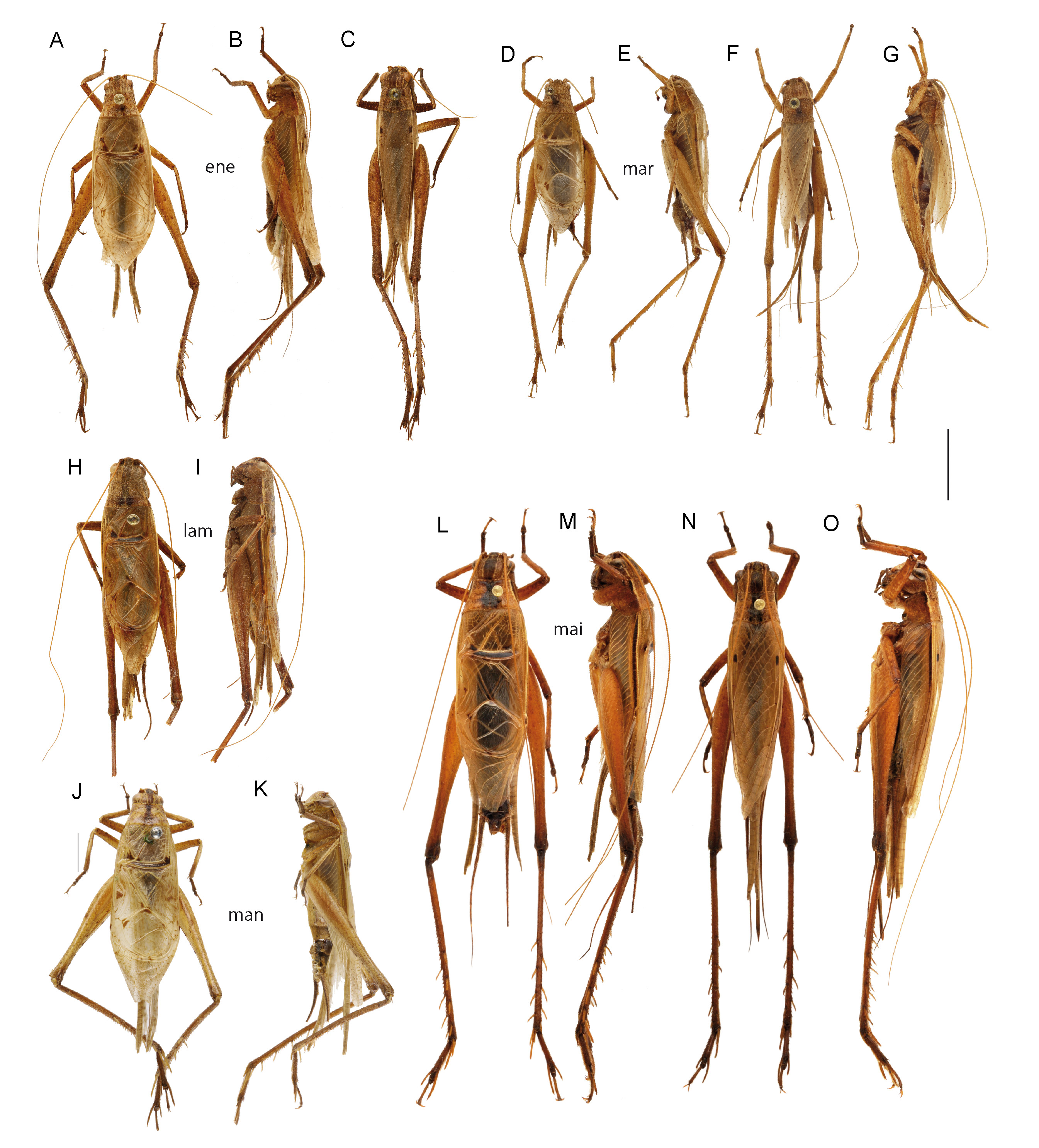
Foto: Jaiswara, Ranjana;Dong, Jiajia;Ma, Libin;Yin, Haisheng;Robillard, Tony
Otoritas penamaan: (Haan, 1844) (1844)
Status taksonomi: ACCEPTED
Status konservasi (IUCN): NE Belum Dievaluasi
Dipublikasikan dalam: Haan, W.de (1844) Bijdragen tot de kennis der Orthoptera. In Temminck [Ed.] Verhandelingen over de Natuurlijke Geschiedenis der Nederlansche Overzeesche Bezittingen. In commissie bij S. en J. Luchtmans, en C.C. van der Hoek, Leiden. Vol. 24, 229–248 pp. Available from http://www.biodiversitylibrary.org/item/200624#page/711/mode/1up
Total Catatan di Indonesia
0
Provinsi Ditemukan
0
dari 38 provinsi
Catatan Pertama
-
belum tersedia
Tren Tahunan
+0%
N/A
Japanese Pine Cricket (Xenogryllus marmoratus) termasuk dalam famili Gryllidae, ordo Orthoptera, kelas Insecta. Berdasarkan data yang terhimpun, spesies ini telah tercatat sebanyak 8 kali di Indonesia, tersebar di 0 provinsi.
Data distribusi ini mencerminkan akumulasi dari berbagai kegiatan survei, penelitian, dan kontribusi citizen science. Pola distribusi yang tercatat mungkin tidak sepenuhnya menggambarkan persebaran alami spesies, karena dipengaruhi oleh intensitas pengamatan di masing-masing wilayah.
Catatan deskriptif tentang Xenogryllus marmoratus dari sumber literatur primer (via GBIF).
(Figs 1 D – G, 3 I – J, 4 E, 5 E, 7 H – I, 8 G, 9 B, 11 CD, 12 B, 14)
Sumber: Taxonomic revision of the genus Xenogryllus Bolívar, 1890 (Orthoptera, Gryllidae, Eneopterinae, Xenogryllini)
Redescription. Species of small to average size, the smallest for the genus (Fig. 1 E – G). Coloration almost homogeneously light ochre. Median dark band on head dorsum faint on vertex (Fig. 4 E), prolonged anteriorly by black fastigium, with three narrow lateral bands on each side. Fastigium straight, not widened anteriorly. Antennae light brown, first segment darker. Face relatively flat in lateral view (Fig. 3 J). Pronotum dorsal disc light brown, with a median brown band variably marked prolonging head coloration; lateral margins not carinated, with a narrow yellow line; lateral lobes ochre, progressively lighter ventrally. Male. FWs light brown, translucent (Fig. 5 E); dark coloration anterior to 1 A sometimes extended on angle of 1 A. Transverse part of file almost straight, with 435 stridulatory teeth (n = 1) on transverse part of 1 A. Harp as wide as long. Fused part of cells c 1 and b 1 as long as individualised part of c 1. Cell d 2 wider than in other species. Mirror wider than long, little rounded, its inner limit forming a wide angle. Apical field short, including five cell alignments. Male genitalia (Fig. 7 H – I): Pseudepiphallic sclerite longer than rami; pseudepiphallic lophi very long (Fig. 8 G), narrow and sclerotized, slightly convergent, ended by an apical lamella curved dorsally and forming a small notch. Pseudepiphallic sclerite with wide lateral membranous lobes. Basal reinforcement of pseudepiphallic sclerite strong. Rami short with convergent hook-like apex. Pseudepiphallic parameres with a ventral transverse crest absent in other species; inner apex of of pseudepiphallic parameres sharp, slightly sclerotized apically. Ectophallic apodemes strong, not lamellate. Ectophallic lateral arms strong, fused to lateral arms of ectophallic fold, and with lateral arms of endophallic sclerite, forming together a wide gutter. Ectophallic fold entirely sclerotized ventrally. Endophallic sclerite small, apodeme made of a thin anterior dorsal crest and narrow lateral lamellas. Female. FWs dorsal field with 8 – 9 strong longitudinal veins (m = 8, n = 10) and faint transverse ones. Subgenital plate not indented apically (Fig. 9 B). Ovipositor longer than FIII, its apex rounded and smooth. Female genitalia: Copulatory papilla (Fig. 11 C – D) thin and conical, widened basally; sclerotization strong basally and apically, its membrane plicate. Life history traits. X. marmoratus lives on low vegetation in bushes and grass in secondary habitats and along roads. The species has a nocturnal activity; males call at night from the vegetation. See Olivero & Robillard (2017) for description of peculiar mating behaviours. Calling song (Figs 12 B, 14). At 26.5 ° C, the calling song of X. marmoratus is made of relatively long syllables, each corresponding to one FW closure. Syllables form a two-part echeme: 1 – 3 singleton syllables (m = 2, n = 10), followed by a chirp made of three syllables, sometimes duplicated. The amplitude profile of the call shows that the singletons are usually less loud than the chirp. Total echeme duration is 711 ± 33 ms, for an echeme period of 6776 ± 368 ms (echeme duty cycle = 10.5 %). The syllables have the following characteristics: 1 st syllable duration = 51.8 ± 1.5 ms (period = 318.3 ± 35.6 ms); 2 nd syllable duration = 50.3 ± 1 ms; chirp duration = 183.8 ± 1 ms; chirp syllable duration = 49.5 ± 1.9 ms (period = 68 ± 0.8 ms). The frequency spectrum shows a pure tone fundamental peak corresponding to the dominant frequency at ca. 5.9 ± 0.2 kHz, with a clear harmonic series, the third harmonic (ca. 18 kHz) being almost as powerful as the fundamental peak. Measurements. See Table 6. Taxonomic discussion. The types of De Haan, supposed to be in Leiden, were not found in RMNH in 2006 (TR, pers. obs.), with no record mentioning them as loaned (Rob De Vries, curator of the Orthopteran collection in RMNH, pers. com. 2006; confirmation by Luc Willemse, current curator of the Orthopteran collection in RMNH, pers. com. 2018). Specimens possibly belonging to the original type series were also searched for in other European museums, but could not be found. We thus designate a neotype from Japan that will serve as a reference for future systematic works. Gorochov (1992) distinguished two subspecies, X. m. marmoratus (Haan, 1844) and X. m. unipartitus (Karny, 1915). In his study, he considered Gryllus (Phalangopsis) marmoratus Haan, 1844 (type from Japan), as the nominal subspecies Xenogryllus marmoratus marmoratus, while he established the subspecies X. m. unipartitus based on the species Heterotrypus unipartitus Karny, 1915, which was described from one female from Taiwan (Takao, examined on photo). The type of H. unipartitus clearly corresponds to a female of Xenogryllus, however, given the continuous variation observed across the wide distribution of X. marmoratus, and the limited information available based on female morphology, there is no reason to maintain these two subspecies. We thus synonymise the subspecies under X. marmoratus, and H. unipartitus becomes a junior synonym of X. marmoratus, as previously proposed by Chopard (1968).
Sumber: Taxonomic revision of the genus Xenogryllus Bolívar, 1890 (Orthoptera, Gryllidae, Eneopterinae, Xenogryllini)
Distribution. Japan, China (including Taiwan and Hainan), South Korea (http: // www. jasa. pe. kr / pulmuchi / korthoptera / Xenogryllus-marmoratus. htm), India (specimens observed by Chopard (1969 )), Sri Lanka (1 male specimen).
Sumber: Taxonomic revision of the genus Xenogryllus Bolívar, 1890 (Orthoptera, Gryllidae, Eneopterinae, Xenogryllini)
Nama-nama ilmiah lain yang pernah digunakan untuk Xenogryllus marmoratus dalam literatur taksonomi.
| Nama Sinonim | Otoritas | Status |
|---|---|---|
| Calyptotrypus marmoratus | (Haan, 1844) | SYNONYM |
| Dionymus marmoratus | (Haan, 1844) | SYNONYM |
| Gryllus marmoratus | Haan, 1844 | SYNONYM |
| Heterotrypus unipartitus | Karny, 1915 | SYNONYM |
| Madasumma marmoratus | (Haan, 1844) | SYNONYM |
| Phalangopsis marmoratus | (Haan, 1844) | HETEROTYPIC_SYNONYM |
| Xenogryllus marmoratus marmoratus | (Haan, 1844) | SYNONYM |
| Xenogryllus marmoratus unipartitus | (Karny, 1915) | SYNONYM |
Jumlah catatan observasi Xenogryllus marmoratus di Indonesia per tahun
Data tren temporal belum tersedia
Xenogryllus marmoratus
Foto: Jaiswara, Ranjana;Dong, Jiajia;Ma, Libin;Yin, Haisheng;Robillard, Tony
Xenogryllus marmoratus
Foto: Jaiswara, Ranjana;Dong, Jiajia;Ma, Libin;Yin, Haisheng;Robillard, Tony
Xenogryllus marmoratus
Foto: Jaiswara, Ranjana;Dong, Jiajia;Ma, Libin;Yin, Haisheng;Robillard, Tony
Xenogryllus marmoratus
Foto: Jaiswara, Ranjana;Dong, Jiajia;Ma, Libin;Yin, Haisheng;Robillard, Tony
Xenogryllus marmoratus
Foto: Jaiswara, Ranjana;Dong, Jiajia;Ma, Libin;Yin, Haisheng;Robillard, Tony
Xenogryllus marmoratus
Foto: Jaiswara, Ranjana;Dong, Jiajia;Ma, Libin;Yin, Haisheng;Robillard, Tony
Xenogryllus marmoratus
Foto: Jaiswara, Ranjana;Dong, Jiajia;Ma, Libin;Yin, Haisheng;Robillard, Tony
Xenogryllus marmoratus
Foto: Jaiswara, Ranjana;Dong, Jiajia;Ma, Libin;Yin, Haisheng;Robillard, Tony
Xenogryllus marmoratus
Foto: Jaiswara, Ranjana;Dong, Jiajia;Ma, Libin;Yin, Haisheng;Robillard, Tony
Xenogryllus marmoratus
Foto: Jaiswara, Ranjana;Dong, Jiajia;Ma, Libin;Yin, Haisheng;Robillard, Tony
| Nama | Bahasa | Sumber |
|---|---|---|
| Japanese Pine Cricket | Inggris | Catalogue of Life |
| Marbled bush cricket | Inggris | Catalogue of Life |
| オキナワマツムシ | Jepang | Catalogue of Life |
| マツムシ | Jepang | Catalogue of Life |
| マツムシ 台湾亜種 | Jepang | Catalogue of Life |
| マツムシ 名義タイプ亜種 | Jepang | Catalogue of Life |
| 云斑金蟋 | Mandarin | Catalogue of Life |
| 金琵琶 | Mandarin | Catalogue of Life |
| 雲斑金蟋 | Mandarin | Catalogue of Life |
| 솔귀뚜라미 | kor | Catalogue of Life |
Japanese Pine Cricket (Xenogryllus marmoratus) memiliki catatan terbatas di Indonesia. Data distribusi yang tercatat masih sangat sedikit, dan diperlukan survei lapangan tambahan untuk memetakan persebarannya secara lengkap.
Ya, Xenogryllus marmoratus memiliki 8 nama sinonim ilmiah, di antaranya: Calyptotrypus marmoratus, Dionymus marmoratus, Gryllus marmoratus. Nama sinonim adalah nama-nama lain yang pernah digunakan untuk spesies yang sama dalam literatur taksonomi.
Xenogryllus marmoratus diklasifikasikan sebagai berikut: Kingdom Animalia, Phylum Arthropoda, Class Insecta, Order Orthoptera, Family Gryllidae, Genus Xenogryllus. Spesies ini dideskripsikan oleh (Haan, 1844).
8 titik observasi Xenogryllus marmoratus di Indonesia
Memuat peta...
Setiap titik merepresentasikan satu lokasi observasi yang tercatat. Klik titik untuk melihat detail.