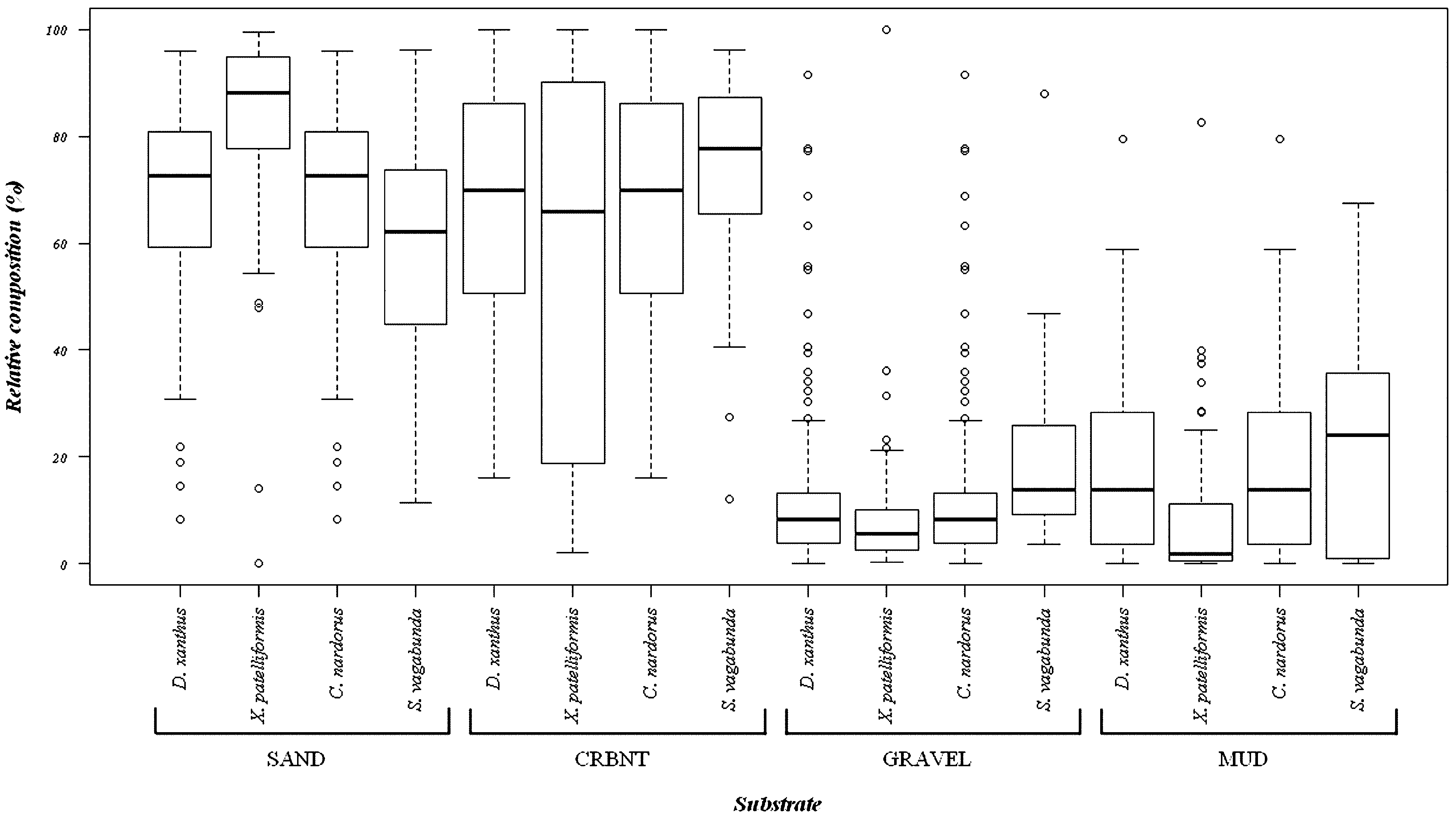
Description. Shape. Distinctive disc shape, ranging in thickness from 3 – 6 mm. All specimens show a concave structure, which allows them to be raised above the seabed. Colour. A beige or grey colour on the surface, when the sponge is turned over, the underside is mottled as the incorporated sand grains are more highly visible. Oscules. No oscules were visible in these specimens. Texture and surface characteristics. Flexible due to the thin shape of the specimens, this sponge is otherwise firm, incompressible, easily torn and becomes very brittle when dry. Spicule bundles and large singler spicules protrude from the ectosome and give the surface a hispid appearance, although the longer spicules are easily broken. The extremities of the disc also have large spicules echinating through the ectosome, allowing the entire sponge to be raised above the seabed. The surface is frequently grooved. Grooves originate from the apex of the sponge and run to the extremities of the disc, with variable degrees of branching. Skeletal structure. Spicules are concentrated almost exclusively in the ectosomal layer on the upper, exposed side. Styles in two size classes are arranged tangentially, forming a matted layer which lies directly below the ectosomal crust of asters. Specialised styles form dense bundles which project through the ectosome, surrounding a single, large, specialised style which extends to a distance of about 1.5 mm. The choanosome is filled almost entirely with sand grains (Figure 9). Megascleres (Table 3). Large styles (Type I) are the most abundant, have smooth heads, rounded tips and can be flexuous. They form the tangential ectosomal layer as well as the dense ectosomal brushes and range from 530 – 1447 μm in length. The upper length limit of these styles, however, may be very conservative as a result of the fragility of these larger spicules. Smaller, thinner styles (Type II) have slightly swollen heads, approaching subtylote, with sharply pointed tips and a straight shaft. They are also located in the tangential ectosomal layer. Very fine, elongate styles (Type III) are the single styles arising from the centre of ectosomal brushes to a distance of approximately 1.5 mm. Microscleres (Table 3). Oxyasters are large and regular, with a small centrum and smooth, slightly recurved, conical rays. These are slender, uniform asters with approximately 11 rays per aster. Strongylasters are very compact and robust, with 7 – 8 stout rays. These have been previously described as tylasters, but our examination shows that the spination is spread along the entire length of the rays, with larger, more sharply pointed spines at the tips of each ray in some asters, giving the appearance of being swollen, thus simply a manifestation of the size of spines and not a true tylaster morphotype. The short tuberculate spines on the shaft of the rays give a warty appearance and can conceal the centrum in smaller asters, due to the shaft width and elaborate spination on the rays. Habitat and distribution. Distributed throughout the Great Barrier Reef, this species has also been recorded from the Torres Strait, Western Australia and allegedly Sri Lanka. Specimens from the GBR were collected in depths ranging from 10 to 87 m, from predominantly sandy and carbonate dominated substrata.