Umum
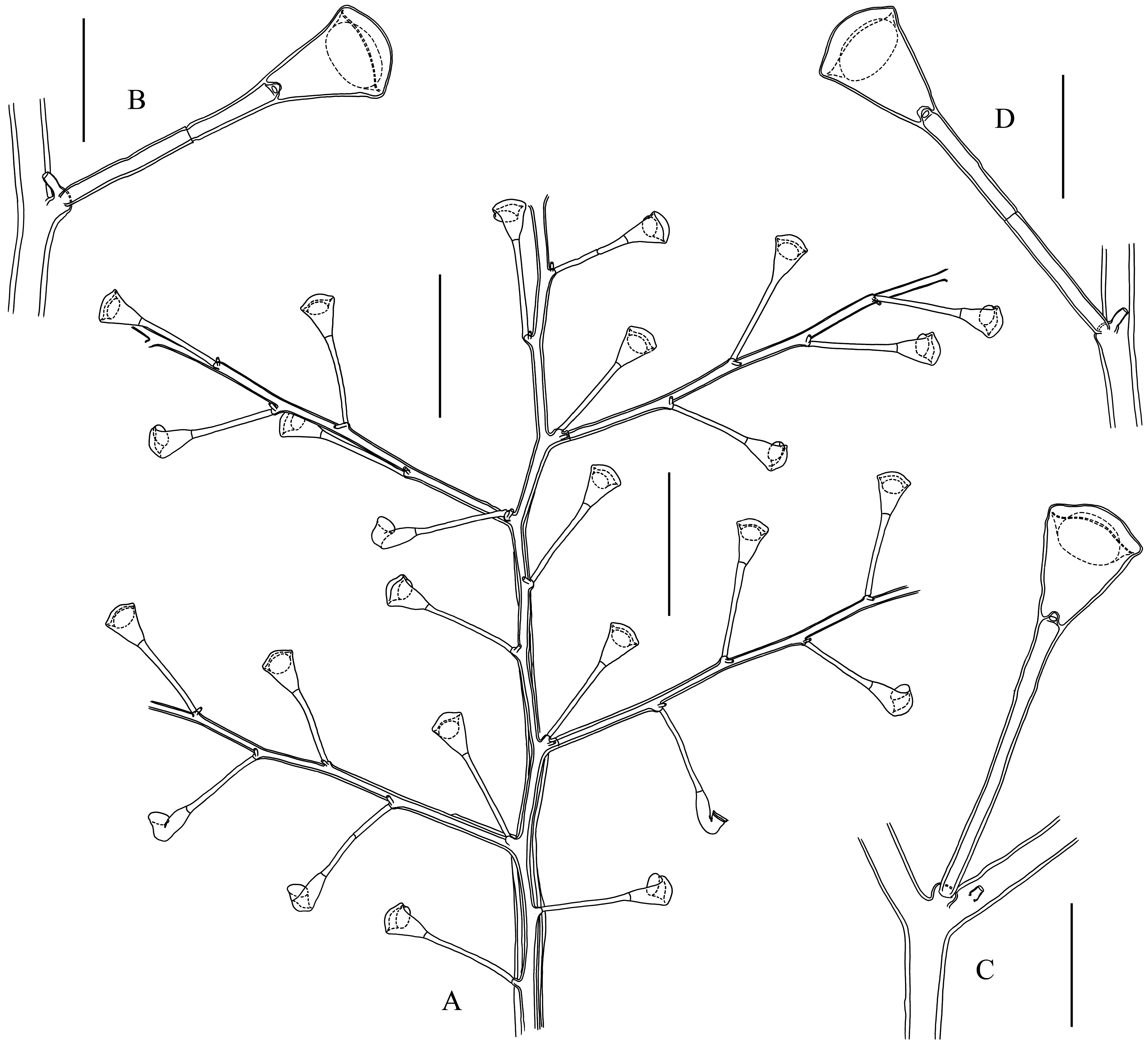
<p>Hydrocaulus flaccid, hyaline, lightly fascicled, polysiphonic tubes almost parallel, running up stem and major branches to just below the distalmost branches.</p><p>Branching irregular, more or less in one plane, bifurcations common, a hydrotheca in each fork; perisarc of stem and branches smooth, internodes long, nodes (if present) just above apophysis of branch.</p><p>Hydrothecae alternate, facing forward, widely separated along branch, pedicels long and narrow, pointing obliquely upward from a strong, bulbous apophysis, a constriction at junction with apophysis, diameter of pedicel increasing distally to hydrotheca. Hydrothecae long, trumpet-shaped, distally bent perpendicular to proximal axis at two thirds distance from floor; hydrothecal floor clearly demarcated from pedicel by a slightly concave diaphragm pierced by a small central foramen; adcauline wall almost straight to bend then becoming concave to margin; abcauline wall swollen below bend, narrowing into a deep flexure at bend then becoming convex to margin. Margin circular, rim strongly everted, most hydrothecae with up to four slightly everted replications. Perisarc moderately thick.</p><p>Nematothecae on adcauline side of apophysis at base of hydrothecal pedicel, variable in length but mostly small, cigar-shaped, diameter of orifice a little less than that of body, some with a long tubular extension with replicated margin, perisarc thin.</p><p>Colour: Transparent and colourless (preserved material).</p>
Sumber: Cnidaria
Deskripsieng
Description. Colonies erect, to 4.5 cm high, not rigid but partially able to support themselves when out of liquid; arising from a dense, rhizoid stolon spreading over, and firmly adhering to various substrates; colonies irregularly ramified in a single plane; stolonal fibers and auxiliary tubes of stems and branches carrying numerous, digitiform nematothecae of varied lengths, tapering apically to a rounded, transversely-set aperture; main cauline tube usually undivided, although a few irregular, transverse constrictions of the perisarc could be occasionally found; composed of successive modules, each comprising a well-developed, proximal apophysis (together with its axillar hydrotheca, itself supported by a short apophysis) bearing a cladium, followed above by two short, alternate apophyses, each carrying a hydrotheca, and a second, prominent apophysis (and its axillar hydrotheca mounted on its own apophysis) bearing another cladium, but on side opposite to its proximal counterpart; apophyses supporting cladia arranged in the same plane with the stem, while those bearing the cauline hydrothecae are distinctly shifted on to the “ anterior ” side of the colony; all apophyses distant from one another, each introducing a geniculation in the stem, geniculation more marked at the apophyses supporting the cladia; apophyses for the hydrothecae (exclusive of the axillar ones) with single, adaxially-set, short, digitiform nematotheca; apophyses for the axillar hydrothecae usually without nematothecae, although the occurrence of a single one is not uncommon; apophyses for the cladia with usually single, occasionally twin nematothecae (both on the same side), near the distal end; nematothecae sometimes renovated; auxiliary tubes of the stem running parallel to their main counterpart, occasionally branching and anastomosing, communicating through large, lateral pores in their perisarc. Cladia to 6.5 mm long, not distinctly demarcated from their corresponding stem apophyses; alternate, the two rows almost coplanar, occasionally additional cladia are given off irregularly around the stem from its auxiliary tubes; basally fascicled, grading to monosiphonic distally; further elongating cladia transform gradually into branches bearing pinnately-set cladia; slightly geniculate, either undivided or irregularly divided into internodes by transverse constrictions of the perisarc, each “ internode ” bearing 1 – 3 hydrothecal apophyses; up to 13 hydrothecae per cladium; equivalents of internodes long, each bearing a latero-distal hydrothecal apophysis; the latter short, alternate, shifted on to the “ anterior ” side of the colony, each with an adaxial nematotheca, the two rows of hydrothecae forming an acute angle between them. Hydrothecae borne on exceedingly long, movable pedicels, the latter clearly demarcated from their corresponding (stem and cladial) apophyses by a distinct, transverse node; sometimes, a nematotheca borne on a given pedicel; the latter tubular, merging imperceptibly with the hydrothecal wall, demarcation internal, by a transversely-set diaphragm (with abaxially-raised edge); hydrotheca greatly expanding above diaphragm (adopting a broadly triangular shape when viewed from above / below) for about 2 / 3 of its length, then bending at right angle (or even more), while flaring distally (in lateral view); consequently, all hydrothecal apertures of the colony are facing “ dorsally ”; apertures almost reniform in frontal view, margin everted and often renovated (several times), rim even; surface of hydrothecae finely and densely striated transversely, striations occasionally extending to the pedicels. Coppinia up to 5 × 3 mm, on either the stem and branches, composed of tree-shaped, nematothecate tubuli, proximally simple, distally branching dichotomously above the gonothecae; the latter urn-shaped, thick-walled, striated transversely, distally with 2 – 3 lateral projections, sometimes curving downwards, each bearing apically a rounded aperture.
Sumber: On some species of Zygophylax Quelch, 1885 (Cnidaria: Hydrozoa: Zygophylacidae) from off New Caledonia
Distribusieng
Distribution. Japan (Hirohito 1995), New Zealand [p. p. Totton (1930), see Rees & Vervoort (1987: 92)], southern Tasmania (Watson & Vervoort 2001), New Caledonia (present report). Additional records are problematic, given the morphological similarities with Z. pseudosibogae and the new taxa described by Gu et al. (2022).
Sumber: On some species of Zygophylax Quelch, 1885 (Cnidaria: Hydrozoa: Zygophylacidae) from off New Caledonia