
Konservasieng
Conservation: CITES – Appendix I; U. S. ESA and IUCN – Endangered.
Sumber: Order Primates
Family Cercopithecidae · Order Primates
Data diperbarui secara berkala dari berbagai sumber observasi biodiversitas.
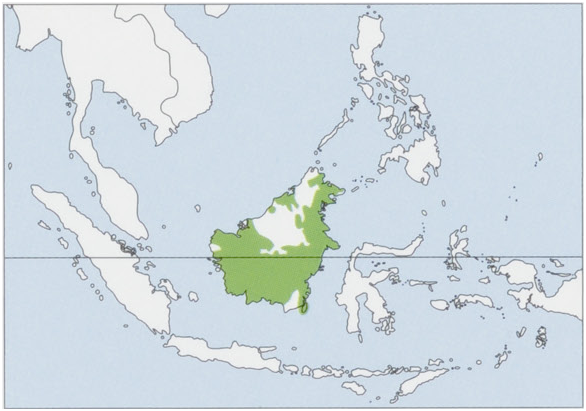
Foto: Russell A. Mittermeier;Anthony B. Rylands;Don E. Wilson
Otoritas penamaan: (van Wurmb, 1787) (1787)
Status taksonomi: ACCEPTED
Status konservasi (IUCN): EN Terancam Punah
Dipublikasikan dalam: Verh. Batav. Genootsch. vol.3 p.353
Total Catatan di Indonesia
0
Provinsi Ditemukan
0
dari 38 provinsi
Catatan Pertama
0
tahun pertama tercatat
Tren Tahunan
+0%
+82.1% vs 2025
Bekantan (Nasalis larvatus) termasuk dalam famili Cercopithecidae, ordo Primates, kelas Mammalia. Berdasarkan data yang terhimpun, spesies ini telah tercatat sebanyak 517 kali di Indonesia, tersebar di 5 provinsi. Catatan pertama tercatat pada tahun 1836.
Kalimantan Tengah merupakan provinsi dengan catatan observasi terbanyak untuk spesies ini, dengan 214 catatan (41.4% dari total). Data distribusi ini mencerminkan akumulasi dari berbagai kegiatan survei, penelitian, dan kontribusi citizen science. Pola distribusi yang tercatat mungkin tidak sepenuhnya menggambarkan persebaran alami spesies, karena dipengaruhi oleh intensitas pengamatan di masing-masing wilayah.
Tren observasi tahunan Nasalis larvatus menunjukkan peningkatan signifikan (+82%) pada periode terakhir dibanding tahun sebelumnya, dengan catatan pertama pada tahun 1836.
Catatan deskriptif tentang Nasalis larvatus dari sumber literatur primer (via GBIF).
Conservation: CITES – Appendix I; U. S. ESA and IUCN – Endangered.
Sumber: Order Primates
STATUS: CITES - Appendix I; U. S. ESA - Endangered; IUCN - Vulnerable.
Sumber: Order Primates
PROTECTED STATUS: CITES - Appendix I and U. S. ESA - Endangered.
Sumber: Order Primates
Habitat. Almost exclusively in coastal forests and forests close to major rivers, especially mangrove, peat swamp, and riparian forests. Proboscis Monkeys occur farther inland immediately adjacent to large rivers in Kalimantan and in inland swamps of Danau Senatarum and Mahakam Lakes. It is never found above elevations of 350 m, except for extremely rare seemingly vagrant individuals. It also occurs in some lowland dipterocarp forests but only near to rivers. In all habitats, Proboscis Monkeys are rarely found more than c. 1 km from a significant waterway. Formerly, they were widespread throughout most coastal forests of Borneo and possibly along most major rivers.
Sumber: Cercopithecidae
Movements, Home range and Social organization. Daily movements of Proboscis Monkeys are determined strongly by the distribution of waterways, and their sleeping sites are generally beside open water. Predators include crocodiles (Crocodylus), Diard’s Clouded Leopards (Neofelis diardi), and reticulated pythons (Python reticulatus). Where waterways are narrow, Proboscis Monkeys traverse them by arboreal routes. They are also proficient swimmers. For widerrivers, they leap from a high branch into the river and then swim the final stretch or, for the wider rivers, climb down to the bank and slip into the water to swim across, with infants and females generally in front and the male farther behind. Proboscis Monkeys can swim considerable distances under water if disturbed. Data on daily movement patterns of individual groups are scarce, but they generally travel less than 1000 m. Home range sizes vary between sites, depending on habitat type and distribution of waterways. In heterogeneous lowland and mangrove forests of Samunsam, Sarawak, home ranges are c. 9 km? whereas in the peat swamp forests Tanjung Puting, Kalimantan, they are 1 - 4 km ®, in both cases encompassing forest on both sides of the river. Proboscis Monkey groups are non-territorial, with more than 90 % home range overlap. Social groups comprise a single adult male and up to nine adult females and their offspring. Ranges of these unimale — multifemale groups overlap, and they frequently aggregate, especially beside rivers in the evenings. Both males and females transfer between groups. Males leave their natal groups at c. 2 years of age and generallyjoin all-male groups, which in most cases are of similar size as unimale — multifemale groups. Infanticide has never been recorded, but occasional movements of females with dependent infants out of their unimale-multifemale groups indicate that it might occur.
Sumber: Cercopithecidae
Status and Conservation. CITES Appendix I. Classified as Endangered on The IUCN Red List. Proboscis Monkeys are fully protected by law in all of the Bornean states where they occur, although enforcement is often weak. Coastal lowlands and land adjoining large rivers, which are the original habitats of the Proboscis Monkey, are the most developed areas of Borneo: most people live along rivers, most large towns are near river mouths, and most large-scale agriculture and aquaculture schemes are on coastal and alluvial plains. Few large, intact areas of suitable habitat remain, and populations of Proboscis Monkey are now highly fragmented and scattered; in Sabah, only an estimated 9 - 8 % of the original suitable habitat remains. Of the remaining habitat, mangroves in many areas have been subjected to intensive logging for poles and charcoal. Peat swamp forests have also been heavily and repeatedly logged in many areas. In the 1970 s and 1980 s, such logging was sometimes followed by poisoning of non-timber trees, many of which were food trees for wildlife, with the aim of enhancing the next timber crop. This practice has been discontinued, but it was responsible for major degradation of some peat swamp forests. Forest fires along rivers can be damaging; e. g. the 1997 - 1998 Bornean fires destroyed large areas of remaining habitat. Hunting in the past might have been significant in some areas, potentially accounting for the limited and patchy distribution of the Proboscis Monkey along major rivers. In coastal areas, traditionally, hunting was not a significant problem because inhabitants are predominantly Muslims who do not eat monkeys. With the advent of speedboats and shotguns, however, people now come from towns to hunt Proboscis Monkeys for sport; their habit of sleeping conspicuously next to rivers makes them easy targets. Intense pressure on coastal land means that few reserves are large enough to protect whole populations, and the current status of the Proboscis Monkey is not well known. It is thought to occur in 18 protected areas, although all but five are too small, or habitat too marginal, to fully protect their populations. The protected areas are: Samunsam Reserve, Bako National Park, Kuching Wetland National Park, Sedilu National Park, Maludam National Park, and Rajang Mangrove National Park in Sarawak, Malaysia; Pulau Siarau & Pulau Beramban Primary Conservation Areas and Bukau Api Api Protection Forest Reserve in Brunei Darussalam; Maliau Basin Conservation Area, Danum Valley Conservation Area, Sepilok Orang Utan Sanctuary, Lower Kinabatangan Wildlife Reserve, and Kulamba Wildlife Reserve in Sabah, Malaysia; and Kutai National Park, Pleihari Tana Laut Wildlife Reserve, Tanjung Puting National Park, Gunung Palung National Park, and Danau Sentaram National Park in Kalimantan, Indonesia. Recent estimates indicate that 6000 Proboscis Monkeys remain in Sabah, mostly in disjunct populations in the Kinabatangan and Segama river floodplains, with a smaller, fragmented population on the Klias Peninsula on the west coast. In Sarawak, less than 1000 individuals remain in patchily distributed populations. Proboscis Monkeys are more abundant in Kalimantan, with population sizes of 100 - 1000 individuals, although recent surveys are lacking. The population in the Mahakam Delta, which would have numbered in the thousands until the early 1990 s, has been decimated because of conversion of the coastal swamps to shrimp farms. The Proboscis Monkey is now extinct in Indonesia’s Pulau Kaget Nature Reserve where it was once abundant.
Sumber: Cercopithecidae
Nama-nama ilmiah lain yang pernah digunakan untuk Nasalis larvatus dalam literatur taksonomi.
| Nama Sinonim | Otoritas | Status |
|---|---|---|
| Cercopithecus larvatus | (Wurmb, 1787) | HOMOTYPIC_SYNONYM |
| Cercopithecus nasica | Lacépède, 1799 | SYNONYM |
| Nasalis capistratus | (Kerr, 1792) | SYNONYM |
| Nasalis larvatus orientalis | Chasen, 1940 | SYNONYM |
| Nasalis nasica | (Lacépède, 1799) | SYNONYM |
| Nasalis recurvus | Vigors & Horsfield, 1828 | SYNONYM |
| Simia capistratus | Kerr, 1792 | SYNONYM |
| # | Provinsi | Catatan | % |
|---|---|---|---|
| 1 | Kalimantan Tengah | 214 | 41.4% |
| 2 | Kalimantan Timur | 68 | 13.2% |
| 3 | Kalimantan Selatan | 36 | 7.0% |
| 4 | Kalimantan Barat | 21 | 4.1% |
| 5 | Kalimantan Utara | 11 | 2.1% |
Jumlah catatan observasi Nasalis larvatus di Indonesia per tahun
Nasalis larvatus
Foto: Russell A. Mittermeier;Anthony B. Rylands;Don E. Wilson
Nasalis larvatus
Foto: Russell A. Mittermeier;Anthony B. Rylands;Don E. Wilson
| Nama | Bahasa | Sumber |
|---|---|---|
| Bekantan | Indonesia | Catalogue of Life |
| Didnosė beždžionė | lit | Catalogue of Life |
| Kera Bekantan | Melayu | Catalogue of Life |
| Long nez | Prancis | Catalogue of Life |
| Long-nosed Monkey | Inggris | Catalogue of Life |
| Macaco-narigudo | Portugis | Catalogue of Life |
| Mono Narigudo | Spanyol | Catalogue of Life |
| Monyet Belanda | Indonesia | Catalogue of Life |
| Nasal Ape | Inggris | Catalogue of Life |
| Nasalis larvatus | Spanyol | Catalogue of Life |
| Nasenaffe | Jerman | Catalogue of Life |
| Nasica comune | Italia | Catalogue of Life |
| Nasica nordorientale | Italia | Catalogue of Life |
| Nasico | - | Cercopithecidae |
| Nasigue | Prancis | Cercopithecidae |
| Nasique | Prancis | Catalogue of Life |
| Neseape | nob | Catalogue of Life |
| Neusaap | Belanda | Catalogue of Life |
| Nosacz sundajski | pol | Catalogue of Life |
| Näsapa | swe | Catalogue of Life |
Berdasarkan data 517 observasi, Kalimantan Tengah adalah provinsi dengan catatan Bekantan (Nasalis larvatus) terbanyak — 214 observasi (41.4% dari total catatan di Indonesia). Spesies ini tersebar di 5 provinsi.
Catatan pertama Bekantan (Nasalis larvatus) di Indonesia tercatat pada tahun 1836. Hingga kini terdapat 517 catatan dari 5 provinsi, yang dihimpun dari survei lapangan, koleksi museum, dan platform citizen science.
Menurut IUCN Red List, Bekantan (Nasalis larvatus) berstatus "Terancam Punah" (kode EN). Status ini mencerminkan tingkat risiko kepunahan global spesies, bukan khusus Indonesia.
Di Indonesia dan Malaysia, Nasalis larvatus dikenal dengan beberapa nama lokal: Bekantan, Monyet Belanda. Penamaan dapat berbeda antardaerah dan bahasa.
Ya, Nasalis larvatus memiliki 7 nama sinonim ilmiah, di antaranya: Cercopithecus larvatus, Cercopithecus nasica, Nasalis capistratus. Nama sinonim adalah nama-nama lain yang pernah digunakan untuk spesies yang sama dalam literatur taksonomi.
Nasalis larvatus diklasifikasikan sebagai berikut: Kingdom Animalia, Phylum Chordata, Class Mammalia, Order Primates, Family Cercopithecidae, Genus Nasalis. Spesies ini dideskripsikan oleh (van Wurmb, 1787).
150 titik observasi Nasalis larvatus di Indonesia
Memuat peta...
Setiap titik merepresentasikan satu lokasi observasi yang tercatat. Klik titik untuk melihat detail.