
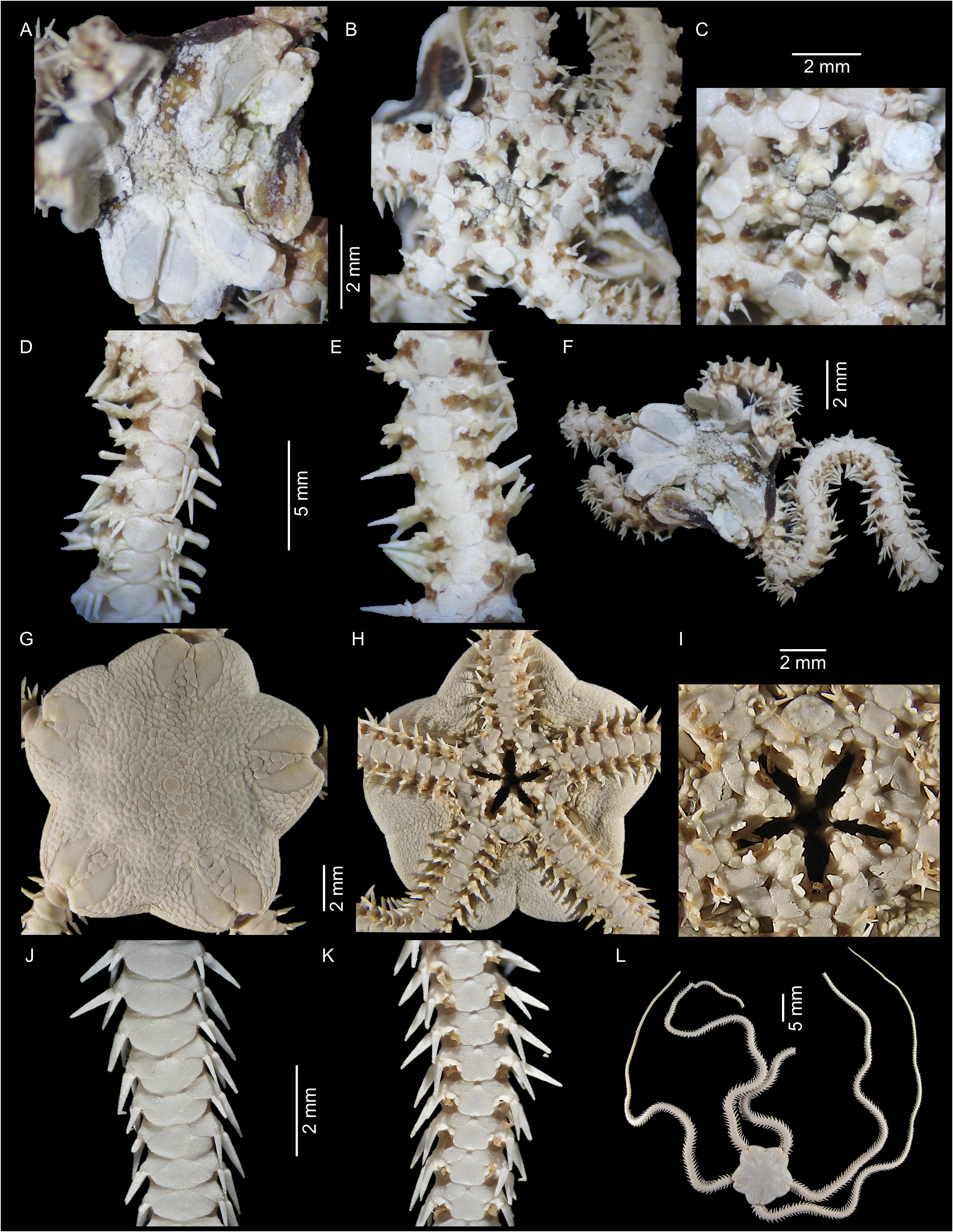
Description (ICML-EMU- 11155). DD = 12 mm. Disc interradially incised. Dorsal disc covered by imbricated scales, center scales larger. Primary plates oval, separated from each other by scales. RS triangular, in contact or slightly in contact only distally, the rest separated by scales (Fig. 15 G). Ventral interradii covered by imbricated scales, smaller than dorsal scales (Fig. 15 H). OSh broader than long, diamond-shaped with rounded edges. Madreporite larger than OSh, with about five hydropores. AdSh scalene triangular, separated. Jaws bearing four oral papillae at each side; AdShSp and 2 AdShSp rounded, short; BSc pointed, short; IPa rounded; a gap between BSc and IPa. vT quadrangular (Fig. 15 I). Arms slender. DAP broader than long, widely fan-shaped, contiguous (Fig. 15 J). VAP almost as broad as long, pentagonal, slightly separated from each other. LAP with up to three ArSp, elongated (almost two arm segments in length), pointed, middle the longest, dorsalmost the shortest and most slender. Tentacle pores with two oval TSc (Fig. 15 K). Color pattern dorsally and ventrally light brown (ethanol preservation) (Fig. 15 G ‒ L). Habitat and distribution. Sri Lanka, Maldives, Philippines Islands, Japan, Tahiti, USA, Mexico, Costa Rica, Panama, Ecuador, and Peru (Lütken & Mortensen 1899; H. L. Clark 1911, 1917; Koehler 1922; Hendler 1996; Stöhr & O’Hara 2021); 71 ‒ 3,310 m depth (Hendler 1996; Stöhr & O’Hara 2021), sandy and rocky substrates (Lütken & Mortensen 1899). The material examined was collected from off western Baja California, in the Gulf of California, and off Colima and Guerrero; 772 ‒ 2,054 m depth.
Sumber: Deep-sea Ophiuroidea (Echinodermata) collected during the TALUD cruises in western Mexico