Deskripsieng
Carlia caesius is heliothermic. In the Timika area, it is often observed basking in patches of sunlight on the floor of primary and secondary lowland alluvial rain forest. These forests have a semiclosed canopy that is 30 – 35 m high and are dominated by large buttressed trees and lianas. The forest floor is relatively open with a thin layer of leaf litter or bare ground and a sparse growth of herbs and shrubs. Some of the dominant tree genera include Pometia (Sapindaceae), Celtis (Ulmaceae), Octomeles (Datiscaceae), and Syzygium (Myrtaceae). There are at least three other similarly sized, grounddwelling, heliothermic species of skinks inhabiting these forests, including Emoia aenea, E. jamur and E. tropidolepis. These species, together with Carlia caesius prefer relatively open parts of the forest that receive moderate to abundant sunlight. Another skink, Lygisaurus [Carlia] novaeguineae, a smaller species, also inhabits the forest floor but tends to prefer denser forest that the other species. Emoia caeruleocauda also occurs in these forests but tends to be semiarboreal and forage in low vegetation such as shrubs and fallen trees. Carlia caesius also occurs in disturbed habitats such as village margins and garden clearings where in the Timika area it cooccurs with at least five species of heliothermic skinks, including Emoia aenea, E. jamur, and E. tropidolepis which occur in small numbers on the ground, and E. caeruleocauda and E. longicauda which are semiarboreal and arboreal, respectively, and common. Carlia caesius is by far the most abundant lizard in disturbed areas. Common trees in these areas include Macaranga sp. (Euphorbiaceae), Casaurina equisetifolia (Casurinaceae), Campnosperma montana (Anacardiaceae), Pisonia sp. (Nyctaginaceae), Linociera sp. (Oleaceae), Artocarpus sp. (Moraceae), and Pandanus sp. (Pandanaceae). The Timika area has a mean temperature of 25.9 ºC with little seasonality (monthly means range from 24.2 to 26.6 ºC). Rainfall is somewhat more seasonal, with a peak in July but no distinct dry season. Generally, monthly rainfall is at least 200 mm with an average of about 20 rain days each month.
Sumber: New Carlia fusca complex lizards (Reptilia: Squamata: Scincidae) from New Guinea, PapuaIndonesia
Deskripsieng
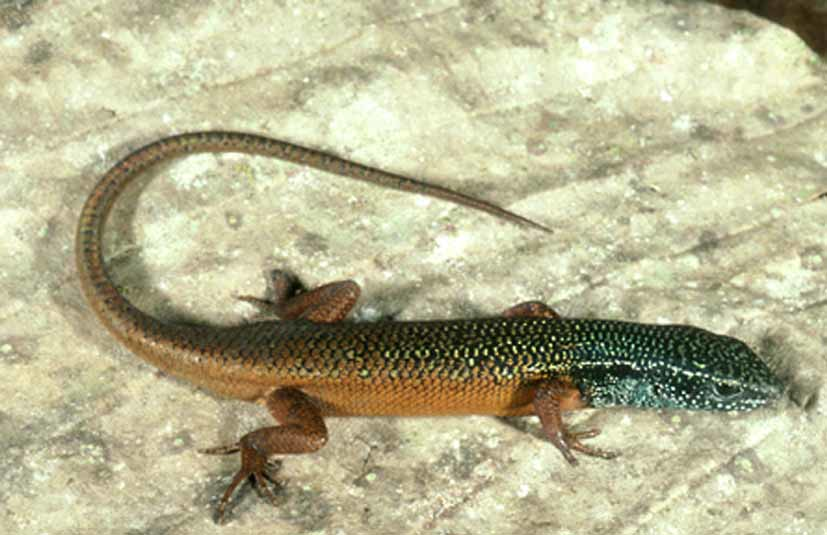
Description of holotype An adult male, 61.9 mm SVL, 85.5 mm tail length (21 mm tip regenerated), 26.9 mm TrunkL, 31.1 mm HindlL, 14.8 mm HeadL, 2.2 mm PalpbD, and 1.9 mm EarD. Scalation right side for bilateral traits: interparietal separate, prefrontals not touching, 4 Supoc, 8 Supcil, 9 Eyeld, 4 Temp, 2 Lor, 7 Suplab, 5 th BlwEye, 6 Inflab, round earopening, 1 AuricN on anterior border, 44 tricarinate Dorsal (anteriormost bilateral pair enlarged as nuchals), 32 Midbody, 22 smooth 3 FingL (slight clefting of few subterminal lamellae), 25 4 ToeL, and precloacal scale slightly enlarged. Coloration in life: strikingly twotoned lizard; dorsally and laterally head and neck turquoise ground color muted by black edging on all scales, irregular edged black lateral band from cheek to anterior axilla, dorsolaterally a narrow white stripe from eye to axilla, ventrally turquoise ground color shifts to light blue with persistence of black scaleedging although narrower; at axilla and forelimbs abrupt shift to bright reddish orange ground color, muted dorsally by black edging on scales, edging nearly disappears laterally, dorsally light spots greenish yellow; limbs above and below uniform reddish orange; ventrally chest onto to tail beige with orangish tint. Coloration in preservative: Dorsally head dark brown, speckled with black and turquoise; neck similar but black restricted to scale margins; rest of dorsum golden brown with black speckling and a few scattered light brown spots; upper parts of tail similar but without light brown spots and with less black than rest of dorsum; dorsolaterally, bluish, discontinuous line from eye to shoulder, face and neck mostly black and speckled with turquoise, especially towards venter and distinct series of black lines extend posteroventrally from lower labials to directly below ear; rest of flanks and anterolateral surface of tail light brown; chin and throat light black suffused with blue, with darker black blotches on chin, and series of longitudinal black lines along throat and neck; rest of venter whitish suffused with yellowish tinge and indistinct blueblack streaks on proximal margins of scales. Description. A moderatesized Carlia ranging in adult size from 45 to 65 mm SVL (females 45.1 – 55.2 mm; males 45.7 – 64.5 mm) with HeadL 9.9 – 13.0 mm (females) 10.8 – 15.9 mm (males), PalpbD 1.0 – 1.8 mm (females) 1.3 – 2.2 mm (males), EarD 1.0 – 2.0 mm (females) 1.2 – 2.0 mm (males), TrunkL 18.8 – 27.0 mm (females) 18.6 – 31.4 mm (males), and HndlL 19.6 – 29.5 mm (females) 22.2 – 32.7 mm (males). Some populations sexually dimorphic in one or more of the following traits: SVL, HeadL, PalpbD, EarD, TrunkL, HndlL, and Dorsal. Head and nuchal scales smooth; interparietal rarely absent; 4 (rarely 5 or 6) Supoc, 7 – 10 Supcil, 6 – 12 Eyeld, 7 (rarely 6) Suplab, 5 th (rarely 4 th) BlwEye, and 6 (uncommonly 5, 7, or 8) Inflab on each side. Ear opening oblong vertical to oblique with 1 – 5 (commonly 3) AuricN, usually pointed, on anterior and dorsal margin. Trunk scales smooth to weakly tricarinate dorsally and laterally, occasionally strongly tricarinate in males, rarely in females, with 42 – 50 Dorsal, 31 – 36 Midbody. Subdigital lamellae smooth, mostly 32 4 ToeL. Coloration is summarized in the subsequent Intraspecific Variations section.
Sumber: New Carlia fusca complex lizards (Reptilia: Squamata: Scincidae) from New Guinea, PapuaIndonesia