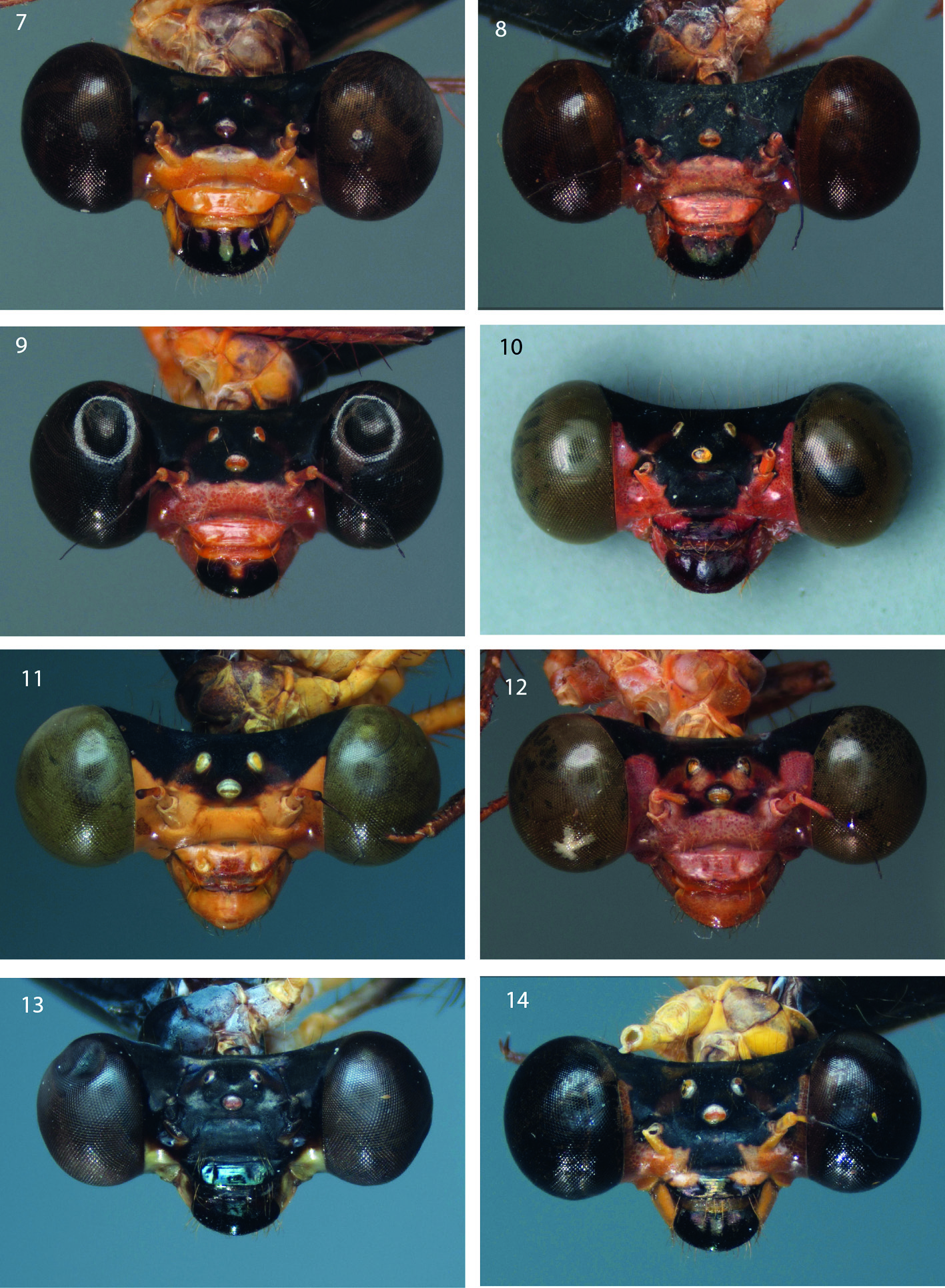
Male Description of male specimen from Ranotongkor (JvT 6476; collected by L. Coomans de Ruiter in 1940) Head − Anterior ⅔ of labium blackish, posterior third yellow-brown. Labrum shining metallic black. Front of head, including mandibles, clypeus and sockets of antennae ochre (Fig. 7). Antennae brown, dorsum of head black. Thorax − Sides of prothorax dull yellow; anterior lobe of pronotum dull yellow with outer rim brown-black, median part of middle and posterior lobe blackish, remainder dull yellow. Posterior lobe of pronotum broad, seen from lateral gently sloping and with the outer border steeply raised, lateral corners rounded. Pattern of thorax as in Figure 15; darker areas black, pale areas dull yellow. Legs − Coxae and trochanters dull yellow, femora yellow with two broad but poorly defined black rings, knees black, tibiae and tarsi yellow-brown. Spines pale orange-brown; femora with respectively 9 – 11, 8 – 9 and 12 – 13 spines laterally; tibiae of fore legs with 8 – 9 smaller and 5 – 6 larger spines laterally; tibiae of mid and hind legs with 11 – 12 and 11 – 13 spines laterally respectively. Wings − Venation black, membrane hyaline, Fw and Hw with 2 Ax, Fw with 35 – 38 Px and Hw with 33 Px. Ac at about a tenth the distance between Ax 1 and Ax 2. Brace vein absent. Pterostigma brown. Three, rarely four rows of cells between anal vein and border of Hw. Abdomen − Pattern as in Figure 15; dark pattern elements dark brown to black, pale pattern elements yellow-brown. Anterior half of S 1 yellow, posterior half brown to black, S 2 with dorsum black and anterior section laterally yellow, S 3 – 8 dorsally largely dark, ventrally and lower lateral section yellow, anteriorly of S 3 – 8 the yellow reaches to the dorsum forming a yellow ring. S 9 – 10 black, the latter strongly depressed in the middle, its hind bor- der without modifications. Appendages as shown in Figures 34 – 36; base of lower appendages yellow, remainder dark brown. Lower appendages long, in lateral view slightly longer than ½ of upper appendages and, when seen from lateral, with tip reaching level of the upper appendages. Genital ligula as in Figures 23 – 25, with a deep apical cleft and with large lateral lobes. Variability In ventral view the inferior appendages shows minute differences in shape between localities. The inferior appendages are however often slightly distorted making it difficult to judge these differences. In part of the material from the Banggai Penisula, listed here as C. cinctus ‘ red leg’ form, the pale coloration of head and thorax has a more reddish tinge (Fig. 17). In addition to this the black rings on the femora are less pronounced and often hardly detectable (Fig. 17). I decided to give no taxonomic status to this form as these specimens do not differ in morphology from specimens from other localities and as there are only differences in tint of the colouration but not in the pattern. The specimens from Sangihe Islands have a relatively open venation with a low number of Px. Despite the variability found within C. cinctus it is likely to be monophyletic. Wings − Fw and Hw with 2 Ax; Fw with 35 – 38 Px (29 – 30 in material from Sangihe) and Hw with 32 – 33 Px (26 – 28 in material from Sangihe). Measurements [mm] − Total length 44 – 48, abdomen 32 – 38, Fw 28 – 34; Hw 29 – 34. Female Head − Pattern on head as in male. Thorax − Pattern on prothorax, synthorax and legs as in male. Fw and Hw with 2 Ax; Fw with 27 – 32 Px (25 in material from Sangihe) and Hw with 25 – 31 Px (23 in material from Sangihe). Pt white with a slight yellow tinge, outer border often mottled greyish-black. Abdomen − Pattern as in Figure 7 a; dark sections dark brown to black, pale sections yellow-brown. S 3 – 9 dorsally largely dark, ventrally and lower lateral area yellow, anteriorly on each segment the yellow reaches to the dorsum forming a yellow ring covering approximately ¹ / ₅ to ¹ / ₁ 0 of the segment. S 10 black, cerci brown, base of valvifer yellow becoming brown to black towards the tip. Measurements [mm] − Total length 36 – 40; abdomen 28 – 31, Fw 27 – 31; Hw 27 – 31.