Biologi & Ekologieng
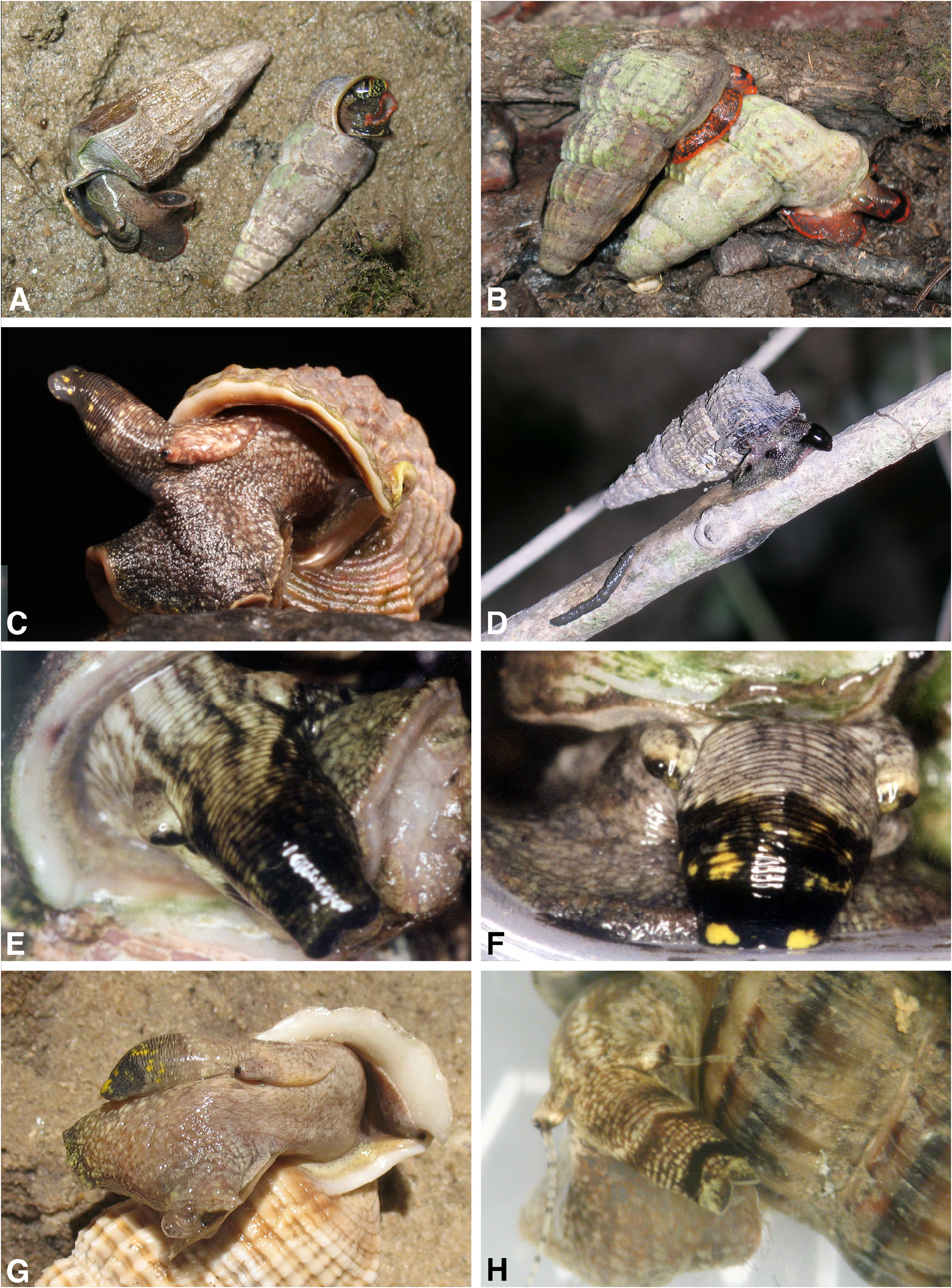
Habitat and ecology. This species is typically found in the Ceriops zone of mangrove forests, often among shrubs on the fringes of bare salt pans, at heights of up to 1 m on trunks, and sometimes on firm mud beneath the trees. It is less common on trunks in the Rhizophora and Bruguiera zones, or in the landward fringe, where it may reach 3 m up the trees.
Sumber: The genus Cerithidea Swainson, 1840 (Gastropoda: Potamididae) in the Indo-West Pacific region
Deskripsieng
Shell (Fig. 10 A – P): H = 24.0 – 50.3 mm. Shape elongated conical (H / B = 2.01 – 2.62, SH = 2.83 – 3.54); decollate, 7 – 10 whorls remaining; spire whorls rounded, suture distinct; spire profile straight to slightly convex; periphery rounded or weakly angled; moderately solid. Adult lip flared, moderately thickened; apertural margin planar in side view; strong anterior projection adjacent to deep notch of anterior canal. Sculpture on spire of straight to slightly curved (opisthocyrt) axial ribs, often bifurcating posteriorly (adapically) to give a row of granules at suture (occasionally bifurcation occurs lower on whorl to increase number of axial ribs; Fig. 10 J, N – P); ribs prominent, narrowly rounded, interspaces 1.5 – 2 times width of ribs (occasionally equal), 14 – 40 ribs on penultimate whorl, remaining strong but becoming more distant after ventrolateral varix, weak on base; spire whorls with 5 narrow spiral cords, often forming nodules where they cross axial ribs, usually increasing by interpolation of narrower threads to give 4 – 10 spiral cords and threads above periphery on final whorl; base with 7 – 11 narrow ridges, peripheral one is a cord of same size as primary cords above, but others on base slightly narrower. Ventrolateral varix a slightly enlarged rib at 200 – 260 °. Surface with fine spiral microstriae on periostracum. Colour: pinkish brown to fawn, spiral ribs usually darker brown (especially on anterior half of whorls, giving appearance of broad brown band), axial ribs paler; aperture pale brown, spiral lines showing through. Animal (Fig. 2 C): Head and base of tentacles pinkish grey with cream spots; anterior half of snout blackish with scattered yellow spots; tentacles cream, grey towards tip; sides of foot dark grey speckled with grey, brown and white, small yellow spots at margin; sole of foot grey with pinkish border; mantle blue grey. Range (Fig. 11): Queensland (Qld) and Northern Territory (NT) of Australia, New Guinea. Records: Australia: Prince Regent River Reserve, Western Australia (Houbrick 1986: fig. 5); Forrest River Mission, 50 miles from Wyndham, NT (AM C. 085156); Buffalo Creek, Darwin, NT (NHMUK 20130241; USNM 828819); Bing Bong Station, W Gulf of Carpentaria, NT (AM C. 412929); Allen I., S Wellesley Is, S Gulf of Carpentaria, Qld (AM C. 015839); Moa I., Torres Strait, Qld (NHMUK 20130244); Cockle Bay, Magnetic I., Qld (NHMUK; USNM 828828); Lota Creek, Wynnum, Moreton Bay, Qld (AM C. 138069); Brunswick R., New South Wales (D. Riek, pers. comm.). Indonesia: Kupang, West Timor (ZMB); Biak, Soepiori I., Schouten Is, East Papua (ANSP 207534); Sulawati I., East Papua (AM); Kokenau, Mimika R., East Papua (AM C. 458258); Merauke, East Papua (AM C. 121289). Papua New Guinea: Collingwood Bay (AM C. 18891). Sowerby (1855, 1866) erroneously gave the locality as ‘ Philippines and Borneo’ (as Cerithium kieneri).