Deskripsieng
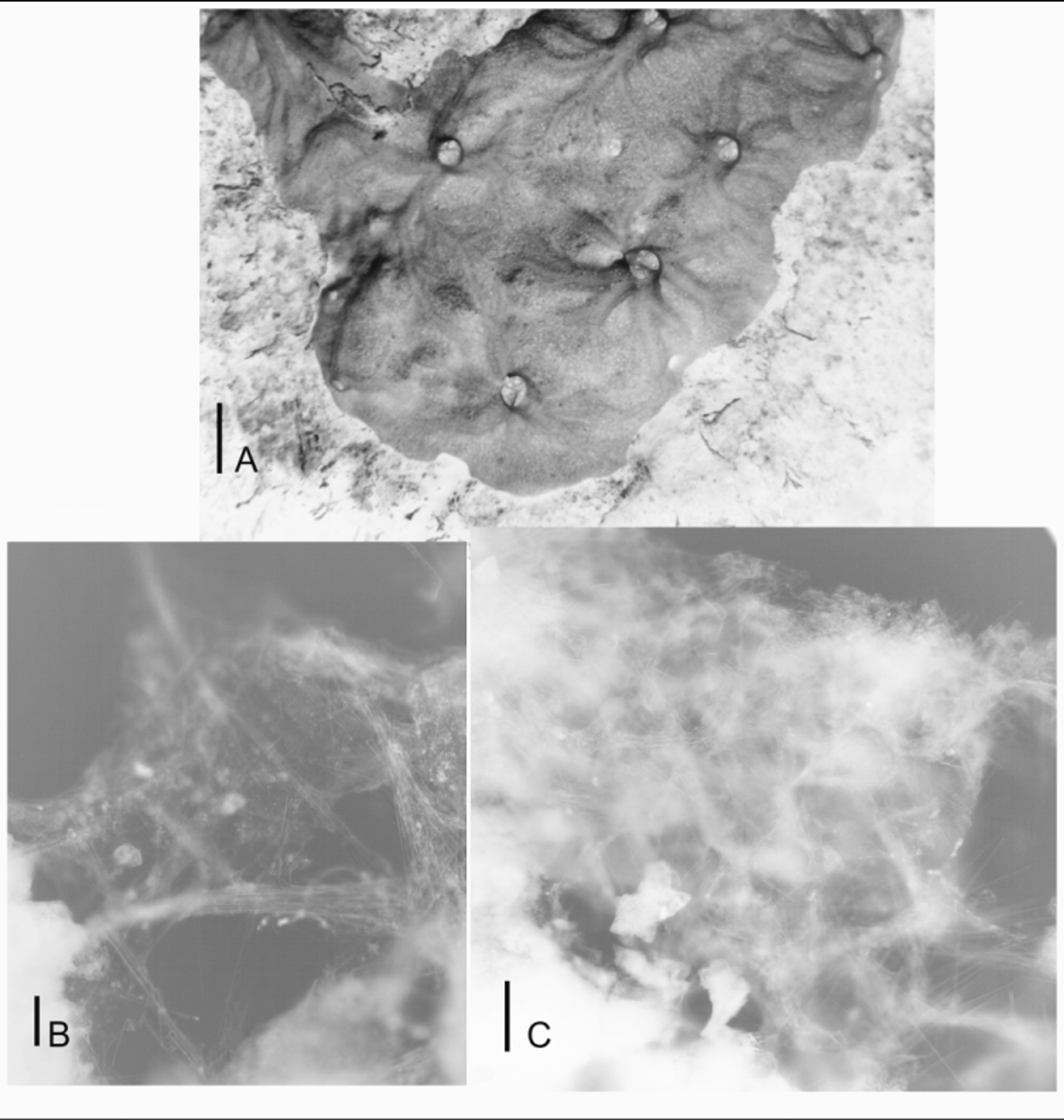
Description. This is a thin incrustation over rock 6 – 9 × 3.8 cm 2, 1 – 3 mm thick. Light grey in vivo, creamy white in spirit, consistency soft, slimy. Surface smooth with a canal system seen through the dermis, characterized by a bulged stellate pattern with oscules round and centered, 4 mm in diameter (Fig. 15 A); all of which contract when out of water. The dermis is detachable when touched. Skeleton. The ectosomal consists here and there of ill-defined bouquets of auxiliary subtylostyles, slightly protruding from the surface; obscured by many other subtylostyles tangentially displayed and others in vague tracts. The choanosomal skeleton consists of a basal plate from which arise vague, straight, and sinuous tracts sometimes just simulating a bundle of spicules aligned in any direction (Fig. 15 B – C); the basal plate is combined also with a leptoclathriid arrangement of singly thick subtylostyles and acanthostyles with their heads fixed to the basal plate, points directed upwards. Spicules. Thin auxiliary subtylostyles with smooth and microspined heads in two size categories: I, 80 – 205 × 1.5 – 3.7 µm; II, 243.7 – 377 × 3 – 6 µm. Thick subtylostyles with a slight constriction at the neck, rugose heads or sometimes smooth; there are few of these in the field 127.4 – 317 × 5 – 10.4 µm; acanthostyles spined all over 47 – 68.1 × 3.6 – 5 µm; palmate isochelae 4.4 – 12 µm; two or perhaps three categories of toxas: I, 5.2 – 15.6 µm; toxa II in low numbers, 34.5 – 57.2 µm; and rhaphidiform or accolada toxa, 87 – 468 µm (Fig. 16 A – I, Measurements in Tab. 5).
Sumber: The genus Clathria from the Gulf of Mexico and Mexican Caribbean, with redescription and resurrection of Clathria carteri (Poecilosclerida: Microcionidae)
Distribusieng
Distribution. It has been recorded once in Veracruz, Mexico 8 m depth (Gómez 2007); Cuba 1 m depth, Brasil 3 – 4 m depth, Panama. From mangrove and reef habitat.
Sumber: The genus Clathria from the Gulf of Mexico and Mexican Caribbean, with redescription and resurrection of Clathria carteri (Poecilosclerida: Microcionidae)
Distribusieng
Distribution and ecology. Gulf of Mexico (Veracruz, Gómez 2014), Cuba (Alcolado 1984, 2002), Jamaica (Hechtel 1965; Lehnert & van Soest 1998), Guadeloupe (Alcolado & Busutil 2012: 69), Colombia [Santa Marta (also Sánchez 1984; Wintermann-Kilian & Kilian 1984; Rozemeijer & Dulfer 1987; Zea 1993, 1994 b; Aerts 2000), Cartagena and Islas del Rosario (also González Calderón 1992; Zea & Díaz-Sánchez 2011), Islas de San Bernardo, Urabá (Valderrama & Zea 2013)], Panama (Díaz et al. 2005; Collin et al. 2005), Belize (Rützler et al. 2000), Brazil (Bahia, Hajdu et al. 2011). Seems to be absent from Florida, Bahamas, and from reefs of the San Andrés and Old Providence Archipelago in the SW Caribbean (although it may be present in the latter localities on mangrove stilt roots). Its presence in Curaçao needs to be confirmed. In Bocas del Toro (Panama), S. Z. did not observe this species on rocky and reef environments; it occurs in mangrove habitats (Díaz et al. 2005 and Collin et al. 2005). In the continental coast of Colombia this species is an important space occupier of hard substrata, including rocky shores, caves (Rozemeijer & Dulfer 1987), reefs (where they frequently interact with live corals, see Aerts 2000), dock pilings and mangrove stilt roots. In general, it inhabits from shallow waters to 30 m deep or more.
Sumber: Taxonomy of Clathria (Thalysias) (Demospongiae: Poecilosclerida: Microcionidae) from the Colombian Caribbean, with description of three new species
Distribusieng
Distribution. Gulf of Mexico and Caribbean.
Sumber: Diversity of sponges (Porifera) from cryptic habitats on the Belize barrier reef near Carrie Bow Cay