
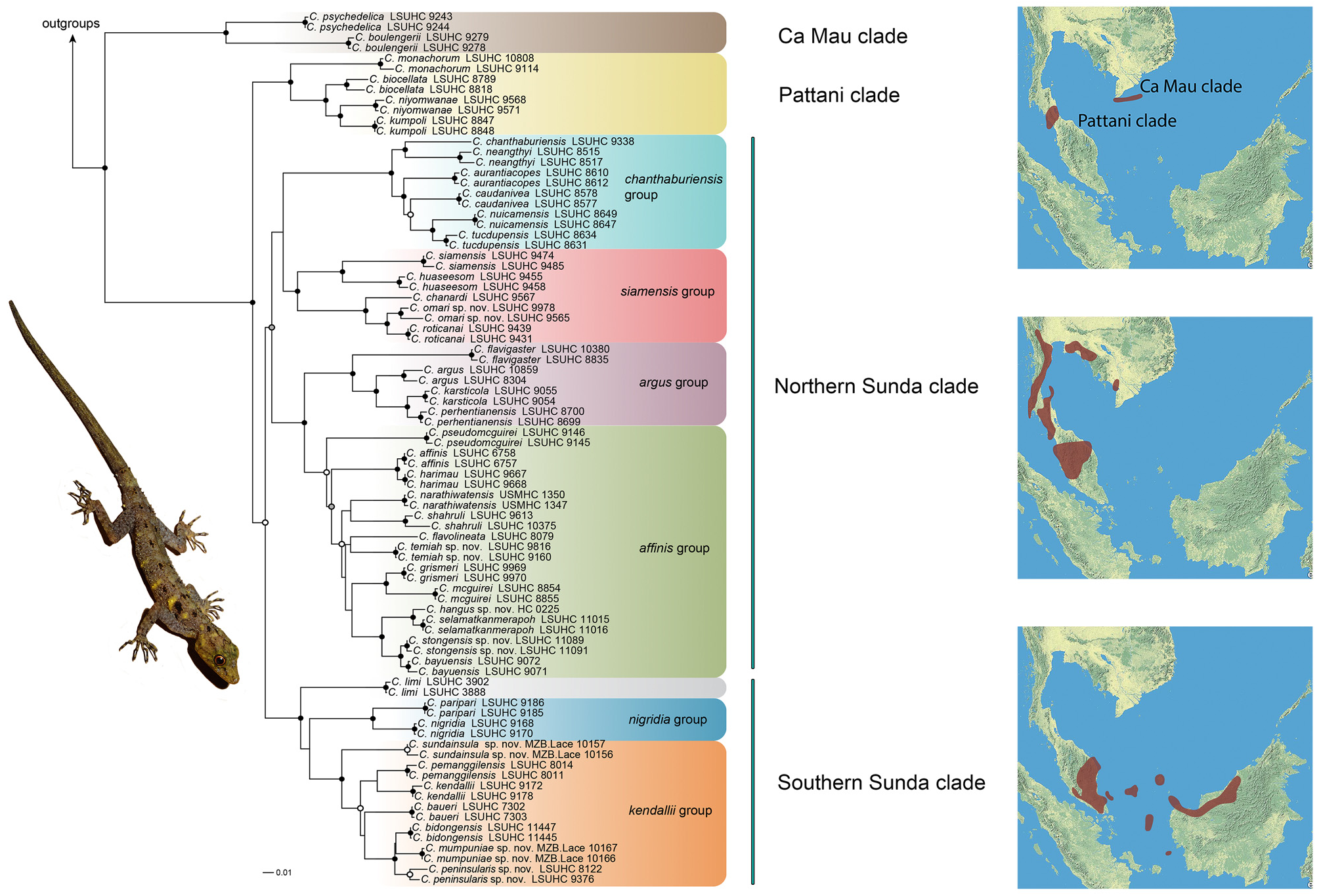
Description of holotype. Adult male SVL 51.6 mm; head oblong in dorsal profile, moderate in size (HL / SVL 0.26), somewhat narrow (HW / SVL 0.17), flattened (HD / HL 0.41), distinct from neck; snout short (ES / HL 0.50), concave in lateral profile; postnasal region weakly constricted medially, flat; scales of rostrum weaklykeeled, slightly raised, slightly larger than similarly shaped scales on occiput; low, supraorbital ridges; weak frontorostral sulcus; canthus rostralis not very discernable; eye large (ED / HL 0.23); extra-brillar fringe scales largest anteriorly; pupil round; ear opening oval, taller than wide; rostral concave dorsally, dorsal 90 % divided by longitudinal groove; rostral bordered posteriorly by two large supranasals, an equally sized azygous scale, and external nares; boredered laterally by first supralabials; 10 R, L raised supralabials decreasing in size posteriorly; 8 R, L infralabials, decreasing in size slightly posteriorly; nostrils elliptical, oriented dorsoposteriorly; bordered posteriorly by small, granular, postnasal scales; mental large, triangular, concave medially, bordered posteriorly by two large, rectangular, lateral postmentals of similar size and one smaller azygous scale; gular scales raised, smooth; throat scales larger, raised, weakly keeled. Body slender, elongate (AG / SVL 0.43); small, keeled, dorsal scales generally equal in size throughout body, intermixed with larger, multicarinate tubercles in semi-linearly arranged; tubercles extend from occiput to base of tail; tubercles moderate in size; tuberculation weak on lower flanks, 18 paravertebral tubercles; pectoral and abdominal scales raised, keeled, not elongate, same size throughout; abdominal scales slightly larger than dorsals; no precloacal pores; forelimbs moderately long, slender (FL / SVL 0.21); dorsal scales of brachium raised, keeled; dorsal scales of forearm raised, keeled; ventral scales of brachium smooth, raised, juxtaposed; ventral scales of forearm weakly keeled, raised, juxtaposed; palmar scales smooth, juxtaposed, raised; digits long with an inflected joint; claws recurved; subdigital lamellae unnotched; lamellae wide throughout digit; interdigital webbing present; fingers increase in length from first to fourth with fourth longer than fifth; hind limbs slightly longer and thicker than forelimbs (TBL / SVL 0.23); dorsal scales of thigh keeled, raised, juxtaposed; scales of anterior margin of thigh keeled; ventral scales of thigh keeled; subtibial scales raised, keeled, juxtaposed, with no enlarged anterior row; plantar scales smooth, juxtaposed, raised; no enlarged submetatarsal scales beneath first metatarsal; digits elongate with an inflected joint; claws recurved; subdigital lamellae unnotched; lamellae beneath first phalanges granular proximally but wider distally throughout digit; interdigital webbing present; toes increase in length from first to fourth with fourth being slightly longer than fifth; 32 subdigital lamellae on fourth toe; caudal scales arranged in segmented whorls; dorsal caudal scales flat anteriorly, keeled, juxtaposed; weak middorsal and deep lateral caudal furrows; subcaudal scales keeled; median row of enlarged, keeled subcaudal scales; caudal tubercles encircle tail; tubercles absent from lateral furrows; two enlarged postcloacal tubercles on lateral surface of hemipenal swellings at base of tail. Color pattern (Fig. 59). Dorsal ground color brick-red; medial, whitish spot on rostrum, canthus rostralis bearing whitish line; thin, white nuchal loop extending from posterior margin of one orbit to the other; thin, white postorbital line below nuchal loop extending obliquely to corner of mouth; paired whitish markings on occiput; small, white, linearly arranged spots on side of neck and nape; large, faint, dark, linearly arranged blotches on anterior portion of body and nape; flanks bearing small, round, white spots thatextend onto lateral margins of abdomen; five whitish bands consisting of a row of three, transversely aligned blotches occur between limb insertions and extend onto anterior one-half of tail transforming into light, caudal bands that alternate with dark bands, posterior one-half of tail black; dorsal surfaces of limbs mottled with white; ventral surface of gular, pectoral, abdominal, and anterior subcaudal region beige; throat and limbs darker; posterior one-half of subcaudal region black; all other ventral surfaces suffused with black stippling in scales. Variation (Fig. 59). The type series shows a modest array of color pattern variation. MZB. Lace 10168 closely resembles the holotype in overall coloration whereas the dorsal ground color in MZB. Lace 10166 and 10168 is lighter and the overall blotching lighter, giving them a less contrasted and spotted appearance. MZB. Lace 10168 is a female and lacks the black posterior caudal region. The posterior one-half of the tail in MZB. Lace 10169 is regenerated and unicolor tan. MZB. Lace 10163 is very faded overall but most likely matches MZB. Lace 9441 and MZB. Lace 10168 in general coloration. The flanks of all specimens of the type series are not as boldly marked as in the holotype. Meristic and mensural variation is listed in Table 13. Comparisons. Cnemaspis mumpuniae sp. nov. is a member of the Southern Sunda clade which includes C. limi, C. nigridia, C. paripari, C. kendallii, C. sundainsula sp. nov., C. pemanggilensis, C. baueri, C. bidongensis, and C. peninsularis sp. nov. Within this clade, it is part of an unresolved polytomy that includes C. kendallii, C. sundainsula sp. nov., C. pemanggilensis, C. baueri, C. bidongensis, and C. peninsularis sp. nov. of the kendallii group (Fig. 2). Cnemaspis mumpuniae sp. nov. is easily separated from C. limi by being much smaller (maximum SVL 56.6 mm versus 88.2 mm); having fewer paravertebral tubercles (18 – 24 versus 25 – 35); having keeled versus smooth subcaudal scales; the presence versus the absence of a ventrolateral row of caudal tubercles; having caudal tubercles that encircle the tail versus not having tubercles encircling the tail; and lacking versus having white caudal tubercles. From C. paripari, C. mumpuniae sp. nov. lacks precloacal pores as opposed to having them; has fewer paravertebral tubercles (18 – 24 versus 26 – 31); has as opposed to lacks tubercles on the flanks; has as opposedto lacks a ventrolateral row of caudal tubercles; has caudal tubercles that encircle the tail versus not having tubercles encircling the tail; lacks as opposed to having an enlarged, median subcaudal scale row; and males lack as opposed to having a yellow head, limbs, and back and the posterior one-half of the original tail being white. Within the kendallii group, C. mumpuniae sp. nov. is distinguished from C. sundainsula sp. nov., C. pemanggilensis, and C. baueri by being much smaller (maximum SVL 56.6 mm versus 67.4 – 84.5 mm) and from C. sundainsula sp. nov. it is further separated by having caudal tubercles that encircle the tail rather than not having such tubercles. Cnemaspis mumpuniae sp. nov. is further separated from C. pemanggilensis by having fewer paravertebral tubercles (18 – 24 versus 30 – 37) and lacking as opposed to having an enlarged, median row of keeled subcaudal scales. From C. baueri, C. mumpuniae sp. nov is further differentiated by lacking an enlarged, median row of keeled subcaudal scales and not having a uniform brown dorsal color pattern bearing large, elongate black blotches on the nape and shoulder region. Cnemaspis mumpuniae sp. nov. is differentiated from C. kendallii sensu stricto in that the posterior two-thirds of the original tail in adult male C. mumpuniae sp. nov. is black dorsally and ventrally and in adult male C. kendallii the tail is banded dorsally throughout its length and the subcaudal region is essentially immaculate white. The regenerated tail in adult male C. mumpuniae sp. nov. is yellow and immaculate dorsally and ventrally whereas that of C. kendallii sensu stricto is straw-colored with small black flecks dorsally and the subcaudal region is immaculate white. Additionally, C. kendallii sensu stricto has a row of nearly contiguous tubercles on the lateral margins of the occipital region bordering the nape which are nearly always absent in C. mumpuniae sp. nov. Within the kendallii group, C. mumpuniae sp. nov. is most closely related to the sister species C. bidongensis and C. peninsularis sp. nov. (Fig. 2). It differs from them in having a brick-red ground color and a thin, white, nuchal loop. It is differentiated further from C. peninsularis sp. nov. having as opposed to lacking an enlarged, median, subcaudal scale row.
Sumber: Systematics and natural history of Southeast Asian Rock Geckos (genus Cnemaspis Strauch, 1887) with descriptions of eight new species from Malaysia, Thailand, and Indonesia