Deskripsieng
Cicak Batu Gunung Muria Figures 2 – 5 urn: lsid: zoobank. org: act: 066 FE 9 E 7 - 7916 - 4 E 8 E-AE 81 - CEFCCB 8901 C 8
Sumber: Hiding in plain sight on Gunung Muria: A new species and first record of rock gecko (Cnemaspis Strauch, 1887; Squamata, Gekkonidae) from Java, Indonesia
Deskripsieng
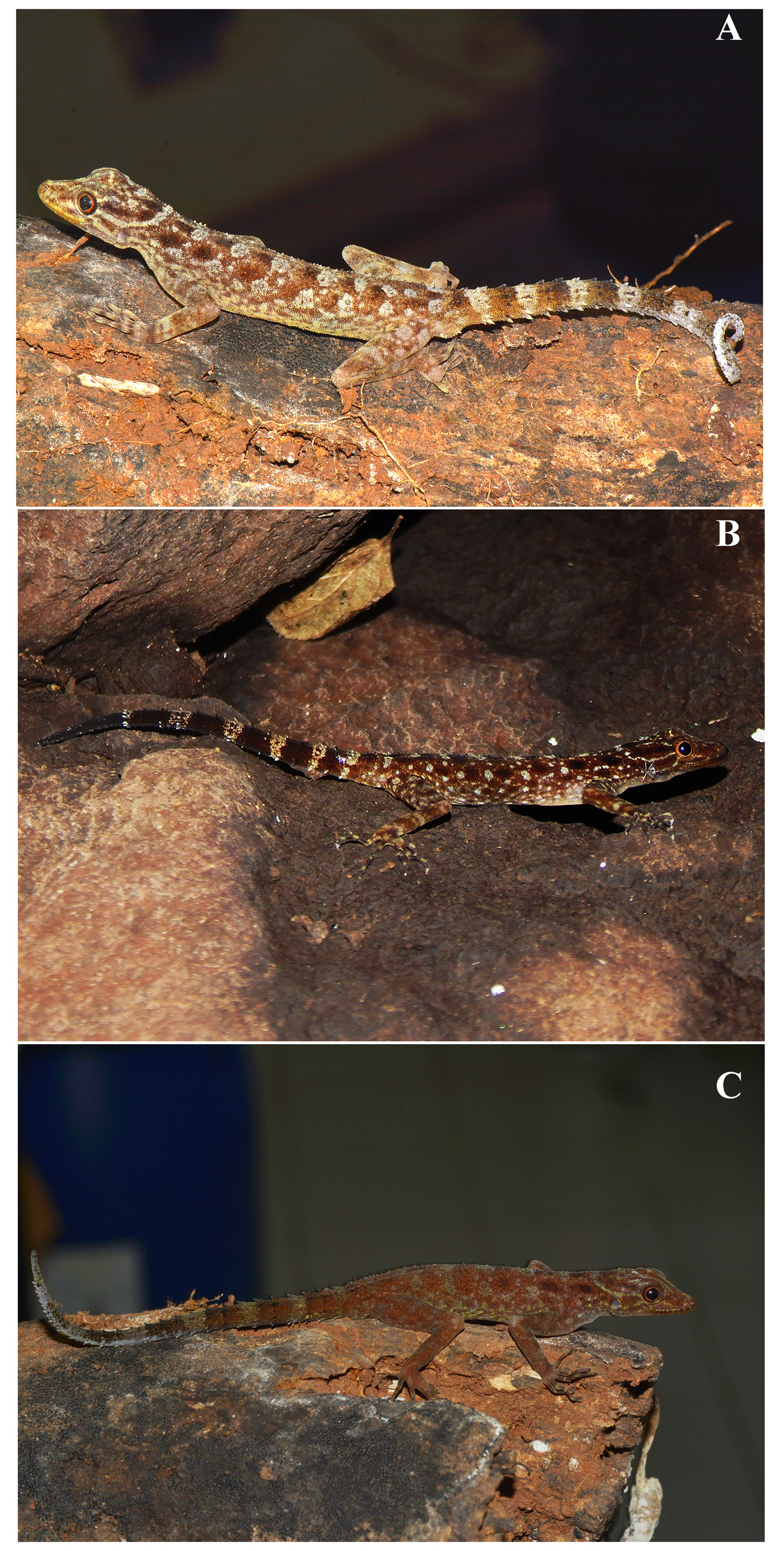
Description of holotype. An adult male, 56.8 mm SVL; head oblong in dorsal profile, moderately large in size (HeadL / SVL 0.28), elongate (HeadW / HeadL 0.65), narrow and flattened (HeadD / HeadL 0.36), distinct from neck; snout short (SnoutL / HeadL 0.43), slightly concave in lateral profile; snout longer than the distance between eye and ear (SnouL / EarEye 1.67); canthus rostralis smoothly rounded; eye large (ED / HeadL 0.21; ED / SnoutL 0.50); pupil round; ear opening oval, taller than wide; rostral concave, dorsal 80 % divided by longitudinal groove; rostral width 1.66 times of it’s length; rostral bordered posteriorly by two small supranasals and two large scales between the supranasals and laterally by first supralabials; 10 supralabials on each side; 9 infralabials on each side, decreasing in size slightly posteriorly; nostrils elliptical, oriented posterodorsally, bordered posteriorly by small, granular, postnasal scales; a pair of bridges of warts present on occiput; nuchal loop present, bearing a bridge of warts extending from upper tympanum to the nape in a curved formation (Fig. 3). Mental large, sub triangular, elongate (MentL / MentW 1.11), and extending posteriorly to a point equal to the anterior part of third infralabial, laterally in contact with first infralabial, posterolaterally bordered by three postmental scales; asymmetric arrangement of the postmentals, slightly damaged on the right side of the postmental, postmentals bordered posteriorly by 11 weakly keeled scales; scales on throat raised and weakly keeled. Body slender, elongate (AGL / SVL 0.41); dorsal body covered by pointed-weakly unicarinate scales which homogeneous in size; dorsal tubercles moderately prominent and randomly distributed; absent tubercles on flank; dorsal scales at mid-body smaller than ventral at same level; 20 PVT, flat, sub-pyramidal and weakly tricarinate, each about two or three times as large as granules separating them; abdominal and ventral scales sub-equal in size, ovoid, tricarinate, juxtaposed; pre-cloacal and femoral pores absent; enlarged femoral scales absent. Forelimbs short (AntBraL / SVL 0.18; BracL / SVL 0.17); dorsal scales on both upper and lower arm, same size as abdominal scales; ventral scales on lower arm slightly larger than ventral scales on upper arm, unicarinate; ventral scales on lower arm weakly tricarinate; digits well developed, elongate, slender, all bearing slightly recurved claws; enlarged sub-metacarpal present at base of first finger (Fig. 4 A); relative length of fingers 4> 3> 5> 2> 1. Hindlimbs relatively long (TibiaL / SVL 0.26; ThighL / SVL 0.23); dorsal scales on both tibias and thighs weakly tricarinate, size relatively homogeneous; subtibial sligthly smaller than subfemoral scales, enlarged scales absent, both tricarinate; digits well developed, elongate, slender, all bearing slightly recurved claws; enlarged submetatarsal present at the base of first toe (Fig. 4 B); relative length of toes 4> 3> 5> 2> 1; 31 lamellae under fourth toe. Tail original (TailL 73.5 mm), long (TailL / SVL 1.29), base swollen; two conical postcloacal tubercles present on each side; a distinct furrow on the lateral surface of the tail present; caudal tubercles encircling tail in whorls; tail segmented with 21 whorls of tubercles, each whorl consisting of ten enlarged keeled tubercles separated from one another by 1 to 8 small scales; each whorl separated from adjacent whorls by 5 to 7 small scales; subcaudal scales unicarinate; interrupted median row of enlarged unicarinate subcaudals (Fig. 5). Color pattern in life. Dorsal ground color brick-red; rostrum mixed yellowish; supralabials, infralabials and superciliaries yellow; a yellowish white continuous nuchal loop present, extending from middle posterior margin of one orbit to the other; a yellow line present, extending from lower posterior margin of orbits to the lower anterior margin of ears; white ocelli in shoulder region; three black weakly longitudinal spots arranged in a transverse row on the nape and shoulder region; seven blackish blotches intermixed with six white blotches along spine extending from shoulder to hindlimb insertion; six white dorsolateral blotches between limb insertions; flanks bearing small, round, yellow spots that extend onto along lateral margins of abdomen; dorsal ground color of tail dorsum is brickred, interrupted by blackish and white transverse bands and the apex of the tail white. In mental region ventral part of infralabials yellow; gular region yellowish white; pectoral and abdominal regions yellow; subantebrachials, subbrachials, precloacal region, subtibials and subfemorals yellowish; palms and tarsals yellow; proximal subcaudals yellow until about the ninth whorl, then white distally. Variation. Meristic data for the single female are similar to those of males and measural data are included within the range of males (see Table 3), which led us to consider them as conspecific, despite the differences in coloration. The new species exhibits sexual dimorphism in ventral color pattern. Males have a yellow belly whereas it is white in the female and the ventral surface of tail in males is proximally yellow and distally white (changing at approximately mid-length) but in the female alternating black and white rings completely encircle the tail, which is black distally (Fig. 6).
Sumber: Hiding in plain sight on Gunung Muria: A new species and first record of rock gecko (Cnemaspis Strauch, 1887; Squamata, Gekkonidae) from Java, Indonesia
Deskripsieng
In having enlarged median row of subcaudals, Cnemaspis muria sp. nov. can be distinguished from C. aceh, C. andalas, C. bidongensis, C. biocellata, C. bidongensis, C. dezwaani, C. jacobsoni, C. kumpoli, C. limi, C. mahsuriae, C. minang, C. modiglianii, C. monachorum, C. mumpuniae, C. nigridia, C. pagai, C. paripari, C. pemanggilensis, C. sundagekko, C. sundainsula, C. whittenorum, and C. tapanuli. The new species can be separated from Cnemaspis andalas, C. biocellata, C. flavigaster, C. kumpoli, C. laoensis, C. limi, C. minang, C. monachorum, C. sundainsula, and C. tapanuli by having keeled subcaudal scales. The new species lacks a vertebral stripe which separates it from C. aceh, C. andalas, C. dezwaani, C. flavolineata *, C. jacobsoni, C. narathiwatensis, C. pseudomcguirei *, C. shahruli *, C. tapanuli, C. temiah * and C. whittenorum (species with variable presence of this character indicated by an asterisk *).
Sumber: Hiding in plain sight on Gunung Muria: A new species and first record of rock gecko (Cnemaspis Strauch, 1887; Squamata, Gekkonidae) from Java, Indonesia
Deskripsieng
The lack of precloacal pores in the new species distinguish it from all the following species which have precloacal pores: C. andalas, C. affinis (Stoliczka, 1870), C. argus Dring, 1979, C. bayuensis Grismer, Grismer, Wood & Chan, 2008, C. bidongensis, C. biocellata, C. hangus Grismer, Wood, Anuar, Riyanto, Ahmad, Muin, Sumontha, Grismer, Chan, Quah & Pauwels, 2014, C. flavigaster, C. dezwani, C. dringi, C. flavolineata (Nicholls, 1949), C. gismeri Wood, Quah, Anuar & Muin, 2013, C. harimau Chan, Grismer, Shahrul, Quah, Muin, Savage, Grismer, Ahmad, Remegio & Greer, 2010, C. karsticola Grismer, Grismer, Wood & Chan, 2008, C. kumpoli, C. leucura, C. limi Das & Grismer, 2003, C. minang, C. mcguirei Grismer, Grismer, Wood & Chan, 2008, C. modiglianii, C. monochorum, C. narathiwatensis Grismer, Sumontha, Cota, Grismer, Wood, Pauwels & Kunya, 2010, C. nigrida, C. pagai, C. paripari C. perhentianensis Grismer & Chan, 2008, C. pseudomcguirei Grismer, Ahmad, Chan, Belabut, Muin, Wood & Ahmad, 2009, C. selamatkanmerapoh Grismer, Wood, Mohamed, Chan, Heinz, Sumarli, Chan & Loredo, 2013, C. stongensis Grismer, Wood, Anuar, Riyanto, Ahmad, Muin, Sumontha, Grismer, Chan, Quah & Pauwels, 2014, C. tapanuli, C. temiah Grismer, Wood, Anuar, Riyanto, Ahmad, Muin, Sumontha, Grismer, Chan, Quah & Pauwels, 2014 and C. whittenorum.
Sumber: Hiding in plain sight on Gunung Muria: A new species and first record of rock gecko (Cnemaspis Strauch, 1887; Squamata, Gekkonidae) from Java, Indonesia
Distribusieng
Distribution. Cnemaspis muria sp. nov. is only known from its type locality, in the southern foothills of Gunung Muria, a dormant volcano 1602 m in maximum elevation, located in the center of the Muria Peninsula of northern Central Java (Jawa Tengah). Gunung Muria represents the first, and so far, the only known locality for the genus Cnemaspis in Java (Fig. 7). Natural history. Cnemaspis muria sp. nov. is a scansorial species known only from large granite rock microhabitats along rivers and coffee plantations (Fig. 8) on the southern slope of Gunung Muria at middle elevations, between 560 and 599 m. The holotype was caught at night, hanging on a tree root, 2 m above a dry river bank. The paratypes MZB. Lace. 14564 and MZB. Lace. 14572 were also caught at night, whereas the other paratypes were caught during the day hanging on shaded crevices of rocks. MZB. Lace. 14572 and four another specimens not collected were found foraging on rock walls, and sympatric with Cyrtodactylus sp.
Sumber: Hiding in plain sight on Gunung Muria: A new species and first record of rock gecko (Cnemaspis Strauch, 1887; Squamata, Gekkonidae) from Java, Indonesia