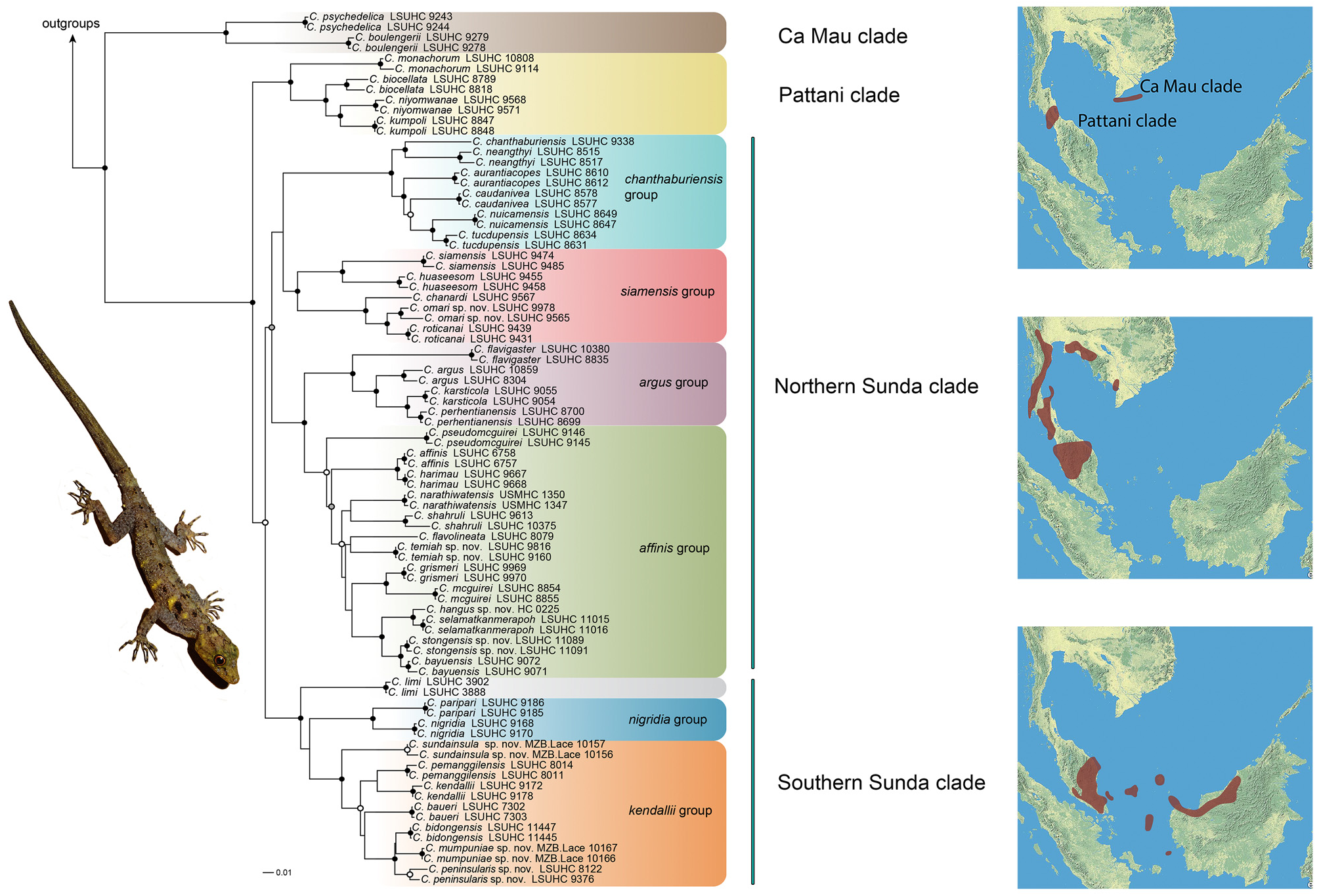
Description of holotype. Adult male, SVL 84.1 mm; head robust, oblong in dorsal profile, moderate in size (HL / SVL 0.23), not narrow (HW / SVL 0.15), flattened (HD / HL 0.41), distinct from neck; snout moderate (ES / HL 0.42), slightly concave in lateral profile; postnasal region constricted medially; scales of rostrum keeled, raised, larger than scales on occiput; distinct, supraorbital ridges; no frontorostral sulcus; canthus rostralis rounded; eye large (ED / HL 0.22); extra-brillar fringe scales largest anteriorly; pupil round; ear opening oval, taller than wide; rostral concave dorsally, posterior 90 % divided by longitudinal groove; rostral bordered posteriorly by two large supranasals and external nares, laterally by first supralabials; 9 R, L raised supralabials decreasing in size posteriorly; 8 R, L infralabials, decreasing in size posteriorly; nostrils round, oriented dorsoposteriorly; mental large, triangular, flat, bordered posteriorly by six postmentals, first two on either side largest; gular and throat scales granular, keeled, raised; pectoral scales slightly larger. Body robust (AG / SVL 0.43); small, granular, rugose, dorsal scales generally equal in size throughout body, intermixed with larger, multicarinate tubercles more or less linearly arranged; tubercles extend from occiput to base of tail; tubercles on flanks; 32 paravertebral tubercles; pectoral and abdominal scales small, granular, keeled, same size throughout; abdominal scales slightly larger than dorsals; no precloacal pores; forelimbs moderately long, robust (FL / SVL 0.19); dorsal scales of brachium raised, keeled; dorsal scales of forearm raised, keeled; ventral scales of brachium keeled, raised, juxtaposed; ventral scales of forearm keeled, raised, juxtaposed; palmar scales, juxtaposed, raised, broadly keeled; digits long with an inflected joint; claws recurved; subdigital lamellae unnotched; lamellae wide throughout digit; interdigital webbing absent; fingers increase in length from first to fourth with fourth longer than fifth; hind limbs robust, slightly longer and thicker than forelimbs (TBL / SVL 0.24); dorsal scales of thigh keeled, raised, juxtaposed; scales of anterior margin of thigh keeled; ventral scales of thigh keeled; subtibial scales raised, keeled, juxtaposed, with no enlarged anterior row; plantar scales smooth, juxtaposed, raised; weakly enlarged to enlarged submetatarsal scales beneath first metatarsal; digits elongate with an inflected joint; claws recurved; subdigital lamellae unnotched, wide throughout digit; interdigital webbing weak to absent; toes increase in length from first to fourth with fourth being slightly longer than fifth; 28 subdigital lamellae on fourth toe; caudal scales arranged in segmented whorls; dorsal caudal scales raised, keeled, juxtaposed; deep middorsal and lateral caudal furrows; subcaudal scales smooth; median row of enlarged subcaudal scales posteriorly; caudal tubercles do not encircle tail; tubercles absent from lateral furrows; three enlarged postcloacal tubercles on lateral surface of hemipenal swellings at base of tail. Coloration in life (Fig. 54). Dorsal ground color of head, body and limbs yellowish brown; paired, yellowish, lineate markings on rostrum; irregularly shaped yellowish markings on top of head; thin, black, upper postorbital stripe extending to occiput; thin, black, lower postorbital stripe extending onto flank; thin, yellowish, postorbital stripe highlighting row of tubercles on latter surface of occiput; transverse, beige marking on nape followed by one square and two rectangular medial beige markings on body alternating with small, elongate, thin, black vertebral markings; light rectangular markings on body grade into diffuse, light caudal bands alternating with darker brown bands; caudal bands do not encircle tail; diffuse light blotches on flanks; tubercles on flanks white; dark, diffuse, rectangular markings on back and flanks alternate with light markings; gular region and throat yellow-orange; lateral margins of abbomen and lower flanks yellow-orange; anterior one-half of subcaudal region yellow, posterior one-half white; ventral surfaces of pectoral region and limbs beige. Variation (Fig. 54). All paratypes closely resemble the holotype in coloration and pattern although TNHC 64276 – 77 and MZB. Lace 4621 are not nearly as boldly marked. The color pattern of MZB. Lace 10156 is much bolder than that of the holotype in that the dark and light dorsal markings stand in distinct contrast to one another. The dark dorsal markings of MZB. Lace 10161 are elongate as opposed to being more square to roundish as in the other specimens. TNHC 64277 lacks a tail and the tail of TNHC 64276 is regenerated and composed of small, dark, roundish, juxtaposed scales that are weakly keeled on the dorsal surface whereas the subcaudals are smooth beige, and slightly larger. USNM 28139 is badly faded and only a general color pattern that matches that of the holotype is visible. Hatchlings tend to have yellow undersides. Meristic differences are listed in Table 12. Comparisons. Within the Southern Sunda clade, Cnemaspis sundainsula sp. nov. is differentiated from the species of the nigridia group (C. nigridia and C. paripari) by having a greater maximum SVL (84.5 mm versus 50.7 – 75.5 mm); lacking as opposed to having precloacal pores; having tubercles on the flanks as opposed to lacking them; having smooth as opposed to keeled subcaudals; generally lacking as opposed to having a median row of enlarged, subcaudal scales; and lacking as opposed to having weakly enlarged, metatarsal scales beneath the first toe. From the species of the kendallii group (C. baueri, C. pemanggilensis, C. mumpuniae sp. nov., C. bidongensis, and C. peninsularis sp. nov.) of which it is a member, it can be differentiated by having a much greater maximum SVL (84.5 mm versus 58.1 – 76.0 mm), having smooth as opposed to keeled subcaudal scales, and not having caudal tubercles that encircle the tail. From C. limi, C. sundainsula sp. nov. is separated by having linearly as opposed to randomly arranged dorsal tubercles, and having a ventrolateral row of caudal tubercles. Cnemaspis sundainsula sp. nov. can be differentiated from C. sundagekko sp. nov, by having a much larger maximum SVL (84.5 mm versus 68.0 mm), a greater number of paravertebral tubercles (26 – 37 versus 20 – 25), smooth as opposed to keeled subcaudals, caudal tubercles that do not encircle the tail, and fewer subdigital lamellae on the fourth toe (26 – 31 versus 33 – 38).