
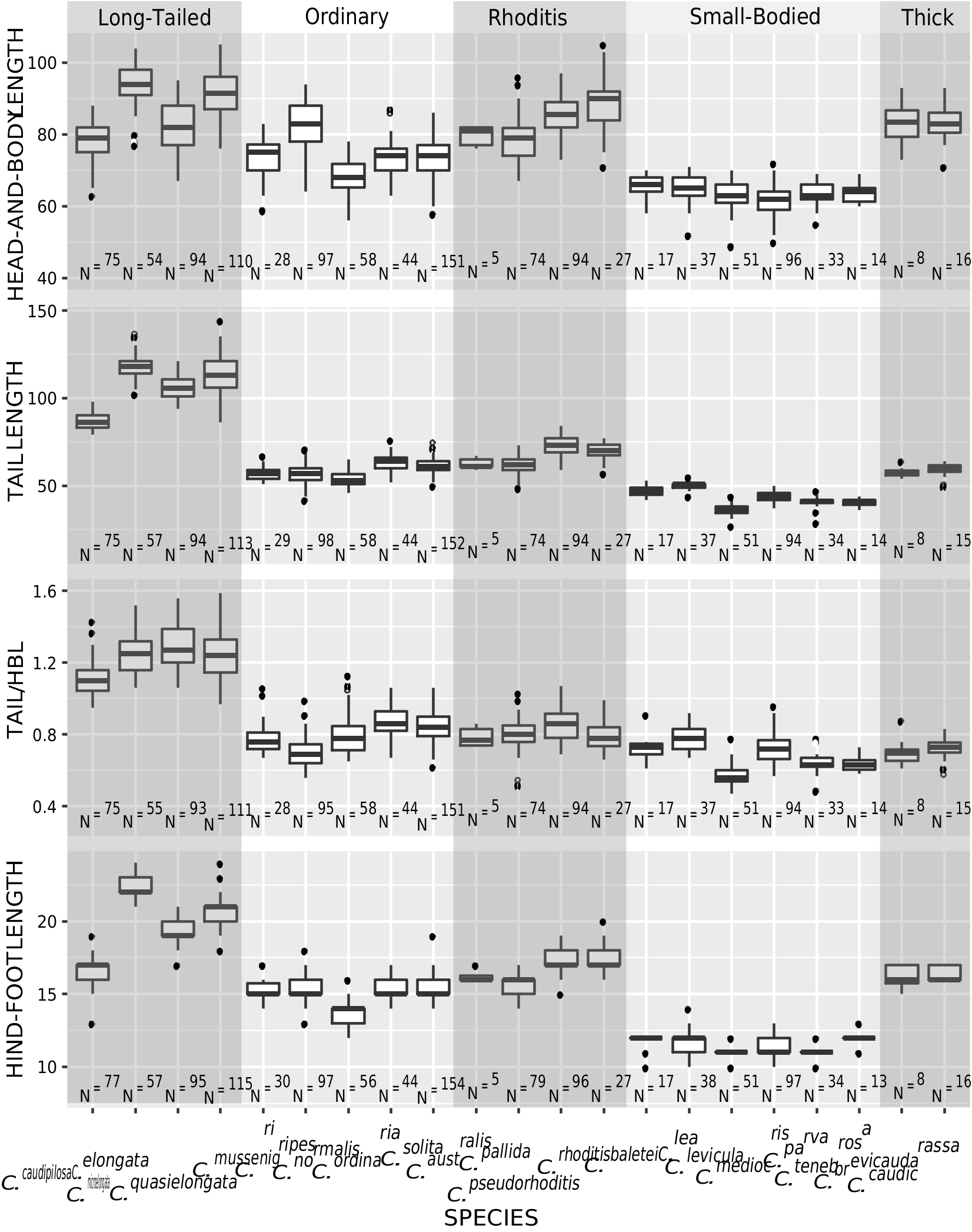
COMPARISONS: Crocidura ordinaria is a moderately sized member of the Ordinary Group. The tail is shorter than head-and-body length (fig. 9; table 2). Members of the Long- Tailed Group are larger and have much longer tails. Rhoditis Group members C. rhoditis and C. pseudorhoditis are larger. Crocidura pallida and C. australis, also members of the Rhoditis Group, are only slightly larger than C. ordinaria in head-and-body length. Compared to C. ordinaria, C. pallida has paler feet dorsally, a narrower relative braincase breadth (BB / CIL) and a narrower relative interorbital width (IOW / CIL) whereas C. australis has a narrower relative interorbital width, but wider relative braincase breadth than C. ordinaria (fig. 10). All members of the Small-Bodied Group are much smaller than C. ordinaria. Within the Ordinary Group, C. nigripes has darker feet and a relatively much narrower interorbital region and braincase than C. ordinaria. Compared to C. ordinaria, C. musseri has a thicker, darker pelage, and darker feet. Crocidura normalis is darker in color, smaller in body size, has more bristles on its darkly colored tail, and its skull is narrower with a shorter relative rostral length (RL / CIL) than C. ordinaria. Crocidura solita, another member of the Ordinary Group, is difficult to distinguish morphologically from C. ordinaria. External measurements are nearly identical between these two species (fig. 9), but C. ordinaria has a higher mass-to-length ratio (fig. 17). The pelage and feet of C. ordinaria are darker and have a smaller hypothenar (fig. 40), on average, than in C. solita. Cranially, C. ordinaria has a wider skull, observable in the absolute and relative breadths at the rostrum, interorbital region, and braincase (figs. 10, 42; table 14). Principal components analyses of external and cranial dimensions show that these two species overlap broadly in multivariate morphometric space, more so with external measurements than with cranial measurements (fig. 43; tables 17, 18).
Sumber: Fourteen New, Endemic Species Of Shrew (Genus Crocidura) From Sulawesi Reveal A Spectacular Island Radiation