
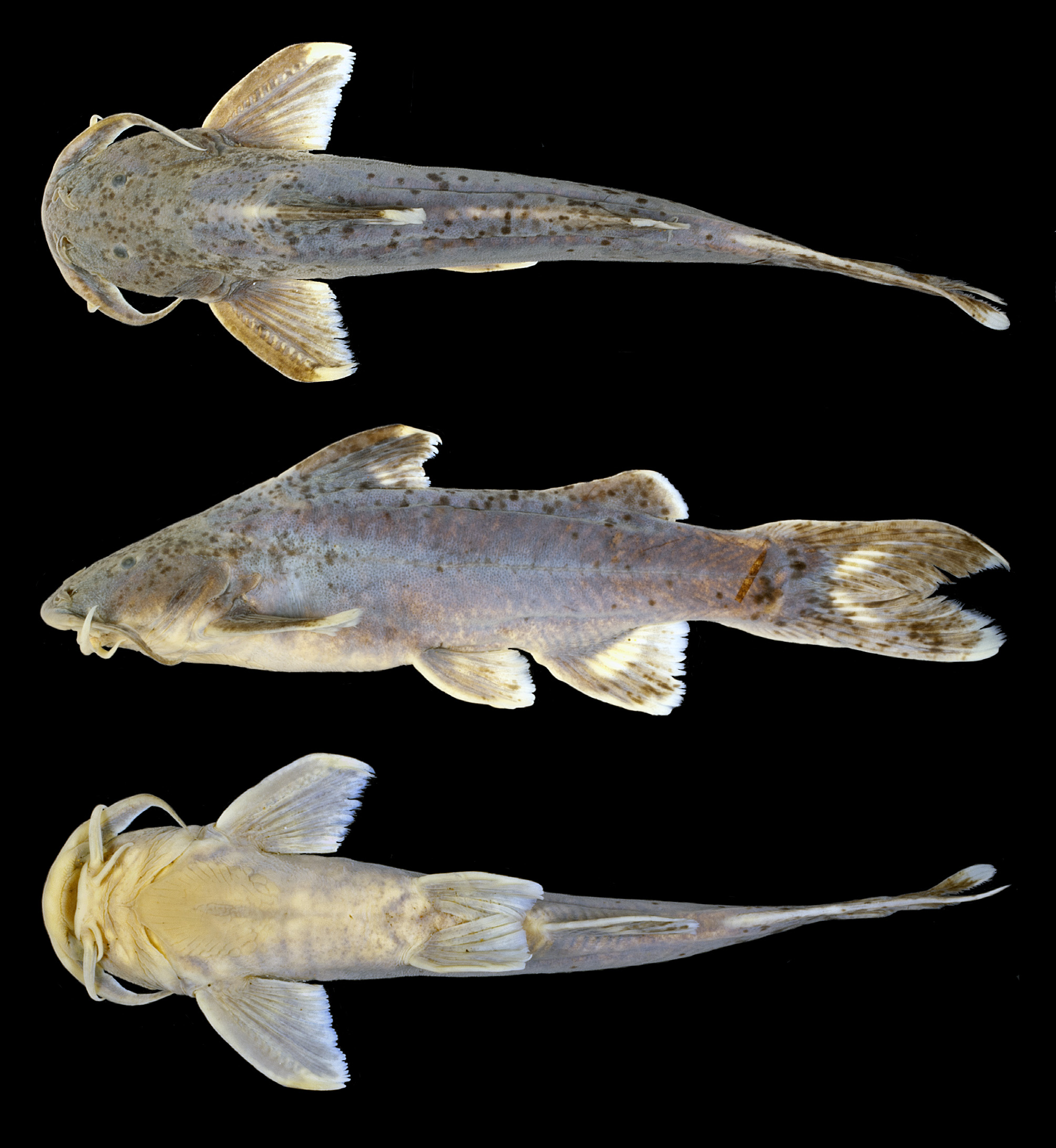
Description. Morphometric data in Table 1. Head depressed; body subcylindrical. Dorsal profile rising evenly from tip of snout to origin of dorsal fin, then sloping gently ventrally from origin of dorsal fin to end of caudal peduncle. Ventral profile straight to anal-fin base, then sloping gently dorsally from anal-fin base to end of caudal peduncle. Anus and urogenital openings located at vertical through middle of adpressed pelvic fin. Skin tuberculate, with tubercles of even size on sides of body. Lateral line complete and midlateral. Vertebrae 16 + 17 = 33 * (3), 16 + 18 = 34 (2), 17 + 17 = 34 (3), 18 + 16 = 34 (1), 17 + 18 = 35 (4), 18 + 17 = 35 (4), 19 + 16 = 35 (2) or 18 + 18 = 36 (2). Head depressed and broad, triangular when viewed laterally. Snout prominent. Anterior and posterior nares large and separated only by base of nasal barbel. Gill opening broad, extending from ventral margin of posttemporal to isthmus. First branchial arch with 2 + 6 (8), 2 + 7 * (8) or 2 + 8 (4) rakers. Bony elements of dorsal surface of head covered with thick, tuberculate skin. Eye ovoid, horizontal axis longest; located entirely in dorsal half of head. Barbels in four pairs. Maxillary barbel long and slender, extending to middle of pectoral-fin base. Nasal barbel slender, extending to midway between its base and anterior orbital margin. Inner mandibular-barbel extending to midway between its base and that of pectoral spine. Outer mandibular barbel extending to two-thirds of distance between its base and that of pectoral spine. Mouth inferior, premaxillary tooth band partially (approximately half) exposed when mouth is closed. Oral teeth small and villiform, in irregular rows on all tooth-bearing surfaces. Premaxillary teeth appearing in single broad semilunate band. Dentary teeth in a single crescentic band, consisting of two separate halves tightly bound at midline. Thoracic adhesive apparatus consisting of keratinized striae in an elongate oblong field extending from isthmus to almost posterior limit of pectoral-fin base (Fig. 3 a); anterolateral edges of adhesive apparatus almost straight. Anteromedial striae present. Narrow, v-shaped medial pit on posterior half. Dorsal fin located above anterior third of body, with I, 6 (20) rays; fin margin concave; spine short and straight, smooth on anterior margin; posterior margin smooth in some individuals and with up to 6 low projections on others. Adipose fin with anterior margin straight or slightly concave and posterior margin straight. Caudal fin strongly forked, with lower lobe slightly longer than upper lobe and i, 7,8, i (20) principal rays. Procurrent rays symmetrical and extending only slightly anterior to fin base. Anal-fin base vertically opposite adipose-fin base. Anal fin with straight anterior margin and straight or slightly concave posterior margin; with iv, 8 * (13), iv, 8, i (2) or iv, 9 (5) rays. Pelvic-fin origin at vertical through posterior limit of dorsal-fin base. Pelvic fin with slightly convex margin and i, 5 (20) rays; tip of adpressed fin not reaching anal-fin origin. Pectoral fin with I, 7, i (1), I, 8 * (18) or I, 8, i (1) rays; posterior fin margin slightly concave; anterior spine margin smooth, posterior margin with 4 – 12 (holotype = 12) serrations. Coloration. In 70 % ethanol: dorsal and lateral surfaces of head and body gray to grayish brown, fading to light gray or beige on ventral surfaces. Dorsal and lateral surfaces of head and body with small irregular darker spots. A thin, light brown mid-dorsal stripe extending from base of last dorsal-fin ray to origin of adipose fin; stripe absent in some individuals. Laterosensory pores rimmed in beige, imparting appearance of a diffuse light brown or light gray midlateral line in some individuals. Dorsal and ventral surfaces of caudal peduncle slightly paler in some individuals. All fins with rays proximally gray to grayish brown, becoming hyaline more distally, and diffuse melanophores on fin membranes. Pectoral and pelvic fins with gray or grayish brown on bases of rays and hyaline posterior margin. Anal fin with gray or grayish brown base; gray or grayish brown spot on anterior third of fin present in some individuals. Adipose fin gray or grayish brown with hyaline distal margin. Base of caudal fin with dark crescent in most individuals. Each caudal-fin lobe with irregular, elongate gray or grayish brown blotch on about half of outer fin; most of inner rays of lobes hyaline. Maxillary and nasal barbels gray or grayish brown dorsally, light brown or light gray ventrally. Mandibular barbels beige or light gray. Habitat. Glyptothorax amnestus is typically found in upland rivers and streams with a moderately fast current and a substrate composed predominantly of rocks and gravel (Fig. 4).
Sumber: The Glyptothorax of Sundaland: a revisionary study (Teleostei: Sisoridae)