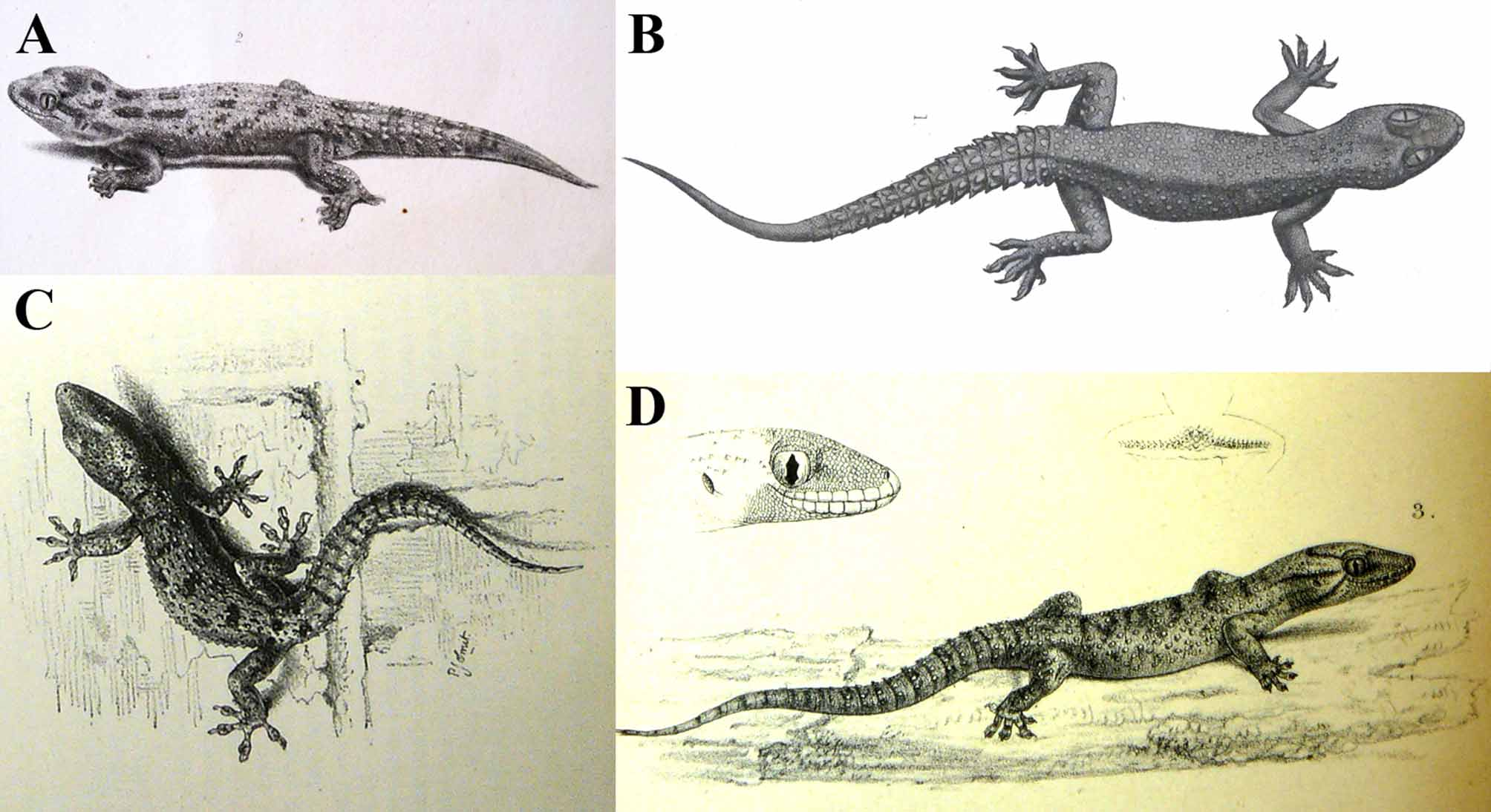
Description of H. subtriedroides lectotype. BMNH 1946.8.25.54, adult male. A summary of mensural and meristic data is provided in table 2. A medium sized species of Hemidactylus (SVL 61.7 mm); head distinct from neck, forehead flat, lores rounded and frontal region slightly concave; snout longer than orbit diameter; scales on snout circular, slightly enlarged and rounded, largest on the canthal region, size subequal to the smaller tubercles on the parietal, size gradually decreasing to become small heterogenous granular scales across the frontal; supraoculars covered with homogenous, small granular scales; dorsal and lateral surfaces of the head posterior to the orbit covered with small granular scales densely mixed with small flattened to domed tubercles, size increasing laterally and posteriorly; twelve interorbital granular scales across the narrowest point of the frontal; canthus rostralis rounded; pupil vertically elliptical, with crenellated edges; supraciliaries small and pointed posteriorly, becoming rounded and size increasing anterodorsally, spinose posteriorly; ear opening deep, narrowly oval, and obliquely orientated posterodorsally, lacking enlarged tubercles on anterior edge; orbit diameter slightly greater than orbit to ear distance; rostral subrectangular, with medial groove dorsally, extending to half of the rostral depth; rostral depth less than half its width, contacted by nostrils, supralabial I, one internasal and two circular, slightly enlarged supranasals; nostrils circular, oriented dorsolaterally, nostril in contact with supralabial I, two postnasals, supranasal and rostral; 10 / 10 (left / right) supralabials; 9 / 9 (left / right) infralabials; mental subtriangular, wider than it is long (MenL / MenW 82.8 %); two paired postmentals, primary pair subequally in contact with each other and the mental, secondary pair not in contact with each other, ~ 70 % the size of the first and rounded posteriorly, no enlarged chin shields border the posterior edge of the primary postmentals; one to three rows of enlarged elongated scales border the lower edge of the infralabials, size gradually increasing laterally from the small throat granular scales; endolymphatic sacs indistinct. Body slightly compressed dorsally, ventrolateral fold weak; dorsum covered with uniform, small granular scales, interspersed with large tubercles, those of the nape are smallest and conical, size increasing posteriorly, tubercles of the anterior paravertebral rows are slightly oval longitudinally with a weak median keel, laterally becoming more conical to transversally oval, primarily without a weak keel, largest are approximately 13 times the size of surrounding granular scales; 20 mostly linear rows at midbody, 34 in a paravertebral line from back of the skull to the area above the vent, intertubercle distance varies randomly; lateral and gular granular scales grade suddenly into large, smooth, subimbricate ventrals; preanal depression absent; precloacal-femoral pores number 7 / 7 (left / right), widely separated medially by five non-pore-bearing scales; precloacal scales between the pore series and the cloaca are not enlarged relative to ventrals. Forelimbs slender; dorsal surface of the upper forelimb covered with small flat to slightly imbricate scales, size decreasing ventrally appearing granular; posterior dorsal surface of the lower forelimb covered with small granular scales of subequal size to dorsals and intermixed with slightly enlarged bluntly conical tubercles of subequal size to those on the head, slightly imbricate scales of the upper forelimb extend along the anterior dorsal surface of the lower forelimb on which they increase in size and become more imbricate, smaller imbricate scales cover the dorsal surface of the manus; hind limbs relatively short; dorsal surface of the hind limbs and posterior thigh covered with small granular scales moderately interspersed with larger domed to bluntly conical tubercles, largest being of equal size to the largest dorsal tubercles, ventral surfaces of hind limbs with flat subimbricate scales; ventral surface of the manus and pes covered with smooth, rounded granular scales; digits relatively short, flattened, a small curved claw on all digital tips; distal phalanges elevated; each digit with mostly divided lamellae, numbering on right manus (total: divided) I (5: 2), II (7: 5), III (7: 5), IV (8: 6) and V (7: 5); and on right pes I (5: 2), II (7: 5), III (7: 4), IV (8: 5) and V (7: 2); basal subdigital lamellae narrow, enlarged lamellae series under digit IV of pes extend to the base of the digit; interdigital webbing absent. Only the first segment of the tail is original, the remaining length is regenerated; dorsally compressed and oval in cross section, longer than snout to vent length; slightly constricted at the base and tapering gradually to a narrow tip; post-cloacal hemipenal bulge distinct; two enlarged, bluntly conical cloacal spurs on each side; longitudinal middorsal and lateral tail furrows absent; median subcaudal series begin close to the base of the regenerated tail portion consisting of transversely enlarged, smooth, subimbricate scales, increasing to approximately 80 % tail width by the fourth subcaudal, laterally bordered by large posteriorly rounded subimbricate scales, and size rapidly decreasing laterally and dorsally where they are twice dorsal granule size; regenerated tail portion unsegmented and without enlarged tubercles; basal most and only original segment with a transverse row of six (left side damaged) posteriorly angled, unkeeled tubercular spines. Colouration in preservative: Dorsal surfaces of the head, body, limbs and tail primarily mid-brown; a dorsal pattern if present is completely indistinguishable due to fading of the specimen, also noted in the original description (Annandale 1905 a); entire ventral surface of the head, body, limbs and tail appear plain light beige, however under magnification individual scales have varying numbers of minute grey specks; precloacal-femoral pores are dark brown. Colouration in life was not documented in the original description (Annandale 1905 a). Variation. Mensural and meristic variation is provided for six additional specimens in table 2. The single paralectotype differs in characters from the lectotype as follows: central parietal area without slightly enlarged tubercles; chin shields bordering the secondary postmental pair posterolaterally are larger than those of the lectotype resembling a third pair of postmentals, not in contact with infralabials; full original tail present with transverse row of six dorsally flattened tubercles on each distinct tail segment, tubercles acutely angled basally becoming imbricate over surrounding granular scales distally; middorsal tail furrow present, lateral tail groove absent; subcaudals of the tail completely transverse the tail width at approximately mid-length; basally the tail narrows suddenly over first few segments before gradually tapering into a long point; as with the lectotype no dorsal pattern can be distinguished due to fading. The remaining specimens allocated to this species primarily fall within the above mentioned variation, but additionally: post nasal scales vary from 2 – 3; 2 – 3 medium sized conical cloacal spurs with the single enlarged posterior spur present on all but one specimen; one large internasal scale on all but one specimen which has two small internasals; 6 – 8 tubercles in transverse row on the first segment of tail; extracranial endolymphatic sacs visible ventrally through the skin of the jowels of two specimens; all specimens appear primarily plain brown, however two have feint darker bands on the tail, another has feint small dark brown spots on the dorsum similar in arrangement to H. cf. brookii individuals in figures 4 A, C and D. A description of colour and pattern of Myanmar H. brookii group taxa is also provided by Zug et al. (2007).