
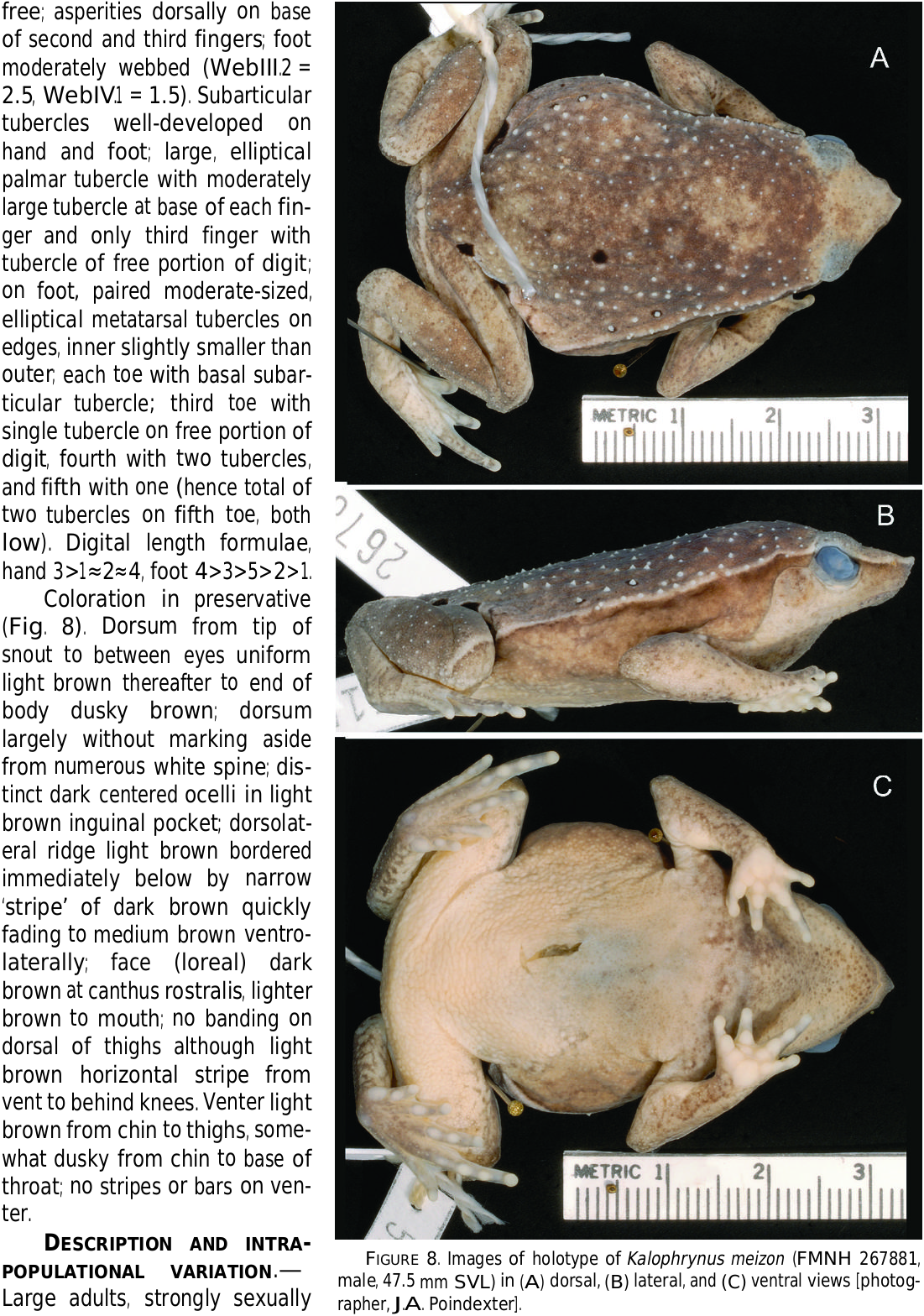
DESCRIPTION OF THE HOLOTYPE. — Moderately robust-bodied male (47.5 mm SVL) with well-developed, moderate-length fore- and hindlimbs (51 % ForarmL + HandL / SVL, 147 % HndlL / SVL); head ovate (33 % HeadL / SVL, 30 % HeadW / SVL) and continuous with body (no apparent constriction or enlargement at juncture of head and trunk). Body measurements are: HeadL 15.8 mm; HeadW 14.2 mm; SnEye 6.2 mm; NarEye 3.4 mm; EyeD 4.1 mm; Tymp 3.7 mm; ForarmL 13.2 mm; HandL 11.0 mm; ThghL 22.7 mm; CrusL 17.9 mm; TarsL 11.9 mm; HndfL 17.2 mm. Eye distinctly larger than tympanum. Skin strongly glandular with dorsal skin thickened and cloak-like extending from nape to posterior end of trunk, surface with numerous small white conical spines in adult males; skin thickest anteriorly forming distinct supratympanic fold over dorsal and posterior edge of tympanic annulus and swollen mass above axilla; distinct diagonal dorsolateral ridge from eye to inguina, below cloak merges imperceptibly into lateral trunk skin; limbs without enlarged glandular areas and surface mostly smooth; chest skin smooth, abdominal skin glandular and pebble-like; chest without small unpigmented glands. Nuptial pad of dense fine spines on bases second and third fingers. Tongue large, spatulate, posterior one half free. Vomerine teeth absent. Three sets of palatal folds on roof of mouth: vomerine paired, each long with low smooth free edge and narrowly separated medially; postorbital single, continuous, composed of 10 to 12 rectangular lobes; buccal slightly lower than postorbital and single continuous fold of 15 to 16 rectangular, abutting lobes, medial lobes larger than lateral ones. Fingers and toes well-developed and tips bluntly rounded; hand web free; asperities dorsally on base of second and third fingers; foot moderately webbed (WebIII. 2 = 2.5, WebIV. 1 = 1.5). Subarticular tubercles well-developed on hand and foot; large, elliptical palmar tubercle with moderately large tubercle at base of each finger and only third finger with tubercle of free portion of digit; on foot, paired moderate-sized, elliptical metatarsal tubercles on edges, inner slightly smaller than outer; each toe with basal subarticular tubercle; third toe with single tubercle on free portion of digit, fourth with two tubercles, and fifth with one (hence total of two tubercles on fifth toe, both low). Digital length formulae, hand 3> 1 ≈ 2 ≈ 4, foot 4> 3> 5> 2> 1. Coloration in preservative (Fig. 8). Dorsum from tip of snout to between eyes uniform light brown thereafter to end of body dusky brown; dorsum largely without marking aside from numerous white spine; distinct dark centered ocelli in light brown inguinal pocket; dorsolateral ridge light brown bordered immediately below by narrow ‘ stripe’ of dark brown quickly fading to medium brown ventrolaterally; face (loreal) dark brown at canthus rostralis, lighter brown to mouth; no banding on dorsal of thighs although light brown horizontal stripe from vent to behind knees. Venter light brown from chin to thighs, somewhat dusky from chin to base of throat; no stripes or bars on venter. DESCRIPTION AND INTRAPOPULATIONAL VARIATION. — Large adults, strongly sexually dimorphic with females averaging larger (54.8 mm, 48.2 – 60. 2 mm SVL) than males (45.6 mm, 44.1 – 47. 5 mm). These size differences occur in all other measurements: HeadL 16.0 – 19. 2 mm ♀♀, 13.4 – 15. 8 mm ♂♂; HeadW 16.3 – 21. 1 mm ♀♀, 14.1 – 16. 9 mm ♂♂; SnEye 6.4 – 8. 4 mm ♀♀, 5.1 – 6. 2 mm ♂♂; NarEye 3.5 – 4.8 mm ♀♀, 5.1 – 6. 2 mm ♂♂; EyeD 3.5 – 4.8 mm ♀♀, 4.0 – 4. 9 mm ♂♂; Tymp 4.4 – 5. 6 mm ♀♀, 3.7 – 4.6 mm ♂♂; ForarmL 14.9 – 18. 3 mm ♀♀, 12.4 – 14. 3 mm ♂♂; HandL 11.3 – 13. 4 mm ♀♀, 10.0 – 11. 9 mm ♂♂; ThghL 21.6 – 27. 1 mm ♀♀, 19.8 – 22. 7 mm ♂♂; CrusL 19.5 – 231. mm ♀♀, 17.9 – 19. 7 mm ♂♂; TarsL 12.1 – 14. 9 mm ♀♀, 11.4 – 12. 5 mm ♂♂; HndfL 17.1 – 19. 8 mm ♀♀, 15.4 – 18.0 mm ♂♂. Body proportions do not differ between females and males, except for TarsL / ThghL and HndlL / SVL (all values are percent): HeadL / SVL 29 – 35 ♀♀, 30 – 34 ♂♂; HeadW / SVL 31 – 36 ♀♀, 30 – 36 ♂♂; HeadW / HeadL 97 – 117 ♀♀, 90 – 108 ♂♂; SnEye / HeadL 36 – 46 ♀♀, 36 – 45 ♂♂; NarEye / SnEye 52 – 62 ♀♀, 53 – 67 ♂♂; EyeD / HeadL 27 – 30 ♀♀, 26 – 31 ♂♂; Tymp / EyeD 90 – 112 ♀♀, 84 – 105 ♂♂; Forarm / SVL 26 – 32 ♀♀, 26 – 32 ♂♂; Forarm / CrusL 66 – 76 ♀♀, 66 – 76 ♂♂; HndlL / SVL 136 – 157 ♀♀, 144 – 156 ♂♂; CrusL / SVL 38 – 43 ♀♀, 38 – 43 ♂♂; CrusL / ThghL 85 – 91 ♀♀, 79 – 93 ♂♂; TarsL / ThghL 51 – 59 ♀♀, 52 – 62 ♂♂; HndfL / SVL 31 – 38 ♀♀, 35 – 39 ♂♂; HndfL / ThghL 71 – 87 ♀♀, 76 – 83 ♂♂. The dimorphism between TarsL / ThghL and HndlL / SVL indicates that the tarsus is longer in males than in females, although the differences are significant, the proportions strongly overlap. All individuals dorsally with thick cloak of glandular skin from behind eyes to vent; unlike other pleurostigma group members surface texture and dorsolateral ridge / fold are sexually dimorphic, latter distinctly elevated in males; surface dimorphic, smoothly rugose in females, spiny rugose in males. Most males, perhaps sexually active ones, have numerous small white, sharptipped, conical spines from nape to vent, spines more numerous on posterior third of males’ trunks; in females, most individuals are spine free, when present, spines rounded (dome-shaped) and widely scattered on posterior third of trunk. Ventrally, males and females have similar surface morphology, smoothly rugose from chin to chest, abdomen large, pebble-like rugose. All adult males have asperities on bases of second and third finger, but of variable development. Oral morphology is relatively uniform among individuals although these data are not quantified. Tongue broadly ovate, about ½ free. No vomerine teeth. Vomerine folds are elongate smooth-edged flaps, nearly in contact on midline. Postorbital folds are well developed and continuous across midline and consist of six to eight abutting rectangular lobes. Buccal fold is low continuous fold with low abutting rectangular lobes. Fingers lack webbing. Both finger and toe tips are bluntly rounded. Subarticular tubercle are well developed on the digits; only third finger bears a subarticular tubercle on free portion of digit; all fingers have a tubercle at their base and another row between a large, elliptical to oblong, nearly medial outer palmar tubercle. Second and third fingers bear asperities on dorsal surface of distal end of the metacarpal and first phalanx. For the hindfoot, each toe has a basal subarticular tubercle, third toe with addition tubercle on free portion of digit, two tubercles on free portion of fourth toe, and fifth toe with basal and midlevel tubercles often poorly developed to nearly absent. Inner and outer metatarsal tubercles are present; inner is large, nearly circular to elliptical; outer circular and small to nearly absent. Toes moderately webbed WebIII 2 median 2.0 (2.0 – 2.5), WebIV 1 1.0 (1.0 – 2.0). Digit lengths nearly constant for fore- and hindfeet; finger formula 3> 1 ≈ 2 ≈ 4; toe formula 4> 3> 5> 2> 1. Color pattern variation statistics for adults are (median and range): HeadMid 0, 0 – 0; HeadPsag 0, 0 – 2; DorsNap 0, 0 – 1; DorsPsag 0, 0 – 2; IngSpt 2, 2 – 2; HndlBr 1, 0 – 2; DlatSt 2, 1 – 2; Loreal 1, 1 – 2; LatTrnk 1, 1 – 2; Chin 0, 0 – 1; Chest 0, 0 – 1. In preservative, most K. meizon are dull, muddy colored (light to moderate grayish brown) frogs from dorsal view. Most individuals are unicolor dorsally or with few widely scattered, small, dark brown spots. Dorsolateral white stripe is well developed in all individuals and extends from snout tip above orbit to inguina, bordered below by dark brown fading to light brown ventrally. Inguinal dark-centered ocelli present in all individuals and uncommonly unilateral, smaller ocellus posteromedial to main ocellus. Venter is typically without pattern, dusky from chin through chest and light brown to cream on abdomen. Hindlimb commonly lack thigh banding and about half of individuals with horizontal light stripe continuously across rear of thighs. One individual (FMNH 267879) possesses the hourglass dorsal pattern of neotype of K. pleurostigma; pattern is outlined by narrow cream edge.
Sumber: Morphology and Systematics of Kalophrynus interlineatus-pleurostigma Populations (Anura: Microhylidae: Kalophryninae) and a Taxonomy of the Genus Kalophrynus Tschudi, Asian Sticky Frogs