
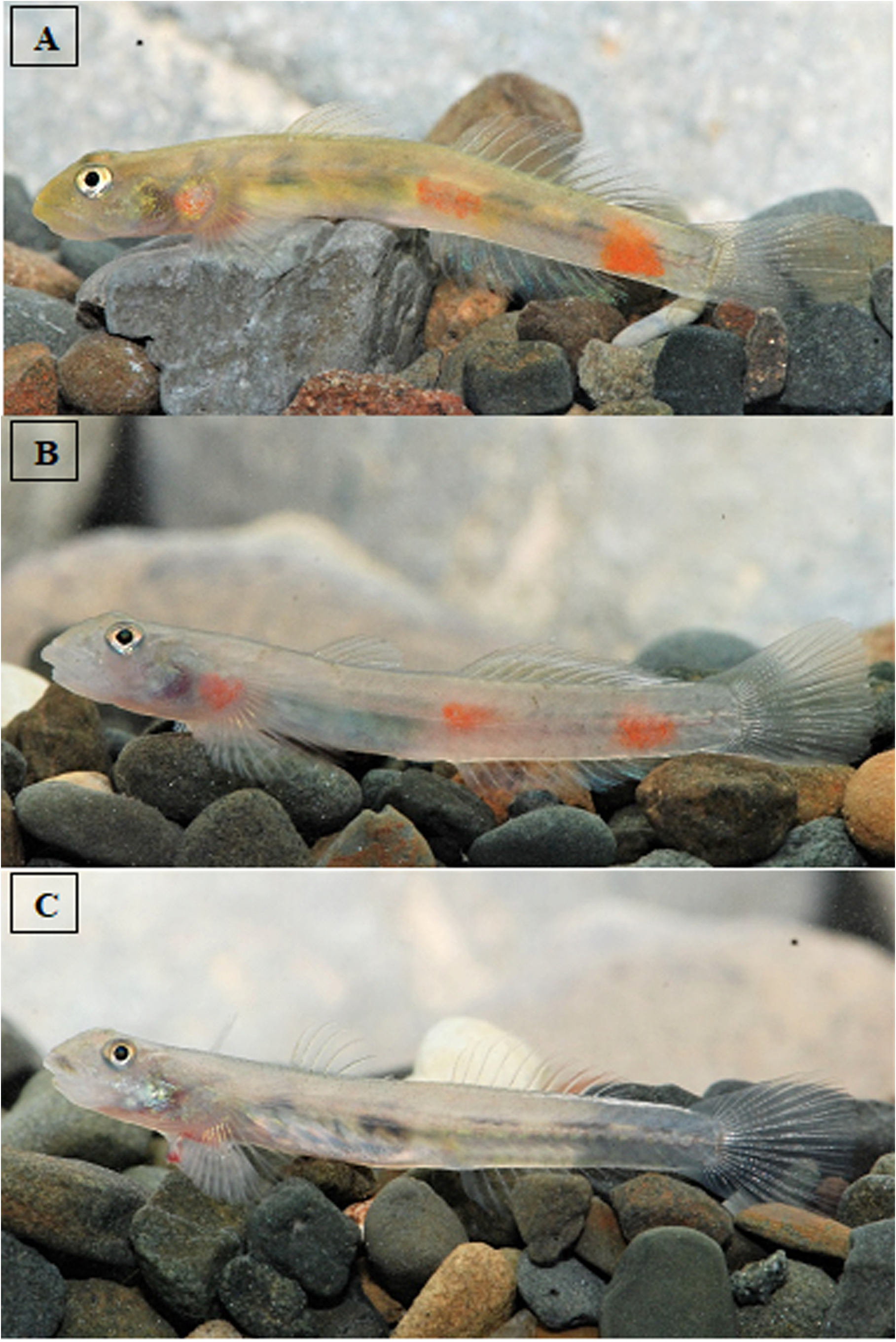
Description: Morphometric data given in Table 1. Body elongated, subcylindrical anteriorly, somewhat compressed posteriorly. Head slightly depressed, snout not protruding. Upper lip thick and more prominent than lower lip. Mouth oblique and posterior end of maxilla extending to vertical through posterior margin of orbit. Anterior nasal opening on short tube and posterior nasal opening a round hole. Gill opening narrow, extending to lower margin of pectoral-fin base. Papillae present around belly and on side of body, starting vertically from anal-fin origin to posterior part of caudal peduncle. Vertebrae count 10 + 16 = 26. In male, upper jaw teeth distinctly tricuspid anteriorly (14 – 19) with recurved canine teeth posteriorly (3 – 4); in female upper jaw with tricuspid teeth from posterior to anterior (33 – 38) and no canine teeth. Lower jaw in both male and female usually with recurved canine teeth (5 – 7). Urogenital papillae in male slender and distally pointed with pair of associated fleshy lobes and not retractable into sheath-like groove (Fig. 4). In female, urogenital papilla somewhat rectangular, also not retractable into sheath-like groove (Fig 4). Fins. D 1 VI, D 2 I / 10, A I / 10, P 17 (in 4 specimens) ‒ 18 (in 3 specimens), V I / 5 + I / 5, C 16 (in 2 specimens) ‒ 17 (in 5 specimens). D 1 rays not filamentous, all spinous rays about equal except 6 th spinous ray shortest and rather distant, not connected to D 2 basally. Gap between D 1 and D 2 of about same length as eye diameter in male and much larger in female. D 2 without black spot. D 2 and A positioned opposite each other, with origin of A directly below 2 nd branched ray of D 2. P large, its posterior tip not reaching to vertical though anus. Rear margin of C rounded. TABLE 1. (Continued) Scales. LR 7 – 11, PreD 0, TR 0. Lateral side of anterior half of body without scales. Body scales present from 5 – 6 th rays of second dorsal-fin through hypural, embedded in skin, with small ctenoid scales dominant anteriorly and cycloid scale generally restricted on caudal peduncle area to hypural. Head canals and pores. See Fig. 3. Nasal extension of anterior oculoscapular canal with pore σ located on dorsal side of snout between anterior nostrils. Interorbital region with paired pore λ anteriorly and single pore κ posteriorly. Paired pore α behind posterior edge of eye. Lateral canal section of posterior oculoscapular with pores ρ, θ and τ. Preopercle canal with two terminal pores γ and ε but lacking pore δ. Head sensory papillae. Infraorbital papillae present as 5 short transverse rows. Row c present as transverse and longitudinal papillae. Row d present above edge of posterior part of mouth. Rows e and i closely arranged. Rows ot, oi, and os well separated on preopercle. Row f paired. Colour in life. See Fig. 1. Male, body, snout and nape yellowish to translucent whitish. Upper lip yellowish to greyish. Opercle yellowish to beige with many tiny black dots. Pectoral-fin base reddish with red dots, these sometime merged into heart-shaped marking. Belly white to silver. Black spots on the lower side of body below first and second dorsal-fin. Two pale red blotches on mid-body, first at origin of second dorsal-fin and second at caudal peduncle. Dorsal-fin and anal-fin translucent with scattered black dots on membrane. Pectoral-fin and anal-fin translucent. Second dorsal-fin without round black spot in both sexes. Female, Body translucent. Snout yellowish. Upper lip grey. Opercle beige. Caudal peduncle with tiny black spots. Pectoral-fin base whitish. Dorsal-fin spine and rays with some tiny spots, membrane mostly clear. Caudal-fin whitish and membrane unpigmented. Pelvic-fin also without pigment. Colour in preservative. See Fig. 2. Male, body slightly creamy yellow and head greyish with yellowish cheek. Black pigmentation present on operculum. Two dark brown cross-bands below each dorsal-fin. All original red coloration faded to yellowish. Dorsal- and anal-fin greyish with black spots. Caudal-fin whitish. Female, body mostly whitish. Pectoral-fin base whitish. Black pigmentation on operculum. All fins whitish.
Sumber: A new species of gobiid fish Lentipes niasensis (Gobiidae: Sicydiinae) from Nias Island, Indonesia