Biologi & Ekologieng
Ecology. Litoria dentata calls from the ground or emergent vegetation associated with permanent or ephemeral water courses and ponds in both natural and disturbed habitats. Published descriptions of oviposition, egg and larval morphology, development and behaviour for L. dentata sensu lato (Anstis 2008) are based on L. quiritatus sp. nov. and have not been documented for L. dentata. The species is relatively commonly recorded via FrogID (> 1600 records from 10 November 2017 – 30 June 2021), and is relatively commonly heard calling in disturbed areas, with 17 % of FrogID records of the species documented as being in suburban or urban habitats and 43 % of records in rural areas. Litoria dentata has been detected calling from August to March, with single recordings in April and June, and a peak calling period of October to April via the FrogID project. Conservation status. Litoria dentata is a relatively widespread frog species, with an estimated Extent of Occurrence of approximately 94,000 km 2. There are no documented or suspected population declines, so the species is likely to meet the IUCN Red List criteria (IUCN 2012) for Least Concern.
Sumber: Two new frog species from the Litoria rubella species group from eastern Australia
Deskripsieng
Hyla dentata Keferstein W. 1868. Über die Batrachier Australiens. Archiv für Naturgeschichte Berlin 34, 253 – 290 [284]. Figs 9, 10
Sumber: Two new frog species from the Litoria rubella species group from eastern Australia
Deskripsieng
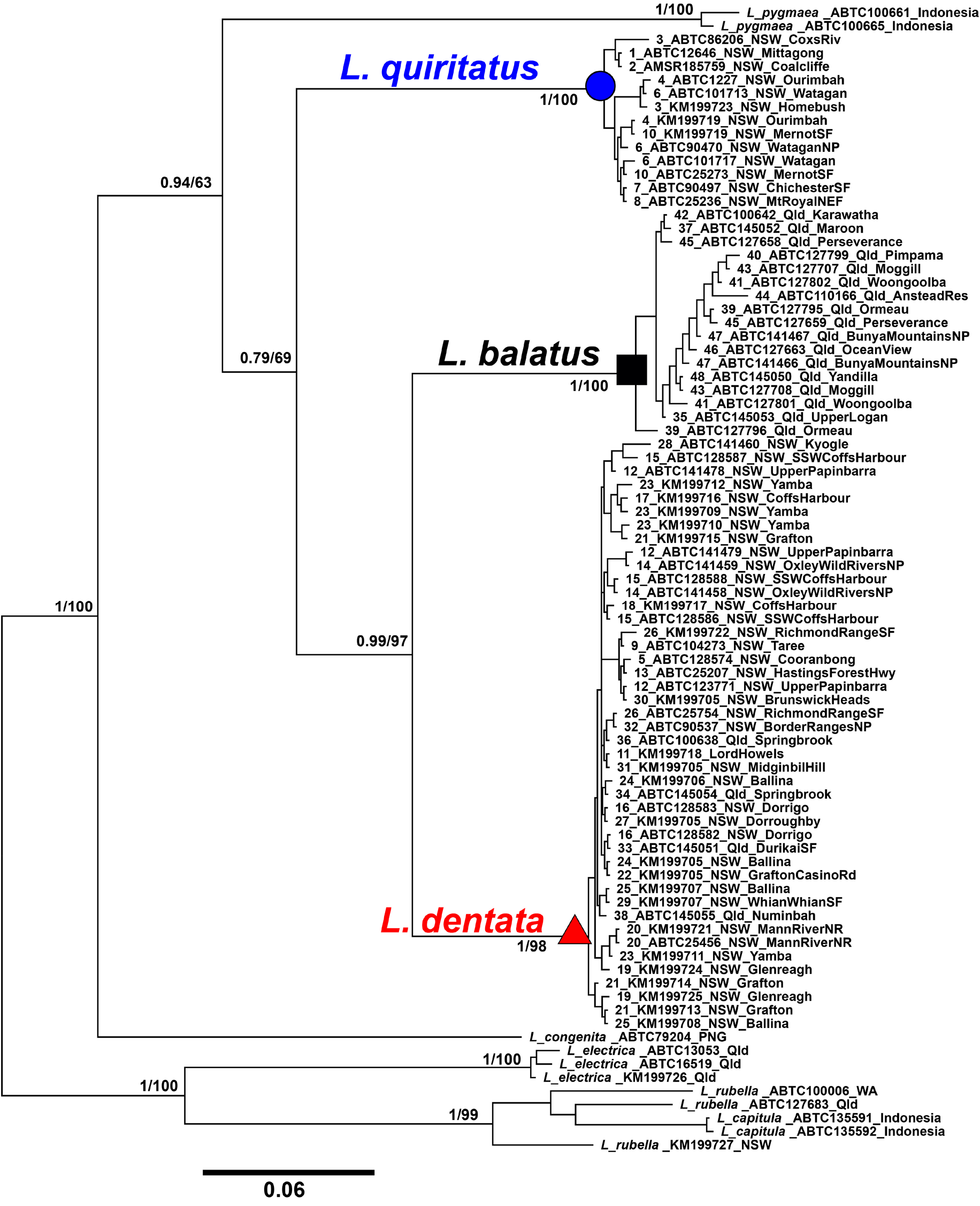
Redescription of holotype. We redescribe the holotype from high quality images of the preserved specimen. SVL 41 mm (Cogger pers. comm.). Habitus relatively robust; head widest at eyes, slightly longer than wide; snout rounded in lateral view and bluntly rounded in dorsal view (Fig. 9); nostrils prominent in dorsal profile; tympanum circular and clearly visible. Legs short; fingers and toes with prominent terminal discs, fingers with basal webbing, toes half webbed; sub-articular tubercles prominent; nuptial pads absent; inner metatarsal tubercle prominent, approximately one third of the length of first toe. Pectoral fold present. Venter coarsely granular, especially posteriorly; dorsum smooth. Colour in life not described in original description by Keferstein (1868). Colour after more than 150 years of preservation medium brown dorsally, creamy yellowish brown ventrally, finely stippled dark brown laterally, with paler patches on dorsum and a pale dorsolateral stripe (Fig. 9). Variation. Male SVL 28 – 42 mm, females SVL 29 – 42 mm. Summary of variation in morphometric variables for each sex is presented in Table 5. Variation in colour is described from images taken in life (Fig. 10). Dorsal colouration varies from cream (e. g. Fig. 10 E) to warm medium brown (e. g. Fig. 10 A, B). All individuals have a distinct darker brown patch across head and down the back, narrowing in width over the axilla and then mid-dorsum, more diffuse posteriorly. A narrow, diffuse, medium-brown mid-dorsal line obvious in some individuals (e. g. Fig. 10 A) and absent in others. Distinctly darker brown dorsolateral line running from eye, over tympanum, and diffusing above insertion of arm, becoming indistinct (versus continuing to groin as distinct line) in all individuals. Dark-brown stripe between eye and snout distinct in some individuals. Bright white patch on upper lip between lower margin of eye and insertion of the arm present in all individuals. Dorsal surface of limbs brown, finger tips often paler brown; toe tips pale brown, cream or pale yellow (e. g. Fig. 10 F). Yellowish wash and / or paler cream patches in the groin region in some individuals, but both absent in most individuals examined. Back of thighs transparent pinkish orange with opaque, creamy yellow flecks; belly white; vocal sac in males black or very dark yellowish black when deflated and yellowish brown when inflated (Fig. 10). Iris copper-brown. Advertisement call. Call descriptions are based on the calls of nine individuals (Table 6, Figs. 6, 8). The advertisement call of L. dentata comprises a single, highly-pulsed note. Individuals had a mean call duration of 0.84 – 1.33 s and an average of 44 – 53 uniformly spaced pulses repeated at a mean rate of 37 – 57 pulses / s. Calls were amplitude modulated, increasing rapidly to a peak at approximately 10 % of the call duration. The mean dominant frequency was 2.9 – 4.0 kHz. Comparison with other species. The distribution of L. dentata potentially overlaps with that of L. rubella in the north and abuts that of L. balatus sp. nov. in the north and L. quiritatus sp. nov. in the south. It is allopatric with the other five members of the L. rubella species group (L. electrica in north-western Queensland, L. congenita and L. pygmaea in New Guinea and L. capitula on Tanimbar Islands, Indonesia). Litoria dentata can be morphologically distinguished from L. rubella by the presence of continuous, irregularly edged, dark brown dorsal band and less robust body (versus head much narrower than body in L. rubella). It can be distinguished from L. electrica by the presence of continuous, irregularly edged, dark brown dorsal band (versus two dark chocolate-coloured bars across the dorsum). It can be distinguished from the New Guinean species L. congenita and L. pygmaea by absence of light spots on dark dorsal background (versus large and conspicuous usually present in L. pygmaea; smaller and more variable usually present in L. congenita). It can be distinguished from L. capitula by the absence of distinctive pale markings above the groin, vent and along lower leg that are present in L. capitula. Litoria dentata can be distinguished from L. quiritatus sp. nov. by males having a vocal sac that is black or very dark yellowish black when deflated and yellowish brown when inflated (versus yellow when deflated and inflated). It can be distinguished from L. balatus sp. nov. by males having a vocal sac that is black or very dark yellowish black when deflated and yellowish brown when inflated (versus black when deflated and inflated), having a dorsolateral line diffusing above insertion of arm (versus continuing to groin) and having a less slender habitus (Fig. 5). From a genetic perspective, apomorphic nucleotide states at 28 sites in the mitochondrial ND 4 gene reliably diagnose L. dentata from L. balatus sp. nov. and L. quiritatus sp. nov. (Table 7).