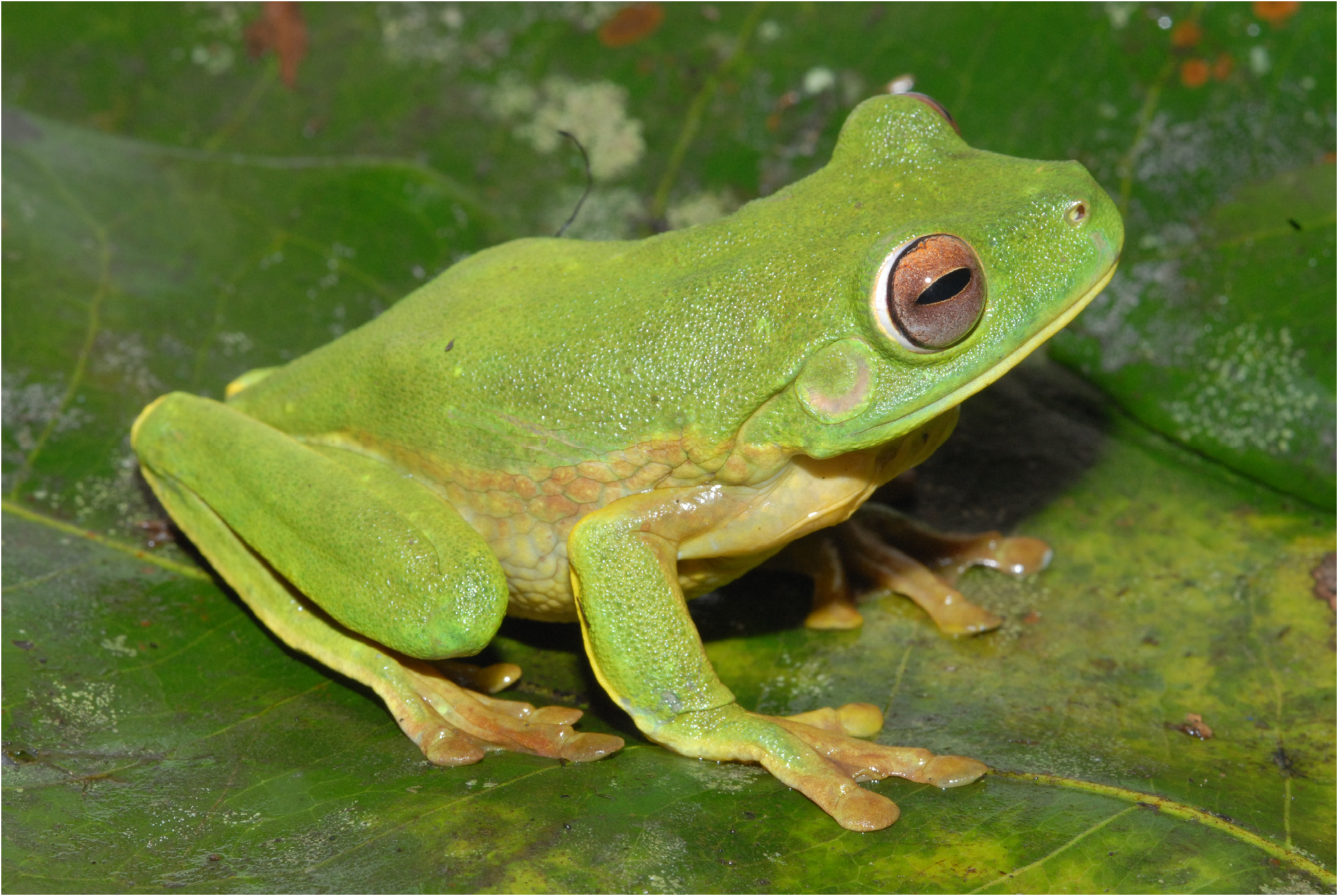
Description of holotype. Habitus moderately robust, limbs moderately long (TL / SVL 0.54); snout broadly rounded in dorsal aspect, blunt, steeply sloping in lateral aspect. Canthus long, poorly defined, nearly straight; loreal region sloping, distinctly concave; nostrils near tip of snout. Eyes moderately small (EYE / SVL = 0.10) (Fig. 1), nictitating membrane without flecks or lines of pigmentation. Tongue oval with shallow posterior notch; vocal slits long, extending from near angle of jaw half way to front of mouth. Ten small teeth on each of two prominent, slightly postero-medially directed vomero-palatine ridges. Tympanum moderately large (EAR / SVL = 0.082), annulus distinct except postero-dorsal edge obscured by thick, curved, postocular fold that extends from posterior edge of eye to above axillary junction. Skin finely but distinctly granular dorsally, slightly coarser on head. Lateral surfaces with large, flat tubercles; throat finely ridged, belly and ventral surfaces of thighs coarsely tubercular. Prominent dermal ridges along posterior edge of forearms and along shanks and ankles extending to toe 5 (Figs. 1, 2 A – 2 B). Fingers short, partially webbed, terminal discs wide (3 FD / SVL 0.071), with circum-marginal grooves (Fig. 2 C). Webbing reaches to half-way between penultimate subarticular tubercle and disc between Fingers 4 and 3, half way between penultimate and third subarticular tubercle on inner side of Finger 3, to disc on outer side of Finger 2, and is restricted to thin basal strip between Fingers 1 and 2 (Fig. 2 A). Subarticular tubercles prominent, undivided. Relative lengths of fingers 3> 4> 2> 1. Nuptial excrescences a narrow, unbroken patch extending along approximately half length of Finger 1, with distal half approximately equal in height to minimum width of Finger 1 and proximal half much narrower and tapering proximally, forming an approximate crescent (Fig. 2 C). Toes fully webbed, terminal discs moderately wide (4 TD / SVL 0.061) with circum-marginal grooves. Webbing reaches discs on Toes 1 – 3 and 5, and to half-way between penultimate tubercle and disc on Toe 4. Inner metatarsal tubercle and subarticular tubercles prominent (Fig. 2 B). Relative lengths of toes 4> 5> 3> 2> 1. In life, dorsal and upper-lateral surfaces of torso and head uniformly green without any pattern; tympanic membrane with a distinct unpigmented U-shaped region (Fig. 1); mid-lateral surfaces of torso yellow with extensive pale blue reticulations along skin creases; ventral surfaces of torso and inner surfaces of limbs yellow or yellowish brown (Fig. 2 D). Dorsal surfaces of digits light brown or yellowish green, ventral surface of digits yellowish, except discs unpigmented; webbing light purplish-blue, nuptial excrescences light brown. Dermal ridges on, and posterior edges of, forearm and hindlimb yellowish white. Labial stripe indistinct, pale yellow, extending to approximately level with posterior edge of eye. Lower half of nictitating membrane green, upper half clear with a dark-brown dorsal margin. Iris with light-grey base colouration, densely stippled with light brown to give an overall reddish-brown appearance, with scattered sparse darker-brown vermiculations; sclera with thin dark-brown inner ring and slightly wider pale-blue outer ring. Skin above eye with very thin pale yellowish-white band. In preservative, most dorsal and upper lateral surfaces mottled light to medium blue, including torso, head, outer forearms, shanks, Finger 4 and Toe 5; tympanic membrane heavily pigmented apart from broad U-shaped unpigmented mark; inner edge of forearm light buff, digits and webbing buff with faint purplish tinge. Lower lateral surfaces of torso buff with indistinct purplish-blue vermiculations. Ventral surfaces light buff and largely unpatterned, with exception of purplish tinge on webbing and digits, especially on feet. Summary meristic data. SVL 69.1; TL 37.4; HW 26.5; HL 23.7; EYE 7.2; TYM 5.7; IN 5.7; EN 4.7; 3 FD 4.9; 3 FP 3.1; 4 TD 4.2; 4 TP 3.8. Advertisement call. The call of Litoria lubisi sp. nov. is a single rasping note, produced in long call series that can last at least five minutes without interruption. Fifty-four calls from a longer series produced by the holotype at an air temperature of 26.5 ° C have a length of 0.18 – 0.30 s (mean = 0.22, SD = 0.031) and were uttered over the course of 66.7 s at a rate of 0.79 calls / s. However, calls within the series tend to be ‘ clumped’ into groups of 2 – 4 (Fig. 3 A), with intervals between calls ranging from 0.40 – 3.17 s (mean = 1.08, SD = 0.82). Energy increases gradually during each call, reaching maximum amplitude approximately halfway or slightly more than halfway through the call, before declining again (Fig. 3 B). Although call length is as much as 0.3 s, most energy is concentrated in the first 0.15 – 0.20 s of each call followed by an initially steep but then gradually more shallow decline in amplitude with a long, tapering ‘ tail’ of low but detectable energy (e. g. Fig. 3 B). Dominant frequency ranges from 1.480 – 1.838 kHz (mean = 1.651, SD = 80.794 among calls. Calls are finely pulsed, and pulses are uniformly distributed, but pulses are of differing intensity, including ‘ primary’ (strong) and ‘ secondary’ (weak) pulses (Köhler et al. 2017). Resolution of the secondary pulses in particular is insufficient to permit pulse counts within calls, particularly in the terminal half, so it has not been possible to calculate pulse rates within calls. To the human ear the call of L. lubisi sp. nov. resembles a rapidly repeated short, harsh, rasping note. Comparisons. Litoria lubisi sp. nov. differs from all other Litoria except taxa in the L. infrafrenata group in having the following set of characters; adult size large (> 55 mm SVL), dorsal colouration uniform and green, paratoid glands not evident pupil horizontal, and webbing not extending to discs on the fingers, but extending discs on most toes. Litoria lubisi sp. nov. (Fig. 4 A) differs from the four other species in the L. infrafrenata Group as follows: from L. infrafrenata (Fig. 4 B) by having sides yellow suffused with pale blue (versus plain light yellow or off white), pale labial stripe indistinct, ending before posterior edge of lower jaw (versus distinct and extending to tympanum), and advertisement call a single rasping note lasting 0.18 – 0.30 s (versus call comprising two notes lasting in total ~ 0.11 s, each note lasting 0.04 – 0.045 s; De la Riva et al. 2004); from L. multicolor in its larger size (adult male SVL 69 mm versus SVL of 49.1 – 55.4 mm, n = 14; Günther 2004), dorsal colouration uniformly green (versus green, grey, brown or yellow, and often patterned with black spots), red spots on venter and thighs absent (versus present), webbing extending to beyond penultimate subarticular tubercle on Fingers 3 and 4 (versus ending at subarticular tubercle on Finger 4 and before subarticular tubercle on Finger 3), and advertisement call consisting of a single rasping note lasting 0.18 – 0.30 s (versus ‘ wooden rattles’ containing 7 – 10 notes and lasting 0.53 – 0.86 s; Günther 2004); from L purpureolata (Fig. 4 C) in having head broader (HW / SVL 0.38 versus 0.33 – 0.37; n = 10), discs wider (3 FD / SVL 0.071 versus 0.054 – 0.066; n = 10), venter yellow (versus purple), sides yellow suffused with purple (versus predominately purple), webbing extending distal to penultimate tubercle between Fingers 3 and 4 (versus ending at tubercle), and single-note rasping calls lasting 0.18 – 0.30 s at a rate of 0.79 calls / s (versus single-note calls lasting 0.11 – 0.17 s uttered at a rate of 1.76 calls / s at the same temperature) (Oliver et al 2007); and from L. sanguinolenta (Fig. 4 D) by its larger size (male SVL 69 mm versus maximum male SVL 55 mm; n = 10), latero-ventral regions of torso yellow with light purple reticulations (versus white), webbing extending beyond penultimate subarticular tubercle on Fingers 3 and 4 (versus ending at subarticular tubercle on Finger 4, and before subarticular tubercle on Finger 3) and advertisement call consisting of a single rasping note lasting 0.18 – 0.30 s (versus call consisting of 6 – 8 pulsed notes and lasting 0.31 – 0.47 s; De la Riva et al. 2004). Litoria lubisi sp. nov. is also similar in size and build to members of the L. graminea Group but differs from all known species in that group by having webbing on hands not extending to penultimate tubercle on inner side of Finger 3 (versus extending beyond penultimate tubercle). Litoria lubisi sp. nov. further differs from Litoria dux Richards & Oliver, 2006 in having nuptial pads elongate and larger than disc on Finger 1 (versus rounded and half size of disc), iris reddish brown (versus white and reddish), and advertisement calls produced at much shorter intervals (every 0.4 – 3.2 s versus every 7 – 30 s) at similar temperatures, with evenly distributed (versus clumped) pulses (Richards & Oliver 2006); from L. graminea (Boulenger, 1905) by having nuptial pads elongate, larger than disc on Finger 1 (versus rounded and half size of disc), iris reddish brown (versus ‘ tan / pale gray with red margin, finely stippled with black’; Kraus 2018), and the sole specimen lacks deep skin creases extending to shoulder (versus usually present); from L. huntorum Richards, Oliver, Dahl & Tjaturadi 2006, by iris reddish brown (versus white with reddish outer rim), size larger (male SVL 69 mm versus 53 – 60 mm; n = 5), lateral edges of venter and webbing yellow suffused with purplish-blue (versus orange), indistinct labial stripe ending before rictus (versus extending to below tympanum), and advertisement call a short, rasping note lasting 0.18 – 0.30 s (versus long guttural grunt lasting 0.7 – 0.9 s; Richards et al. 2006); from L. nullicedens Kraus, 2018 by nuptial pads elongate (versus round and small), labial stripe weak, white (versus absent), iris predominately reddish brown (versus reticulated black and dark brown), nictitating membrane without flecking (versus present), and sides, abdomen, and webbing of hands and feet yellow and purple (versus bright orange-red; Kraus 2018); from L. pallidofemora Kraus, 2018 by having a narrower snout (EN / IN = 0.82 versus 0.97 – 1.04; n = 6, Kraus 2018), lateral edges of venter and webbing yellow suffused with purplish-blue (versus yellow or orange), and iris predominately reddish-brown (versus tan or reddish with a wide black outer margin), and may also be a smaller species (adult male SVL 69.1 mm versus 73.5 – 79.7 mm; n = 6), although larger sample sizes are required to confirm this; from L. pterodactyla Oliver, Donnellan & Richards, 2019 by its venter and webbing yellow suffused with light blue (versus overall blue), calls shorter (0.18 – 3.0 versus 0.95 – 1.01 s) with uniformly distributed (versus clumped) pulses (S. Richards unpublished data from four calls associated with the L. pterodactyla holotype that are of insufficient quality for more detailed analysis); and from L. sauroni Richards & Oliver, 2006 in having iris reddish-brown (versus with red and black vermiculations), pigment flecks across lower eyelid absent (versus present), nuptial pads elongate (versus small and round), and advertisement calls with much shorter intervals (every 0.4 – 3.2 s versus every 7 – 30 s) at similar temperatures, with evenly distributed (versus clumped) pulses (Richards & Oliver 2006).