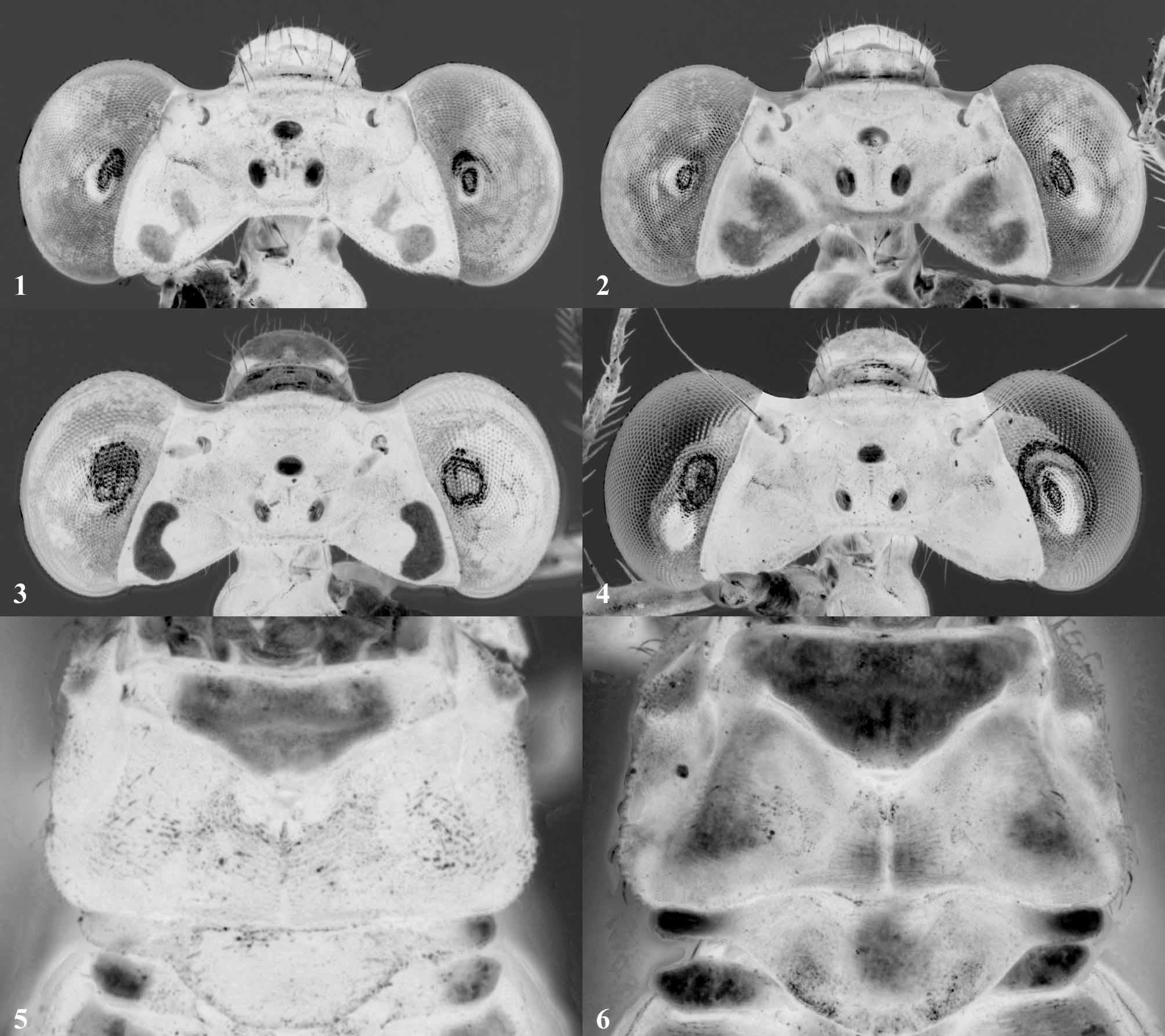
Description of mature male (Pulau Ubin, Singapore, SIN 10 _ COE 1): Head: Labium entirely pale. Labrum dark brown and black, mandible bases brownish. Clypeus mostly olive brown. Antenna with scape black, pedicel brownish, flagellum black. Ocelli whitish. Top of head otherwise bronzy black with a pair of large, bilobed, pale bluish-grey postocular markings (Fig. 1). Thorax: Prothorax mostly black, except centrally on anterior lobe where greenish, obscure pale areas on the lateral extremities of the posterior pronotal lobe, and pale marks on the lower and rear parts of the propleuron. Posterior pronotal lobe with lateral parts short and narrow, abruptly expanded to rear centrally, this part semicircular in dorsal view (Fig 5). Synthorax with mesepisternum bronzy black, with narrow full length linear pale antehumeral stripes, continued onto the outer part of the mesostigmal plates and slightly extended towards the mesopleural suture near the antealar triangle (Fig. 11). Mesepimeron mostly bronzy black. Metepisternum bronzy black, largely occupied by a complicated pale stripe running rearwards and slightly upwards, past the spiracle and above the level of the interpleural suture, to the antealar carina (Fig 13). Metepimeron almost entirely pale. Venter of synthorax pale. Legs: Coxae and trochanters largely brownish cream. Femora brownish with a dark stripe along the extensor surface and a dark area on the flexor surface shortly above the joint. Tibiae pale brown with a black streak on the upper ca one-fourth of the flexor surface. Tarsi mostly pale brown, darker at joints. Wings, with 10 Px in Fw, 8 Px in Hw. Fw quadrilateral with costal side ca two-thirds distal side, slightly longer proximal side and less than half rear side. Hw quadrilateral with costal side ca 1.5 times as long as distal side, ca 2.5 times as long as proximal side and ca two-thirds rear side. Three postquadrilateral cells in each wing except left Fw, where 2 postquadrilateral cells. Pt brown with paler margin, covering slightly less than one underlying cell. Abdomen: S 1 black above, except behind posterior carina, where pale, laterally black with a transverse lateral stripe. S 2 black above but a basal lateral marking that extends onto the dorsum and a marking along the margin of the tergite in its apical ca three-fourths. S 3 – 6 largely brown, becoming darker above on successive segments, with a small pale basal mark, becoming fainter on successive segments, extending dorsally but not meeting centrally. Each of S 3 – S 6 black in rear ca one-fourth. S 7 mostly black. S 8 black with basal ca two-thirds occupied dorsally by an approximately rectangular pale blue mark (Figs. 15, 17), this extending approximately halfway down the sides. S 9 and S 10 black. S 10 with a pair of triangular projections on hind margin dorsally. Cerci shorter than S 10, mostly black and dark brown, but with dorsal basal projections that are white interiorly, of complicated structure as shown in Figs 21, 23. Paraprocts black and dark brown, slightly longer than S 10, hollowed interiorly, tapering and curving inwards to tip, which is slightly upturned. Genital ligula as shown in Fig. 30. Measurements (mm): Abdomen without anal appendages 22, paraproct ca 0.5, Hw 14. Description of Female (Pulau Ubin, Singapore, SIN 10 _ COE 9): similar to the male described, but overall paler. Differences are listed here. Head: Anteclypeus pale, postclypeus brown with a bluish-green border at sides and along rear margin, where narrowly interrupted centrally. Dorsum of head (Fig. 2) bronzy black with obscure paler areas. Postocular markings similar to male, but larger and less well-defined, pale brownish cream in colour; a transverse stripe of the same colour runs behind the ocelli. Thorax: Prothorax (Figs. 6, 9) much paler than in male, propleuron mostly pale blue and brownish cream, anterior pronotal lobe mostly pale blue, middle lobe mottled brownish and pale blue, posterior lobe dark except at lateral extremities, where whitish, and centrally. Posterior pronotal lobe larger than in the male, with the lateral parts longer, the central part not so raised, broad, depressed centrally, viewed dorsally shaped like a broad-based halfbrown disc. Synthorax with mesostigmal plates raised up, so resembling a low ridge, their free margin close against the lateral part of the posterior pronotal lobe (as in Fig. 9 showing another female from Pulau Ubin). Rest of synthorax almost identical to the male, except that ground colour of the mesothorax and metepisternum is pale brown and the stripe on the metepisternum is less well defined. Wings with 10 Px in Fw, 8 in Hw. Quadrilateral in both wings varying slightly from the male. Three postquadrilateral cells in all wings. Pt pale brown with lighter border. Abdomen: Similar to male, pale markings on S 1 – 2 smaller than in male, those on S 3 – 6 somewhat larger, in lateral view the contrast between the pale brown of most of the segment and the darker apical part very strong. S 8 dorsally (Fig. 19) with a pale blue marking in the basal half, this divided centrally almost to the segment base. S 9 – 10 entirely dark brown. Valves of ovipositor mostly dirty cream and brown, just extending beyond S 10. Cerci shorter than S 10, conical, brown. Paraprocts well-defined, almost triangular in shape. Measurements (mm): Abdomen without anal appendages or ovipositor 23, Hw 15. Variation. Aside from small variations in markings within populations, there appear to be marked colour changes with age and a tendency for the markings on head, thorax and S 1 – 2 of the abdomen to be less well defined in the more northern populations. Tang et al. (2010) stated that two male colour forms exist in the Singapore population, one with postocular markings and pale markings on the thorax blue, and the other with these yellow. However, judging from the condition of specimens I have examined, immature individuals have these markings blue, but they change to a yellowish colour with age, and then fade in very mature individuals. The other markings on the head also tend to change colour and fade with increasing age. In one immature male from Pulau Ubin the inner lobe of the postocular markings is absent. The male Connaught Bridge specimen has pale markings less well defined and greyish brown rather than blue or yellow. The male from Pulau Tioman is teneral and has pale blue markings on the thorax. The female from Pulau Tioman has the ground colour of the mesepisternum brown and indistinct pale thoracic markings; the dorsum of the head is pale greyish brown with indistinct darker areas and no distinct postocular markings. The specimens from Thailand have the dorsum of the head coloured like the female from Pulau Tioman, the ground colour of the mesepisternum greyish brown, and very indistinct pale markings on thorax and S 1 – 2. In contrast the female from Belitung has large postocular markings of the same shape as Singapore specimens; the ground colour of the mesepisternum is dark and the pale markings are well defined. Asahina (1965) states that in a female from the Mergui Islands, Burma: “ postocular spot unrecognizable ”. Measurements (mm): Males: Abdomen without anal appendages 22 – 26, Hw 13.5 - 16, 9 – 11 Px in Fw, 8 – 11 Px in Hw. Females: Abdomen without ovipositor or anal appendages 20.5 – 26, Hw 13 – 16.5, 9 – 11 Px in Fw, 8 – 11 Px in Hw.