
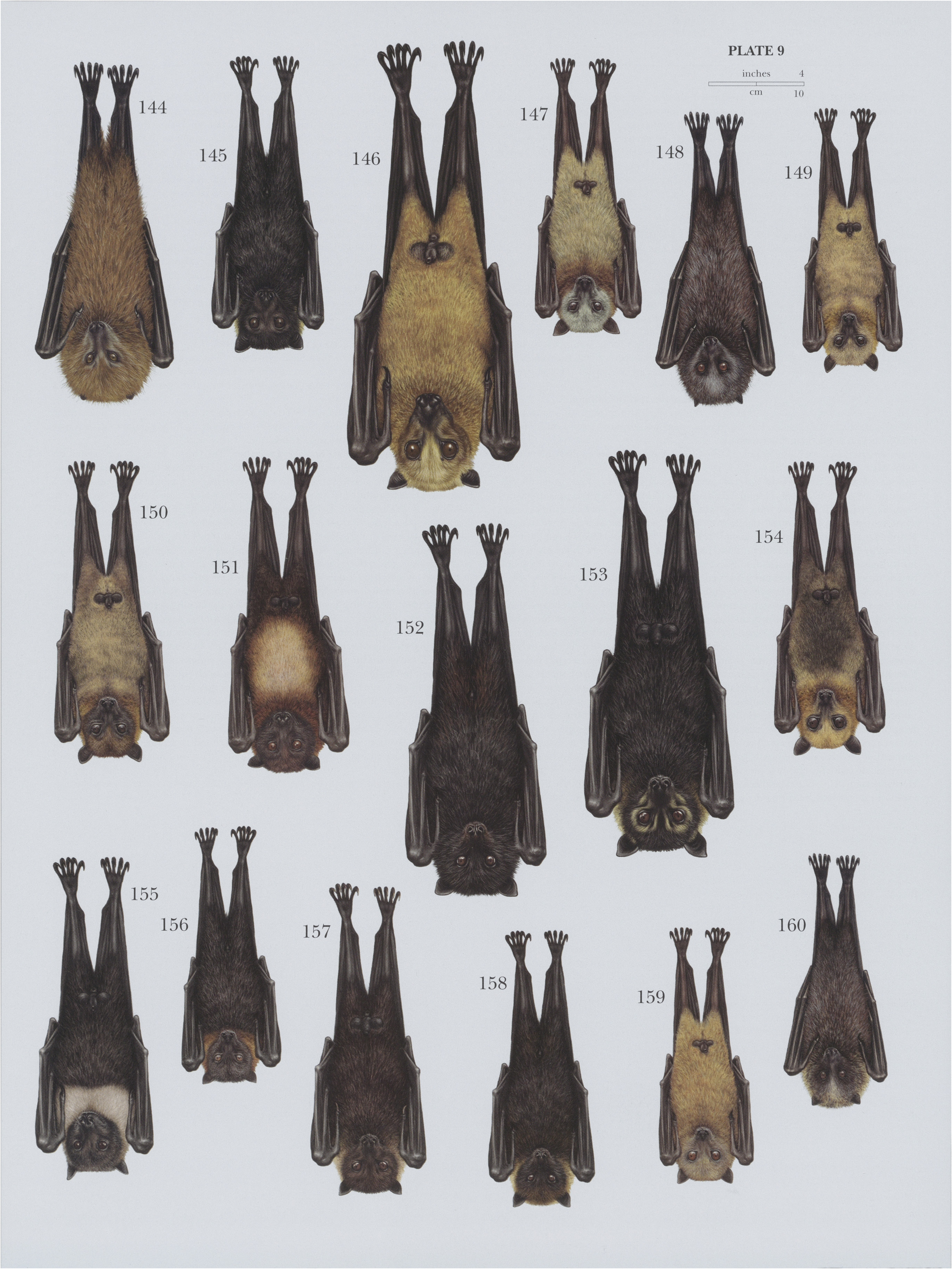
DISTRIBUTION: Nicobar Isis.; Engano Isl. and Nias Isl. (W. Sumatra); Christmas Isl.; Andaman Isis.
Sumber: Order Chiroptera
Family Pteropodidae · Order Chiroptera
Data diperbarui secara berkala dari berbagai sumber observasi biodiversitas.

Foto: Don E. Wilson;Russell A. Mittermeier
Otoritas penamaan: Blyth, 1863 (1863)
Status taksonomi: ACCEPTED
Status konservasi (IUCN): VU Rentan
Dipublikasikan dalam: Cat. Mamm. Mus. Asiat. Soc. Calcutta p.20
Total Catatan di Indonesia
0
Provinsi Ditemukan
0
dari 38 provinsi
Catatan Pertama
0
tahun pertama tercatat
Tren Tahunan
+0%
+0.0% vs 2023
Black-eared Flying Fox (Pteropus melanotus) termasuk dalam famili Pteropodidae, ordo Chiroptera, kelas Mammalia. Berdasarkan data yang terhimpun, spesies ini telah tercatat sebanyak 36 kali di Indonesia, tersebar di 2 provinsi. Catatan pertama tercatat pada tahun 1842.
Bengkulu merupakan provinsi dengan catatan observasi terbanyak untuk spesies ini, dengan 16 catatan (44.4% dari total). Data distribusi ini mencerminkan akumulasi dari berbagai kegiatan survei, penelitian, dan kontribusi citizen science. Pola distribusi yang tercatat mungkin tidak sepenuhnya menggambarkan persebaran alami spesies, karena dipengaruhi oleh intensitas pengamatan di masing-masing wilayah.
Tren observasi tahunan Pteropus melanotus relatif stabil pada periode terakhir dibanding tahun sebelumnya, dengan catatan pertama pada tahun 1842.
Catatan deskriptif tentang Pteropus melanotus dari sumber literatur primer (via GBIF).
DISTRIBUTION: Nicobar Isis.; Engano Isl. and Nias Isl. (W. Sumatra); Christmas Isl.; Andaman Isis.
Sumber: Order Chiroptera
Habitat. Semideciduous, evergreen, and mangrove forests mostly near sea level but island habitats go up to elevations of ¢. 900 m. The Black-eared Flying Fox is a specialist of small islands, roosting primarily in lowland mangrove habitats. It shifts temporarily to inland forests in response to disturbance.
Sumber: Pteropodidae
Movements, Home range and Social organization. The Black-eared Flying Fox is generally gregarious and roosts colonially in tall, defoliated trees with low levels of disturbance. It occurs in sympatry with the Nicobar Flying Fox (P. faunulus), and both have been captured in fruit plantations. In areas close to human settlements, colonies have fewer than 200 individuals, but in areas further from human settlements, colonies can have more than 2000 individuals.
Sumber: Pteropodidae
Status and Conservation. CITES Appendix II. Classified as Vulnerable on The IUCN Red List. Population declines of Black-eared Flying Foxes of more than 30 % are suspected during the next three generations because of habitat loss, hunting, and possibly introduced predators. Continual rises in global sea levels will likely result in loss of essential roosting habitat. On Andaman and Nicobar islands, some hunting occurs near human settlements. Hunters commonly use air guns and catapults. On Nias and Enggano (Indonesia), some hunting occurs. Black-eared Flying Foxes supposedly have medicinal value. Severe weather events have destroyed important mangrove roosts and have forced some colonies to move to inland forests. The Christmas Island subspecies (natalis), which might be a full species after additional taxonomic review, would likely be assessed as Critically Endangered, given population decline of 83 % in three generations, with current estimates of ¢. 2000 individuals remaining. Habitat loss, severe weather events, and negative effects of introduced carnivores, introduced yellow crazy ants (Anoplolepis gracilipes, Formicidae), insecticide poisoning, disease, and pollution have caused this decline. There have been efforts to reduce feral cat numbers and changes in methods of controlling yellow crazy ants. Captive breeding has been discussed for subspecies natalis.
Sumber: Pteropodidae
Descriptive notes. Tailless, ear 25 - 27 mm, hindfoot 37 - 5 - 52 mm, forearm 110 - 165 mm; weight 220 - 500 g. Greatest lengths of skulls are 72 - 75 - 5 mm and tibias 72 — 76 mm. Claw and tibia lengths of males are only slightly larger than those of females. Subspecies natalis is the smallest, and melanotus is the largest, suggesting largersize in northern subspecies. Fur is short and adpressed on back. Subspecies modiglianii, tytleri, and natalis are black, with sprinklings of white hairs on belly and mantle; other subspecies have dark brown back and rump, with a few whitish hairs, but mid-chest and belly vary from ocherous buffy to deep tawny, with rufous in areas of body where it meets darker color. Subspecies modiglianii and natalis are longer haired. Head and crown are dark brown to blackish, contrasting with tawny to rufous mantle. Ears are broad and narrowly rounded off at tips. Wing membranes of all subspecies are dark brown and arise near sides of spine. Index claw is present. Tibia is naked. Skull has well-developed postorbital process and temporal ridges fused to form a well-developed sagittal crest. Orbits are rather large. Coronoid is moderate and somewhat sloping. Palate ridges: 5 + 5 + 3. Teeth of smaller subspecies do not decrease in size as skulls decrease in size. Cingulum of C' is narrow, and posterior basal ledge of P ° is short. P' is minute and sometimes missing in adults. Posterior ledge of P, is moderate and short in P ,, making both separate posteroexternally from main cusp. Dentition of natalis is slightly different: canine is heavier at base and more recurved, with broad cingulum and slight groove on front face of tooth; P' is larger than in other subspecies; and M * and M, are reduced. Posterior basal ledges of P * and P, are present but shorter.
Sumber: Pteropodidae
Conservation: CITES – Appendix II. IUCN / SSC Action Plan (1992) – Not Threatened. IUCN 2003 – Lower Risk (lc).
Sumber: Order Chiroptera - Family Pteropodidae
| # | Provinsi | Catatan | % |
|---|---|---|---|
| 1 | Bengkulu | 16 | 44.4% |
| 2 | Sumatera Utara | 3 | 8.3% |
Jumlah catatan observasi Pteropus melanotus di Indonesia per tahun
Pteropus melanotus
Foto: Don E. Wilson;Russell A. Mittermeier
Pteropus melanotus
Foto: Don E. Wilson;Russell A. Mittermeier
| Nama | Bahasa | Sumber |
|---|---|---|
| Black-eared Flying Fox | Inggris | Order Chiroptera - Family Pteropodidae |
| Black-eared Flying Fox. | Inggris | Catalogue of Life |
| Black-eared Flying-fox | Inggris | Catalogue of Life |
| Black-eared flying fox | Inggris | The Paleobiology Database |
| Blyth's Flying Fox | Inggris | Pteropodidae |
| Christmas Island Flying Fox | Inggris | Pteropodidae |
| Christmas Island Flying Fox (natalis) | Inggris | Catalogue of Life |
| Kalong Enggano | - | Catalogue of Life |
| Karakulak Kanatayak | tur | Catalogue of Life |
| Roussette a oreilles noires | Prancis | Pteropodidae |
| Rudawka czarnoucha | pol | Catalogue of Life |
| Schwarzohrflughund | Jerman | Pteropodidae |
| Volpe volante orecchie nere | Italia | Catalogue of Life |
| Weihnachtsinsel-Flughund | Jerman | Catalogue of Life |
| Zorro Volador de Andaman | Spanyol | Catalogue of Life |
| Zorro volador de Andaman | - | Pteropodidae |
| andamaanienlenkko | fin | Catalogue of Life |
| natalis | Inggris | Catalogue of Life |
| Никобарская летучая лисица | rus | Catalogue of Life |
| クロミミオオコウモリ | Jepang | Catalogue of Life |
Berdasarkan data 36 observasi, Bengkulu adalah provinsi dengan catatan Black-eared Flying Fox (Pteropus melanotus) terbanyak — 16 observasi (44.4% dari total catatan di Indonesia). Spesies ini tersebar di 2 provinsi.
Catatan pertama Black-eared Flying Fox (Pteropus melanotus) di Indonesia tercatat pada tahun 1842. Hingga kini terdapat 36 catatan dari 2 provinsi, yang dihimpun dari survei lapangan, koleksi museum, dan platform citizen science.
Menurut IUCN Red List, Black-eared Flying Fox (Pteropus melanotus) berstatus "Rentan" (kode VU). Status ini mencerminkan tingkat risiko kepunahan global spesies, bukan khusus Indonesia.
Pteropus melanotus diklasifikasikan sebagai berikut: Kingdom Animalia, Phylum Chordata, Class Mammalia, Order Chiroptera, Family Pteropodidae, Genus Pteropus. Spesies ini dideskripsikan oleh Blyth, 1863.
19 titik observasi Pteropus melanotus di Indonesia
Memuat peta...
Setiap titik merepresentasikan satu lokasi observasi yang tercatat. Klik titik untuk melihat detail.