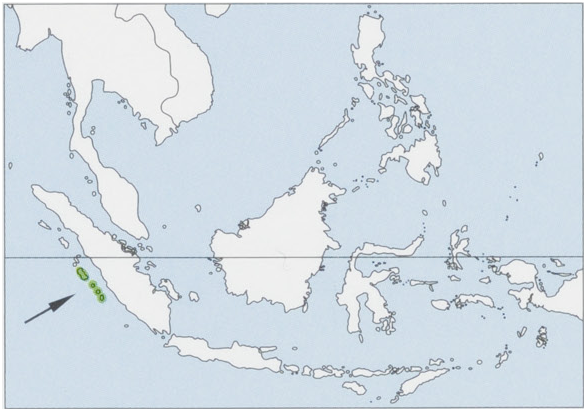
Conservation: CITES – Appendix I and U. S. ESA – Endangered as Nasalis concolor; IUCN – Endangered as S. c. concolor and S. c. siberu.
Sumber: Order Primates
Family Cercopithecidae · Order Primates
Data diperbarui secara berkala dari berbagai sumber observasi biodiversitas.

Foto: Russell A. Mittermeier;Anthony B. Rylands;Don E. Wilson
Otoritas penamaan: Miller, 1903 (1903)
Status taksonomi: ACCEPTED
Status konservasi (IUCN): CR Kritis
Dipublikasikan dalam: Smithson. Misc. Coll. vol.45 p.67
Total Catatan di Indonesia
0
Provinsi Ditemukan
0
dari 38 provinsi
Catatan Pertama
0
tahun pertama tercatat
Tren Tahunan
+0%
+100.0% vs 2022
Simakobu (Simias concolor) termasuk dalam famili Cercopithecidae, ordo Primates, kelas Mammalia. Berdasarkan data yang terhimpun, spesies ini telah tercatat sebanyak 180 kali di Indonesia, tersebar di 2 provinsi. Catatan pertama tercatat pada tahun 1859.
Sumatera Barat merupakan provinsi dengan catatan observasi terbanyak untuk spesies ini, dengan 21 catatan (11.7% dari total). Data distribusi ini mencerminkan akumulasi dari berbagai kegiatan survei, penelitian, dan kontribusi citizen science. Pola distribusi yang tercatat mungkin tidak sepenuhnya menggambarkan persebaran alami spesies, karena dipengaruhi oleh intensitas pengamatan di masing-masing wilayah.
Tren observasi tahunan Simias concolor menunjukkan peningkatan signifikan (+100%) pada periode terakhir dibanding tahun sebelumnya, dengan catatan pertama pada tahun 1859.
Catatan deskriptif tentang Simias concolor dari sumber literatur primer (via GBIF).
Conservation: CITES – Appendix I and U. S. ESA – Endangered as Nasalis concolor; IUCN – Endangered as S. c. concolor and S. c. siberu.
Sumber: Order Primates
Distribution: Mentawai Isls (Indonesia).
Sumber: Order Primates
Habitat. Swamp and lowland rainforest and primary hillside forest in the interior of the islands. Pig-tailed Langurs are sometimes found in mangrove forest but rarely in secondary forest. Mentawai forests are ever-wet with annual rainfall of up to 4000 mm.
Sumber: Cercopithecidae
Movements, Home range and ‘ Social organization. Despite the fact that the limbs of Pig-tailed Langurs are roughly of equal length (suggesting a more terrestrial existence), their movements are mostly through trees. Group travel is initiated by adults of either sex, with no consistent leader, and group members stay within a short distance of each other throughout the day. They tend to move more slowly and quietly than sympatric Presbytis. Males produce loud calls (a series of loud nasal barks), mostly in the early morning but also throughout the day, with another peak in the late afternoon. Females with infants often “ park ” them in a tree crown while feeding nearby. Groups of Pig-tailed Langurs typically sleep in densely foliated trees in the canopy or in emergent trees. Home range size is variable, depending on their density. In most areas, typical home ranges are c. 7 - 25 ha. Hunting appears to affect group size and social organization by changing densities. Social organization is variable, described as “ monandrous, ” because the most commonly observed group composition is one adult male and one or more adult females. Multimale — multifemale groups have also been reported, with more adult females than males. Average group size for the Siberut Pig-tailed Langur in northern Siberut (7 - 9 individuals) is reportedly higher than in other parts of Siberut or for the Pagai Pig-tailed Langur throughout its range (3 - 4 individuals). Population densities of the Pagai Pig-tailed Langur are ¢. 5 - 21 ind / km? in unlogged forest. The density of the Siberut Pig-tailed Langur is up to 53 ind / km? in the Peleonan Forest in northern Siberut. The Pig-tailed Langur is sympatric with the Siberut Langur (Presbytis siberu), the Siberut Macaque (Macaca siberu), and Kloss’s Gibbon (Hylobates klossii) on Siberut and with the Mentawai Langur (FP. potenziani), the Pagai Macaque (Macaca pagensis), and Kloss’s Gibbon on the southern Mentawai Islands. Pig-tailed Langurs form mixed-species associations with the Mentawai Langur and the Siberut Langur.
Sumber: Cercopithecidae
Status and Conservation. CITES Appendix I. Classified as Critically Endangered on The IUCN Red List, including both subspecies. The Pig-tailed Langur is protected by Indonesian law. They are remarkably little known or studied; indeed, up until the late 1970 s, they had not even been photographed. They are threatened mainly by hunting for meat, commercial logging, conversion of their habitat into oil palm plantations, and forest clearing by local people. While all Mentawai primates are hunted, Pig-tailed Langurs are preferred prey in all areas. Recently, hunting has increased because of improved access to remote areas due to logging roads and tracks, replacement of bows and arrows with rifles, and changes in local rituals and taboos that formerly regulated hunting. Pig-tailed Langurs are sometimes taken for the pet trade, but they rarely, if ever, thrive. They are also occasionally poisoned as agricultural pests. All of these factors have resulted in a significant decline in their numbers and even their total elimination on some islands that they formerly occupied. The Siberut Pig-tailed Langur has the largest remaining population of 6000 - 15,500 individuals, estimated in 2006. The Pagai Pig-tailed Languris in urgent need of protective measures, with a total population estimated at just 700 - 1800 in 2006. The most recent estimate of total population size for the Pig-tailed Langur was 6700 - 17,300 in 2006, representing a decline of 73 - 90 % since a 1994 estimate. It is known to occur in only one protected area (Siberut National Park), butit also occurs in the proposed Betumonga Research Area on North Pagai (recently reported to have been logged over). It is found at its highest density in the Peleonan Forest in northern Siberut, which, as of 2011, is protected on a short-term basis by local agreements to exclude logging concessions. In 2006, the following conservation actions were suggested: increased protection for Siberut National Park, which currently lacks enforcement; formal protection of the Peleonan Forest in North Siberut, which has an unusually large primate population and is easily accessible; protection of areas in the Pagai Islands by cooperating with a logging corporation that has practiced sustainable logging techniques since 1971; conservation education, especially regarding hunting; and the development of alternative economic models for local people to reduce the likelihood of them selling off their lands to logging companies.
Sumber: Cercopithecidae

Descriptive notes. Head — body 49 - 55 cm (males) and 46 - 52 cm (females), tail ¢. 16 cm (males) and c. 14 cm (females); weight 8.5 - 8.8 kg (males) and 7.7 - 2 kg (females). Male Pig-tailed Langursare larger and ¢. 30 % heavier than females, with canines ¢. 95 % longer in males than females. In both subspecies, there are two distinct color morphs. The first, more common, morph is dark grayish-black, with some agouti banding on anterior parts of the body, a white penal tuft, and a lighter-colored crown. The second morph is a pale buff color; it is somewhat uncommon on Siberut (c. 33 % of observed individuals in central and southern Siberut and only ¢. 5 % in northern Siberut) and extremely rare on the Pagai Islands. Both color morphs have white cheek patches and black on face, hands, and feet. The “ Pagai Pig-tailed Langur ” (S. c. concolor) is less dark, more brownish-toned, than the “ Siberut Pig-tailed Langur ” (S. ¢. siberu). White cheeks on the Siberut Pig-tailed Langur are more conspicuous than on the Pagai Pig-tailed Langur, and its black color (in the dark morph) has more banding on anterior parts. Fur on crown is directed backward, except for a pair of sideways-facing ear tufts. Nasal bone is elongated, but nose itself is snubbed and upturned. Tail is short, upturned, curly, and mostly hairless. The Pig-tailed Languris the only colobine with a short tail. Buttock pads of males are joined in the midline, but they are separated by the urogenital triangle in females. Unlike any other Asian colobine, female Pig-tailed Langurs exhibit sexual swellings, with the urogenital triangle swelling prominently during receptive periods of the menstrual cycle. Front and hind limbs are roughly equal length. Pig-tailed Langurs have a powerful odor.
Sumber: Cercopithecidae
Nama-nama ilmiah lain yang pernah digunakan untuk Simias concolor dalam literatur taksonomi.
| Nama Sinonim | Otoritas | Status |
|---|---|---|
| Nasalis concolor | (Miller, 1903) | SYNONYM |
| # | Provinsi | Catatan | % |
|---|---|---|---|
| 1 | Sumatera Barat | 21 | 11.7% |
| 2 | Sumatera Utara | 2 | 1.1% |
Jumlah catatan observasi Simias concolor di Indonesia per tahun
Simias concolor
Foto: Russell A. Mittermeier;Anthony B. Rylands;Don E. Wilson
Simias concolor
Foto: Russell A. Mittermeier;Anthony B. Rylands;Don E. Wilson
| Nama | Bahasa | Sumber |
|---|---|---|
| Domuz kuyruklu langur | tur | Catalogue of Life |
| Entelle de Pagai | Prancis | Catalogue of Life |
| Grisehalelangur | nob | Catalogue of Life |
| Kurzschwanzstumpfnase | Jerman | Catalogue of Life |
| Kurzschwanzstumpfnasenaffe | Jerman | Catalogue of Life |
| Langur a queue de cochon | Prancis | Catalogue of Life |
| Langur cola de cerdo | Spanyol | Catalogue of Life |
| Langur de cola de cerdo | - | Cercopithecidae |
| Langur à queue de cochon | Prancis | Catalogue of Life |
| Masepsep | Inggris | Catalogue of Life |
| Masepsep / Pagai Pig-tailed Langur / Pig-tailed Snub-nosed Monkey (concolor | Inggris | Catalogue of Life |
| Mentawai Islands Snub-nosed Langur | Inggris | Cercopithecidae |
| Nasique des îles Pagai | Prancis | Catalogue of Life |
| Pagai Pig-tailed Langur | Inggris | Catalogue of Life |
| Pageape | nob | Catalogue of Life |
| Pageh-Stumpfnase | Jerman | Cercopithecidae |
| Pagehstumpfnase | Jerman | Catalogue of Life |
| Pagi mentawajski | pol | Catalogue of Life |
| Pig-tailed Langur | Inggris | Catalogue of Life |
| Pig-tailed Snub-nosed Langur | Inggris | Catalogue of Life |
Berdasarkan data 180 observasi, Sumatera Barat adalah provinsi dengan catatan Simakobu (Simias concolor) terbanyak — 21 observasi (11.7% dari total catatan di Indonesia). Spesies ini tersebar di 2 provinsi.
Catatan pertama Simakobu (Simias concolor) di Indonesia tercatat pada tahun 1859. Hingga kini terdapat 180 catatan dari 2 provinsi, yang dihimpun dari survei lapangan, koleksi museum, dan platform citizen science.
Menurut IUCN Red List, Simakobu (Simias concolor) berstatus "Kritis" (kode CR). Status ini mencerminkan tingkat risiko kepunahan global spesies, bukan khusus Indonesia.
Di Indonesia dan Malaysia, Simias concolor dikenal dengan beberapa nama lokal: Simakobu. Penamaan dapat berbeda antardaerah dan bahasa.
Ya, Simias concolor memiliki 1 nama sinonim ilmiah, di antaranya: Nasalis concolor. Nama sinonim adalah nama-nama lain yang pernah digunakan untuk spesies yang sama dalam literatur taksonomi.
Simias concolor diklasifikasikan sebagai berikut: Kingdom Animalia, Phylum Chordata, Class Mammalia, Order Primates, Family Cercopithecidae, Genus Simias. Spesies ini dideskripsikan oleh Miller, 1903.
16 titik observasi Simias concolor di Indonesia
Memuat peta...
Setiap titik merepresentasikan satu lokasi observasi yang tercatat. Klik titik untuk melihat detail.