
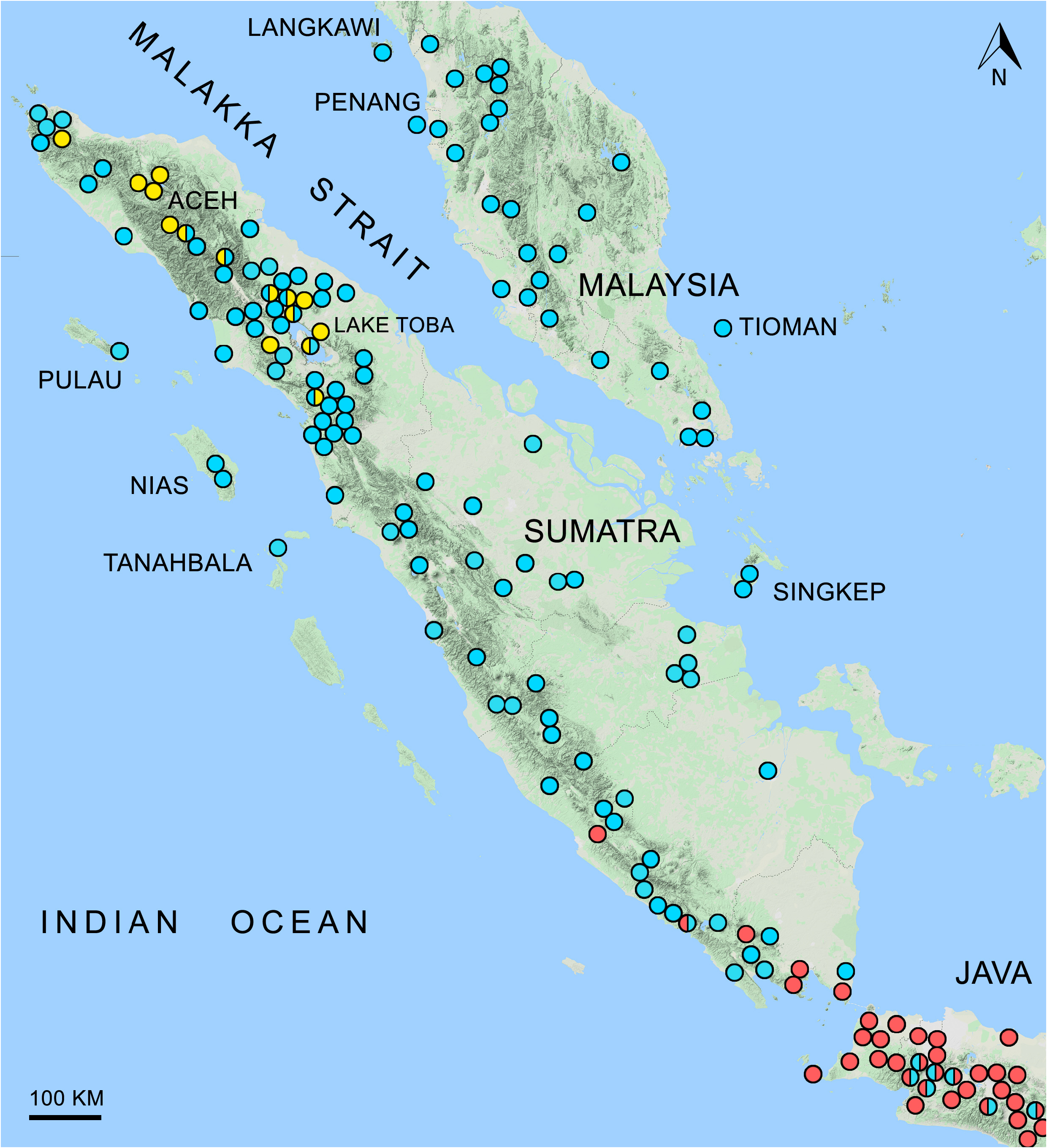
Redescription based on UIMZ 0243. An adult male, SVL 117 mm. Head moderately large, elongate, HL 28.8 % of SVL, narrow, subtriangular in dorsal and ventral aspects, HW 51.2 % of HL; distinct from neck; snout elongate, snout length greater than eye diameter, ED 71.9 % of ES; interorbital distance broad; eye large, pupil rounded; diameter of eyes greater than eye-tympanum distance, TYE 68.5 % of ED; ear opening shallow, its greatest diameter dorsolaterally, tympanum smaller than orbit, half sized; tympanum surrounded by keeled scales; temporal scales not enlarged, keeled, juxtaposed, 5 – 7 scale rows between orbit and tympanum; forehead convex; scales on interorbital and supercilium area keeled; scales on snout keeled, larger in size than those of occipital region; a developed nuchal crest continue dorsally as a dorso-nuchal crest; dorsal crest rudimentary, consisting of 12 crescent-shaped scales up to the level of axilla, no crest on the tail; rostral scale width greater than its height, ventroposteriorly in contact with first supralabial, contact posteriorly by five more or less equal-sized postrostral scales; around nostrils on each side two supranasals, two or three postnasals, two prenasals, and two subnasals, which separate nasal from supralabials; nostrils round located middle of the undivided nasal plate; canthus rostralis and supraciliary edges sharp; five canthal scales between supranasal and anterior margin of orbit; no distinct parietal plate; mental subtriangular, shorter than wide, posteriorlaterally in contact with two enlarged postmentals separated by a smaller scale; each postmental pair bordered posteriorly by three smooth scales, including the medial scale, but exclusive of infralabial; chin scales smooth; gular pouch present; throat scales and midgular scales keeled, mucronate, and imbricate; three scale rows separate orbit from supralabials; supralabials nine (seventh in midorbit position); infralabials nine, decreasing in size toward gape; ventral scales on the neck granular and keeled. Body slender; lateral body scales equal, strongly keeled and imbricate; scales on lateral body much smaller (approximately 1 / 10 th of mid ventrals) in size than those of venter at same level, directed backward and downward anteriorly and directed backward and upward posteriorly; lateral body scales on the posterior body slights enlarged and shorter than the anterior body scales; 5 – 7 upper dorsal scale rows directed backward and upward along the body; 69 scales around the midbody; pectoral scales and abdominal scales keeled, acuminated, imbricate and keels forming regular and parallel continuous ventral ridges; abdominal scales larger than pectoral scales; eight scale rows enlarged ventrally, with clear margin with the lateral scales; ventrals, 57. Forelimbs moderately short; no oblique fold (pit) present on shoulders, but shoulder scales keeled and granular; dorsal scales on fore- and hind limbs keeled, enlarged, imbricate and mucronate; ventral scales on upper arm and lower arm keeled, imbricate, and mucronate; hind limbs relatively longer than forelimbs; scales on ventral surface of thigh keeled, enlarged, imbricate and mucronate; tibia comparatively longer than femur; keels on tibia forming a series of continuous parallel ridges; digits elongate, slender; relative length of digits (fingers) 3> 4> 2> 5> 1; (toes) 4> 3> 5> 2> 1; all bearing slightly recurved claws, claws are sharp and elongate; subdigital lamellae entire, bicarinate, and regular, subdigital lamellae on toe IV (left) 30. Tail elongate and complete, 412 mm. Ventral scales on tail base keeled and imbricate, smaller in size than on dorsal tail; dorsal scales on tail enlarged, imbricate, keeled, mucronate, and keels forming continuous parallel ridges; tail with subcaudals on median row not enlarged, subequal, imbricate, keeled, and mucronate. Colouration. In preservative, dorsum pale grayish green; few greyish blue markings on the lateral body; lateral head and nuchal crest scales cream, dorsal head greyish cream; orbit, labial band including the tympanum brown; dorsal crest scales, knee, elbow, wrist, heel grey; dorsal fingers and toes, posterior 2 / 3 rd of the tail brown; ventral body, limbs, anterior tail, and mid gular pale yellowish green; ventral digits light brown. In life, dorsum bright luminous green; few sky blue markings on the lateral body; lateral head lemon yellow; nuchal crest blonde yellow, dorsal head greyish green; ventral head bluish green; orbit, labial band including the tympanum blackish brown; dorsal crest luminous green; knee, elbow, wrist, heel dark green; dorsal fingers and toes, posterior 2 / 3 rd of the tail greenish brown; ventral body, limbs, anterior tail, and mid gular lighter luminous green; ventral digits light brown. Habitat, natural history, and distribution. This species is usually found in open canopy areas in primary forests (mostly forest edge) or undisturbed secondary forests, but avoids completely open areas. We often found it at the ecotone of forests and other vegetation (e. g. bamboo forests, coffee and pepper plantations, pine forests, wellmaintained home gardens etc.) while basking (from sunrise until midday) on horizontal bamboo sticks or coffee branches, usually 1.5 to 4 meters above the ground. It is usually active during the daytime, mostly around 09: 00 hr. At night, the adults prefer higher branches of the tress to sleep, mostly in open canopy areas, while juveniles prefer tiny branches of shrubs. In the Tapanuli area, we sometimes observed this species on Benjamin trees (Styrax benzoin; Family Styracaceae) around 7 m above the ground. The species seems sensitive to being disturbed when approached and when in danger quickly jump to the dense undergrowth and disappear.
Sumber: Taxonomy, distribution, and conservation status of a rare arboreal lizard Bronchocela hayeki (Müller, 1928) (Reptilia: Agamidae) from northern Sumatra Indonesia