Data diperbarui secara berkala dari berbagai sumber observasi biodiversitas.
Foto: Russell A. Mittermeier;Don E. Wilson
Klasifikasi Taksonomi
KingdomAnimalia
PhylumChordata
ClassMammalia
OrderSoricomorpha
FamilySoricidae
GenusCrocidura
SpeciesCrocidura lepidura
Otoritas penamaan: Lyon, 1908 (1908)
Status taksonomi: ACCEPTED
Status konservasi (IUCN): LCRisiko Rendah
Dipublikasikan dalam: Proc. U. S. Nat. Mus. vol.34 p.662
Total Catatan di Indonesia
0
Provinsi Ditemukan
0
dari 38 provinsi
Catatan Pertama
0
tahun pertama tercatat
Tren Tahunan
+0%
+475.0% vs 1991
Sumatra-Weif 3 zahnspitzmaus (Crocidura lepidura) termasuk dalam famili Soricidae, ordo Soricomorpha, kelas Mammalia. Berdasarkan data yang terhimpun, spesies ini telah tercatat sebanyak 33 kali di Indonesia, tersebar di 3 provinsi. Catatan pertama tercatat pada tahun 1903.
Jambi merupakan provinsi dengan catatan observasi terbanyak untuk spesies ini, dengan 4 catatan (12.1% dari total). Data distribusi ini mencerminkan akumulasi dari berbagai kegiatan survei, penelitian, dan kontribusi citizen science. Pola distribusi yang tercatat mungkin tidak sepenuhnya menggambarkan persebaran alami spesies, karena dipengaruhi oleh intensitas pengamatan di masing-masing wilayah.
Tren observasi tahunan Crocidura lepidura menunjukkan peningkatan signifikan (+475%) pada periode terakhir dibanding tahun sebelumnya, dengan catatan pertama pada tahun 1903.
Informasi Tambahan
Catatan deskriptif tentang Crocidura lepidura dari sumber literatur primer (via GBIF).
Biologi & Ekologieng
Habitat. Primary lowland and montane forest. It ranges from sea level up to 2000 m, attaining its maximum abundance in highly degraded forest and cultivated lands at elevations of 1500 - 1800 m. Trapped at 1500 - 1800 m in Mount Kerinci area, where revealed to be sympatric with Beccari’s White-toothed Shrew (C. beccarii) and the Sumatran Long-tailed White-toothed Shrew (C. paradoxura), and also with other terrestrial insectivores of the family Galericidae, namely the Shorttailed Gymnure (Hylomys suillus), and the Dwarf Gymnure (H. parvus). The upper distribution range of the Sumatran Giant White-toothed Shrew may be limited by the Dwarf Gymnure, which was most abundant in the moss forest around 3000 m.
Sumber: Soricidae
Biologi & Ekologieng
Movements, Home range and Social organization. No information.
Sumber: Soricidae
Konservasieng
Status and Conservation. Classified as Data Deficient on The IUCN Red List in view ofits wide distribution, tolerance of a degree of habitat modification, and presumed large population, and because it is unlikely to be declining fast enough to qualify for listing in a more threatened category. There are no major threats to this adaptable species. Given its wide range, the Sumatran Giant White-toothed Shrew is likely to be present in a number of protected areas.
Jumlah catatan observasi Crocidura lepidura di Indonesia per tahun
Galeri Foto
Crocidura lepidura
Foto: Russell A. Mittermeier;Don E. Wilson
Crocidura lepidura
Foto: Russell A. Mittermeier;Don E. Wilson
Nama Vernakular
Nama
Bahasa
Sumber
Crocidure de Lyon
Prancis
Catalogue of Life
Musarafna gigante de Sumatra
-
Soricidae
Sumatra-Weif
Jerman
Soricidae
Sumatra-Weif 3 zahnspitzmaus
Inggris
Catalogue of Life
Sumatran Giant Shrew
Inggris
Order Soricomorpha
Sumatran Giant White-toothed Shrew
Inggris
Soricidae
zębiełek gładkoogonowy
pol
Catalogue of Life
ウロコオジネズミ
Jepang
Catalogue of Life
Pertanyaan Umum
Berdasarkan data 33 observasi, Jambi adalah provinsi dengan catatan Sumatra-Weif 3 zahnspitzmaus (Crocidura lepidura) terbanyak — 4 observasi (12.1% dari total catatan di Indonesia). Spesies ini tersebar di 3 provinsi.
Catatan pertama Sumatra-Weif 3 zahnspitzmaus (Crocidura lepidura) di Indonesia tercatat pada tahun 1903. Hingga kini terdapat 33 catatan dari 3 provinsi, yang dihimpun dari survei lapangan, koleksi museum, dan platform citizen science.
Menurut IUCN Red List, Sumatra-Weif 3 zahnspitzmaus (Crocidura lepidura) berstatus "Risiko Rendah" (kode LC). Status ini mencerminkan tingkat risiko kepunahan global spesies, bukan khusus Indonesia.
Crocidura lepidura diklasifikasikan sebagai berikut: Kingdom Animalia, Phylum Chordata, Class Mammalia, Order Soricomorpha, Family Soricidae, Genus Crocidura. Spesies ini dideskripsikan oleh Lyon, 1908.
eng
Descriptive notes. Head — body 90 - 112 mm, tail 60 - 84 mm, hindfoot 16 - 7 - 18 - 8 mm; weight 13 - 21 - 5 g. Condylo-incisive length 23.9 - 26: 4 mm. The Sumatran Giant White-toothed Shrew is the largest shrew in Sumatra, and is only approached in size by the slightly smaller Kinabalu White-toothed Shrew (C. baluensis) of Borneo. Blackish upperparts have relatively stiff, long hairs (7 - 9 mm on mid-dorsum). Sparse, shining, longer guard hairs give a grizzled appearance to its dorsal pelage. The contrasting midline ventral part is variable in color, from slate gray to chocolate brown. Tail is relatively long, brownish black above, and paler beneath, with short, stiff applied hairs and only a few bristles at the base of the tail. Upper surfaces of foreand hindfeet are brownish. In skull measurements the Sumatran Giant Shrew is larger than any other Sumatran Crocidura. There is a great morphological resemblance between this species and the Kinabalu White-toothed Shrew: apart from slightly smaller skull dimensions and smaller hindfeet, there is hardly any difference between the species, but they may be convergent forms, not closely related. Dentition is strong and robust. Most specimen have a bifid mesostyle on M * (and sometimes M?), a character also found in other Indomalayan shrews. Chromosomal complement has 2 n = 37 - 38 and FN = 54. It shares a polymorphic translocation of two acrocentrics with the Hutan White-toothed Shrew (C. hutanis), also of Sumatra; this is a rather unusual phenomenon in shrews.
Sumber: Soricidae
Distribusieng
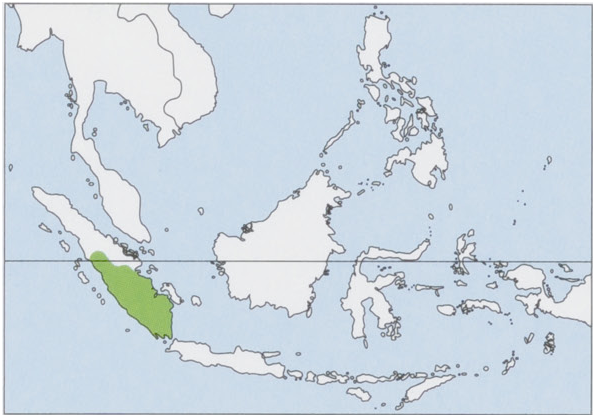
Distribution. Endemic to Sumatra; it seems widely distributed from upper montane rainforest in W Sumatra to hillsides in E & S Sumatra.
Sumber: Soricidae
Peta Sebaran Observasi
28 titik observasi Crocidura lepidura di Indonesia
Memuat peta...
Setiap titik merepresentasikan satu lokasi observasi yang tercatat. Klik titik untuk melihat detail.