
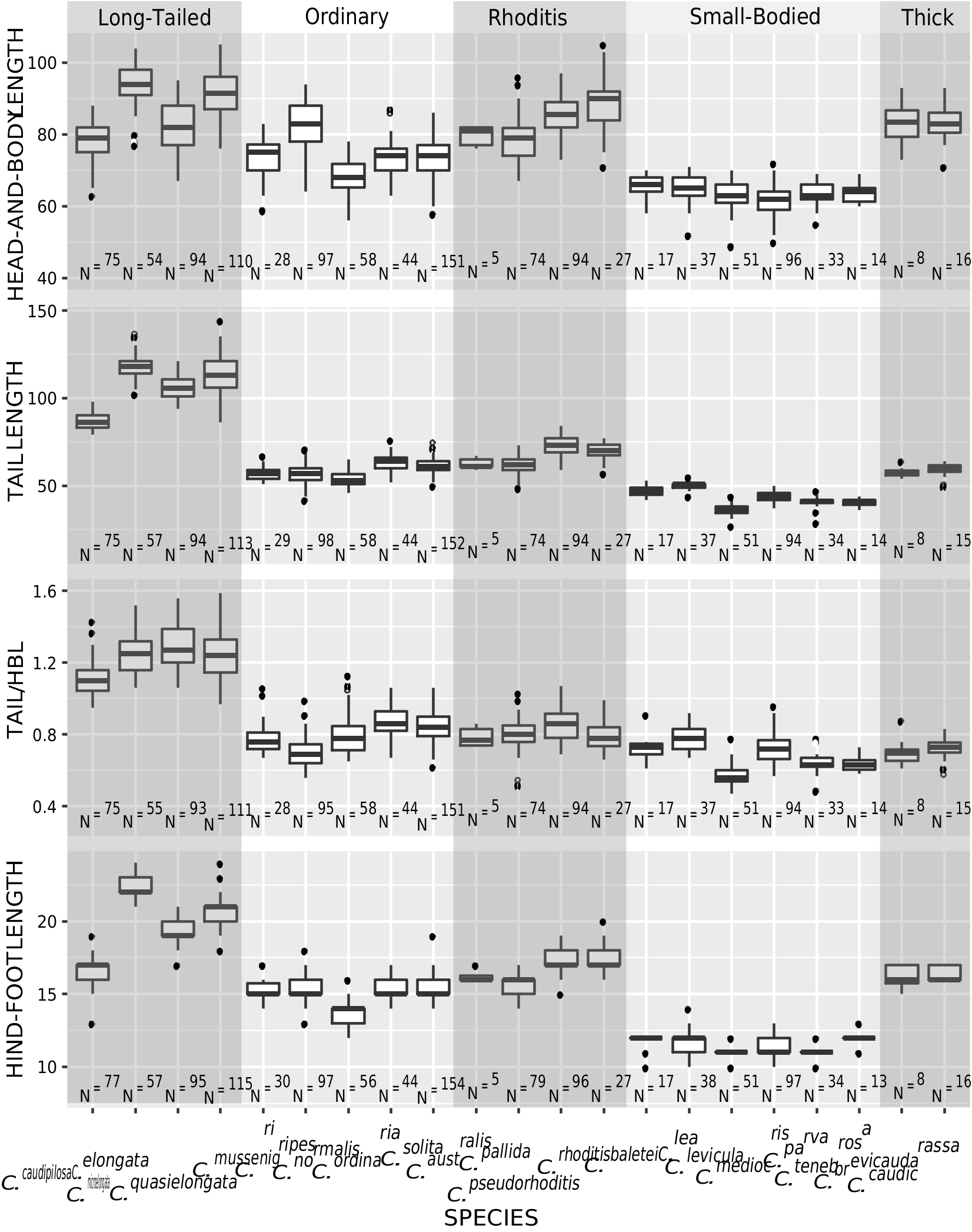
COMPARISONS: Crocidura rhoditis is larger than all Sulawesi Crocidura except C. elongata, C. quasielongata, C. nigripes, and the two Thick- Tailed Group members, C. brevicauda and C. caudicrassa. Its mass-to-HBL ratio is greater than in all other species except C. caudicrassa (fig. 17) and its relative rostral length (RL / CIL) is greater than in all other species (fig. 10). The tail of C. rhoditis is much shorter absolutely and relative to body length than in members of the Long-Tailed Group, but longer absolutely than in all other species except C. pseudorhoditis (fig. 9). The dorsal pelage of C. rhoditis is similar in color to C. elongata, darker than C. quasielongata, and paler than C. nigripes. The feet of C. rhoditis are paler than those of most other species, with the excep- tions of C. lea (much smaller), C. pallida (smaller), C. elongata (longer tail), and C. quasielongata (longer tail). Within the Rhoditis Group, C. rhoditis is easily confused with C. pseudorhoditis, its apparent sister species, but it is larger in all dimensions than the other two members of the Rhoditis Group, C. australis and C. pallida. Both C. rhoditis and C. pseudorhoditis have a pale integument, but C. rhoditis is larger, slightly paler, and has a narrower thenar pad on the hind foot (fig. 21). Although differences in body length are modest (fig. 23), C. rhoditis is stockier than C. pseudorhoditis (fig. 17) and size differences are apparent in condyloincisive length and braincase breadth (fig. 23; table 7). In addition to the greater relative rostral length mentioned above, C. rhoditis also has a lesser relative interorbital width (IOW / CIL) than all other members of the Rhoditis Group (fig. 10). The narrowness of the interorbital region is also reflected in that it is lesser relative to braincase breadth (IOW / BB) in C. rhoditis compared to C. pseudorhoditis, whereas braincase breadth relative to skull length (BB / CIL) does not differ appreciably between the two species (figs. 10, 22). The skull of C. rhoditis has a prominent ridge at the suture of the squamosal and parietal bones. This ridge is present, but less conspicuous in C. pseudorhoditis. A PCA of cranial measurements largely separates these two taxa along the first axis, which represents size (fig. 19; table 6). The differences in size measurements between C. rhoditis and its sister species are somewhat more pronounced when only syntopically sampled specimens from Mt. Ambang are considered (fig. 23), perhaps indicating a role for character displacement in these species.
Sumber: Fourteen New, Endemic Species Of Shrew (Genus Crocidura) From Sulawesi Reveal A Spectacular Island Radiation