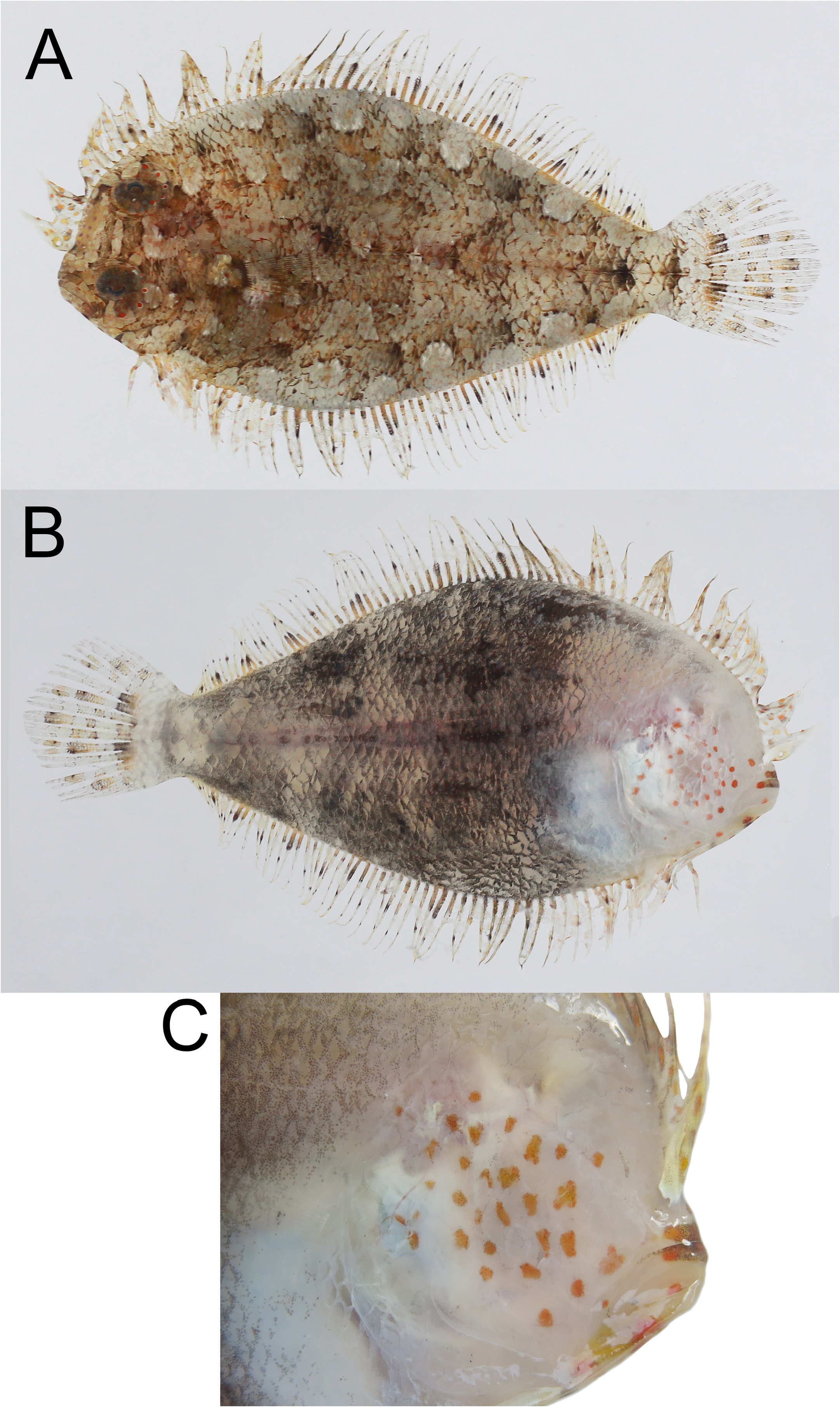
Chinese name: 大 ṕḇạḛ Figs 1 – 3. Tables. 1 & 2
Sumber: New record of Engyprosopon macrolepis (Regan, 1908) from Taiwan (Pleuronectiformes: Bothidae)
Family Bothidae · Order Pleuronectiformes
Data diperbarui secara berkala dari berbagai sumber observasi biodiversitas.

Foto: Su, Yo;Ho, Hsuan-Ching;Amaoka, Kunio
Otoritas penamaan: (Regan, 1908) (1908)
Status taksonomi: ACCEPTED
Status konservasi (IUCN): LC Risiko Rendah
Total Catatan di Indonesia
0
Provinsi Ditemukan
0
dari 38 provinsi
Catatan Pertama
0
tahun pertama tercatat
Tren Tahunan
+0%
+100.0% vs 2020
Largescale Dwarf Flounder (Engyprosopon macrolepis) termasuk dalam famili Bothidae, ordo Pleuronectiformes. Berdasarkan data yang terhimpun, spesies ini telah tercatat sebanyak 5 kali di Indonesia, tersebar di 4 provinsi. Catatan pertama tercatat pada tahun 2015.
Bali merupakan provinsi dengan catatan observasi terbanyak untuk spesies ini, dengan 2 catatan (40.0% dari total). Data distribusi ini mencerminkan akumulasi dari berbagai kegiatan survei, penelitian, dan kontribusi citizen science. Pola distribusi yang tercatat mungkin tidak sepenuhnya menggambarkan persebaran alami spesies, karena dipengaruhi oleh intensitas pengamatan di masing-masing wilayah.
Tren observasi tahunan Engyprosopon macrolepis menunjukkan peningkatan signifikan (+100%) pada periode terakhir dibanding tahun sebelumnya, dengan catatan pertama pada tahun 2015.
Catatan deskriptif tentang Engyprosopon macrolepis dari sumber literatur primer (via GBIF).
Chinese name: 大 ṕḇạḛ Figs 1 – 3. Tables. 1 & 2
Sumber: New record of Engyprosopon macrolepis (Regan, 1908) from Taiwan (Pleuronectiformes: Bothidae)
Description of Taiwanese specimens. Meristic and morphometric data are provided in Tables 1 & 2. Dorsal-fin rays 75 – 79. Anal-fin rays 55 – 60. Caudal-fin rays 3 + 11 + 3. Ocular-side pectoral-fin rays 11 – 12; blind-side pectoral-fin rays 9. Ocular-side pelvic-fin rays 6; blind-side pelvic-fin rays 6. Gill rakers 0 + 6 – 8 = 6 – 8. Lateral-line scales 40 – 48, not including 1 – 2 scales on caudal fin. Vertebrae 10 + 24 = 34 (n = 2). Body ovate, greatest depth 1.8 – 2.2 in SL; its dorsal and ventral profiles convex and nearly symmetric. Head length 3.6 – 3.9 in SL; anterior profile of head steep, and with slight concavity above snout, in front of interorbital space. Snout length 4.0 – 4.6 in HL, distinctly shorter than both eyes. Rostral spine present in male. Eyes sinistral, upper-eye and lower-eye diameter 3.1 – 3.4 and 3.0 – 3.3 in HL, respectively; anterior margin of upper eye slightly posterior to vertical through anterior margin of lower eye. Orbital spines present on both eyes in male. Ocular flap present in male, situated at posterodorsal and posteroventral corner of upper and lower eye, respectively. Interorbital space separated by concavity, its width 2.6 – 3.6 (male) or 12.0 (female) in HL. Two nostrils on ocular side: anterior nostril forming tube and short flap, situated on snout; posterior nostril forming pore, situated in front of lower eye; nostrils on blind side present, minute, both situated just below dorsal-fin origin. Mouth oblique and large; upper-jaw length on ocular side 2.7 – 2.9 in HL; its anterior tip slightly in advance of lower-jaw tip when closed; its posterior tip reaching point at one-third of lower eye. Upper-jaw teeth uniserial on both ocular and blind sides, slightly and gradually larger anteriorly. Lower-jaw teeth uniserial on both ocular and blind side jaws. Gill rakers present on outer-three arches; those on first arch laterally compressed; all rakers smooth, not serrated on inner sides; those on second arch about same size as those on first arch; those on third arch shorter than first and second arches; upper limb of all four arches without rakers. Scales on ocular side deciduous, with very short ctenii; scales absent on snout and both ocular-side jaws; scales on blind side cycloid and deciduous. Dorsal-fin origin before midline of interorbital space, above ocular-side anterior nostril; anterior rays not elongated; longest ray (ca. 40 th – 45 th ray) at point slightly posterior to vertical through middle of body. Anal-fin origin at vertical through base of pectoral-fin origin on ocular side; its shape subsymmetrical to that of dorsal fin. Pectoral fin on ocular side filamentous, longer in male than in females, its length 0.6 – 0.8 and 1.1 in HL, respectively; pectoral fin on blind side short, length 2.0 – 2.2 in HL. Origin of pelvic fin on ocular side at tip of isthmus; origin of pelvic fin on blind side opposite to middle of fourth and fifth rays on ocular side. Tip of isthmus slightly before vertical through middle of lower eye. Caudal fin rounded, length 1.0 – 1.2 in HL. All rays simple except middle 11 caudal-fin rays branched.

Sumber: New record of Engyprosopon macrolepis (Regan, 1908) from Taiwan (Pleuronectiformes: Bothidae)
KD 82, Albatross Passage, Kavieng District, Bismarck Sea, 02 ° 44.59 ’ S 150 ° 43.137 ’ E, 3 – 13 m depth, 26 June 2014).
Sumber: Checklist of the marine and estuarine fishes of New Ireland Province, Papua New Guinea, western Pacific Ocean, with 810 new records
Distribution and habitat. New Ireland: 2. — General distribution: Red Sea and Saint Brandon’s Shoals east to Papua New Guinea, south to New Caledonia. Found on sand or mud bottoms, 3 – 91 m depth. Marine.
Sumber: Checklist of the marine and estuarine fishes of New Ireland Province, Papua New Guinea, western Pacific Ocean, with 810 new records
Nama-nama ilmiah lain yang pernah digunakan untuk Engyprosopon macrolepis dalam literatur taksonomi.
| Nama Sinonim | Otoritas | Status |
|---|---|---|
| Engyprosopon filimanus | (Regan, 1908) | SYNONYM |
| Scaeops filimanus | Regan, 1908 | SYNONYM |
| Scaeops macrolepis | Regan, 1908 | SYNONYM |
| # | Provinsi | Catatan | % |
|---|---|---|---|
| 1 | Bali | 2 | 40.0% |
| 2 | Nusa Tenggara Barat | 1 | 20.0% |
| 3 | Nusa Tenggara Timur | 1 | 20.0% |
| 4 | Kalimantan Timur | 1 | 20.0% |
Jumlah catatan observasi Engyprosopon macrolepis di Indonesia per tahun
Engyprosopon macrolepis
Foto: Su, Yo;Ho, Hsuan-Ching;Amaoka, Kunio
Engyprosopon macrolepis
Foto: Su, Yo;Ho, Hsuan-Ching;Amaoka, Kunio
Engyprosopon macrolepis
Foto: Su, Yo;Ho, Hsuan-Ching;Amaoka, Kunio
| Nama | Bahasa | Sumber |
|---|---|---|
| Hoshizoradarumagarei | Jepang | List of Japan's all fish species. Current standard Japanese and scientific names of all fish species recorded from Japanese waters. |
| Largescale Dwarf Flounder | Inggris | Catalogue of Life |
| Linguado-anão-do-Indo-Pacífico | Portugis | Catalogue of Life |
| ホシゾラダルマガレイ | Jepang | Catalogue of Life |
Berdasarkan data 5 observasi, Bali adalah provinsi dengan catatan Largescale Dwarf Flounder (Engyprosopon macrolepis) terbanyak — 2 observasi (40.0% dari total catatan di Indonesia). Spesies ini tersebar di 4 provinsi.
Catatan pertama Largescale Dwarf Flounder (Engyprosopon macrolepis) di Indonesia tercatat pada tahun 2015. Hingga kini terdapat 5 catatan dari 4 provinsi, yang dihimpun dari survei lapangan, koleksi museum, dan platform citizen science.
Menurut IUCN Red List, Largescale Dwarf Flounder (Engyprosopon macrolepis) berstatus "Risiko Rendah" (kode LC). Status ini mencerminkan tingkat risiko kepunahan global spesies, bukan khusus Indonesia.
Ya, Engyprosopon macrolepis memiliki 3 nama sinonim ilmiah, di antaranya: Engyprosopon filimanus, Scaeops filimanus, Scaeops macrolepis. Nama sinonim adalah nama-nama lain yang pernah digunakan untuk spesies yang sama dalam literatur taksonomi.
Engyprosopon macrolepis diklasifikasikan sebagai berikut: Kingdom Animalia, Phylum Chordata, Order Pleuronectiformes, Family Bothidae, Genus Engyprosopon. Spesies ini dideskripsikan oleh (Regan, 1908).
5 titik observasi Engyprosopon macrolepis di Indonesia
Memuat peta...
Setiap titik merepresentasikan satu lokasi observasi yang tercatat. Klik titik untuk melihat detail.